
Since Shop Stack Breakdown launched in May, Autobody News has profiled 11 collision repair shops from single-location independents to a small MSO operating in Florida and Puerto Rico. By cataloging what actually runs their estimating, parts ordering, customer communication, and repair floors, it’s clear that some patterns are consistent across very different operations, while others aren’t.
Every shop runs CCC for estimating. Not every shop lets it run everything.
All 11 shops profiled so far write estimates in CCC, including Choice Collision Centers, which runs Mitchell only for Progressive claims per that insurer's requirement, and Collision Care Xpress, which splits estimating between CCC and Mitchell based on a mix of carrier requirements and job type.
Where the pattern splits is shop management. Nine of the 11 also run CCC's own management tools to handle production tracking, scheduling, and reporting. The other two, Cliff's Body Repair and Shadow Lake Collision, pair CCC estimating with Nexsyis for management and accounting instead.
Shadow Lake owner Eric Dawson described the logic directly: "I feel like using CCC's management system is trying to manage your business with an estimating platform, because that's more or less what it is."
Parts ordering is fragmented everywhere, and that's by design.
No shop in the series runs parts ordering through a single platform. Every one of the 11 uses at least two, and six use three or four: All County Collision runs CCC, PartsTrader, OpsTrax, and CollisionLink simultaneously to chase close to 100% OEM parts capture.
The fragmentation isn't accidental. It's driven primarily by two forces that show up again and again: insurer requirements and price-matching, though a few shops also cited vendor compatibility or OEM certification requirements as factors.
Yoder Collision Network's Micah Elsom described PartsTrader doing double duty for some carriers: "For some of our insurance partners, Parts Trader is not only a parts procurement platform, but it also is a compliance tool they utilize to measure certain KPIs in their scorecards," he said. "For instance, Geico and State Farm, we would primarily use Parts Trader, because that's what they want to see, that's how they measure some things."
At Choice Collision, owner Steve Melo described running the same order across CollisionLink, Auto Parts Bridge, and CCC One because pricing hasn't been standardized across platforms: "If you want to get the most profit, you should be using multiple platforms, because right now they haven't perfected it where all the prices are equal."
ADAS calibration is moving in-house, and recently.
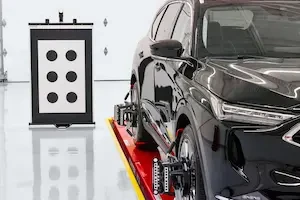
Seven of the 11 shops now perform ADAS calibration in-house. Three sublet it, and one runs roughly a 50/50 split. What stands out is how recently several of those shops made the switch.
Malecha's Auto Body built a dedicated calibration center about six months before its profile ran. Shadow Lake Collision brought calibration in-house within roughly the same window. All County Collision made the move in September 2025.
Liability and quality control over calibration conditions drove the decision at multiple shops. Malecha's William Malecha pointed to mobile vendors calibrating in uncontrolled environments: "Well, a lot of these mobile guys are coming in and they're doing the calibrations in a parking lot."
All County's Ryan DeMarco raised the same concern. "If I have a mobile vendor coming in and my technician is using that space, they're likely to do a calibration in the parking lot, which is not a controlled environment."
DeMarco also pointed to a financial case behind the move — reviewing the shop's sublet spending made the margin gain from in-house work clear. Malecha's reasoning, by contrast, stayed on liability and quality control without a stated cost calculation.
Certification usually comes before the equipment purchase, not after.
Most shops in the series described OEM certification as the trigger for new equipment, not the other way around. Center Collision's Kevin House put it plainly. "They won't give them to you unless you have the tools," House said of the certification programs. "That's what really generates us going after more tools."
Yoder's Elsom described weighing certification-driven capital expenses directly against timing. "If we're going to get into something that carries a lot of heavy CapEx, that might be something that I want to wait on."
Cliff's Body Repair is the clear exception. Owner Ben Bowman came from a luxury-brand dealership background and said his shop's certifications, General Motors, Genesis, and Infiniti, among others, had little influence on his equipment decisions, since his existing standards already exceeded what those programs require.
Customer communication is the layer most shops add a separate tool for.
Eight of the 11 shops run a dedicated third-party tool for customer communication on top of their estimating and management platform: Body Shop Booster, Kenect, Podium, Thryv, and UpdatePromise all show up in the series, including at Newman's Auto Body & Repair, which runs Podium as its primary customer communication platform. The remaining three, Malecha's, Shadow Lake, and Cliff's, handle customer communication natively inside CCC or Nexsyis without adding a separate layer.
Bale Collision's experience shows what can go wrong with the layered approach. The shop runs Body Shop Booster and CCC side by side, but the sync only runs one way. "You can update the customer in Booster, but it doesn't update in CCC," body shop manager David Cates said. "You have to manually put that in there, so they don't necessarily talk to each other as far as updating."
Cliff's Ben Bowman described choosing the opposite path deliberately, consolidating onto Nexsyis after an earlier split between two communication systems became, in his words, "a telephone game."
Digital check-in adoption is mixed, and one shop walked it back.
Digital vehicle check-in isn't universal across the series, and it isn't a one-way trend toward more automation.
Center Collision tested a tablet-based check-in and abandoned it after repeated lockups frustrated customers. General Manager Jared Osten explained the decision: "Most people don't get wrecks very often, so it's like a super big inconvenience," Osten said. "To start off their interaction with our shop with another inconvenience — no. ... We're here to help. We have the shoulders, we want to take on the problem for them."
Bale Collision has not added a dedicated digital check-in workflow beyond what its CCC mobile app already supports for photo documentation, a deliberate choice tied to the shop's emphasis on in-person service.
A few smaller signals worth watching.
Car-O-Liner appears in the measuring stack at eight of the 11 shops. At two of those, it hasn't fully replaced Chief. Yoder Collision Network runs Car-O-Tronic alongside Chief Velocity and Pulse at the same location, with plans to expand Car-O-Liner to all three of its shops. At Shadow Lake Collision, Car-O-Liner runs exclusively at the newer Omaha location while Chief Meridian stays at the separate Papillion shop; owner Eric Dawson said he'll probably add Car-O-Liner there too.
AI tools are appearing in narrow, specific applications rather than across the board: an AI phone agent for after-hours calls at All County, a custom AI-built production board at Choice, and an AI parts procurement platform under evaluation at Johnson Auto Body.
And when it comes to vetting new technology before buying, peer networks came up repeatedly as the primary method, independent of shop size. 20 groups, Facebook shop-owner groups, and SEMA conversations were the specific channels cited most often.
Across all 11 shops, the throughline isn't a single winning platform. It's that shops consolidate wherever they have room to control the system, and fragment wherever insurers, OEMs, or unstandardized parts pricing force their hand. The shops that could explain their stack most clearly tended to be the ones treating each tool as an answer to a specific problem, not a default.
Shop Stack Breakdown profiles a new collision repair shop's technology stack in every edition of Future Fix. Want to see your shop featured? Fill out our intake form and we'll be in touch.


Lisa McArdle