Robert Molina was 16 years old when he started in the collision industry, doing custom paint and designs. He is 43 now, and the business he opened in 2008, in the middle of a financial crisis, has grown into a small MSO with more than 20 OEM certifications, shops across Florida and Puerto Rico, and a reputation he describes as the American Express of car repair.
Collision CareXpress started as a one-man operation out of South Florida. Around 2015, Molina purchased the shop's first building, hired a team, and began building toward something larger.
That same year, Tesla called. The company was looking for shops with strong reviews and asked Molina if he wanted to join their certification program. He did his research, concluded Tesla represented the future of collision repair, borrowed heavily to cover equipment and training costs, and signed on. Collision Care Xpress was among the first shops in Florida to earn Tesla certification.
Rivian and Lucid followed, and the full OEM certification list now exceeds 20 programs. The most recent expansion includes a location in Daytona Beach and a shop in Puerto Rico, where Molina says the company is the first MSO offering certified repairs.
"This is all I know," Molina said. "My whole life, this is all I know."
THE STACK
Estimating and Management
- Estimating: CCC, Mitchell
- Shop Management: CCC
- Parts Ordering: PartTrader, CCC
- Accounting: QuickBooks
- DRP/Insurer Portals: Progressive, GEICO, USAA
Collision Care Xpress runs both CCC and Mitchell for estimating. The split is partly insurer-driven: some carriers require Mitchell, so maintaining both platforms gives the shop flexibility across its DRP relationships. Mitchell also carries capabilities relevant to certain job types that inform how work is divided between the two systems. CCC serves as the shop management backbone across all locations.
Parts ordering follows a similar two-platform logic. Large orders run through PartTrader, where the shop can compare sourcing options and find the most cost-effective parts. Smaller, faster jobs go straight through CCC.
“On a small order, we can go ahead and go straight to CCC and order the part directly,” Molina said. “It just makes it quicker, especially if it's a small job.”
Communications and Workflow
- Customer Communication: Podium, CCC (transitioning to proprietary app)
- Internal Communication: Podium
- Photo and Documentation: CCC
- Scheduling/Capacity Planning: Bodyshop Booster
Customer communication is in transition. The shop has run both Podium and CCC for customer-facing outreach, but Molina is consolidating that function around a proprietary company app that will allow direct customer communication through a single platform.
Podium continues to handle internal team communication in the meantime. Bodyshop Booster handles scheduling and capacity planning, filling a gap that CCC alone did not cover in that category.
Digital Check-In and Documentation
- Digital Check-In: Video, photos, Hunter drive-through system
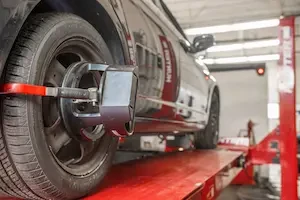
Every incoming vehicle gets video and photo documentation at drop-off. The shop also runs cars through a Hunter drive-through inspection system, which does more than capture images: it generates alignment data, identifies whether the vehicle is within spec, and records tire condition. That data travels with the vehicle through the repair process. The Hunter system is deployed across all locations.
Repair and Production Technology
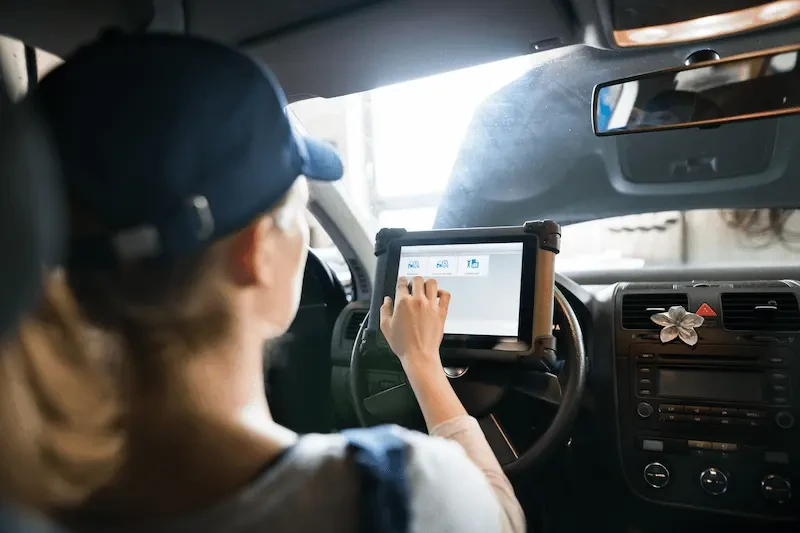
- Scanning and Diagnostics: Autel, Snap-on, OEM-specific tools
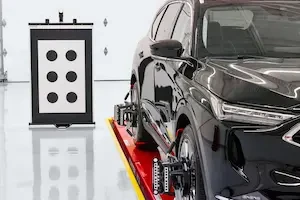
- ADAS Calibrations: In-house (upgraded alignment systems perform alignment and ADAS simultaneously)
- Measuring: Car-O-Liner, Celette
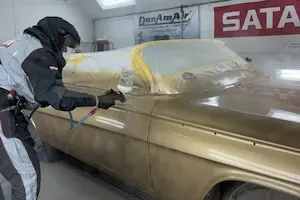
- Paint Mixing and Color Matching: Axalta
- Spray Booths: Garmat
Structural measuring runs on two systems: Car-O-Liner first, to generate a computerized diagnosis of what is going on with the vehicle's structure before repair begins, and Celette for precision verification during the actual repair work. Paint mixing and color matching run on Axalta, applied through Garmat spray booths, which Molina selected for their airflow performance with the shop's paint system.
One recent equipment investment reflects the shop's broader direction: Collision Care Xpress upgraded all of its alignment systems to units capable of performing both wheel alignment and ADAS calibrations simultaneously. That shift is consistent with how Molina evaluates new technology generally. When he sees the shop repeatedly sending the same type of work out, he takes it as a signal to invest. “We don't want to continue to keep that trend going,” he said.
Managing 20-plus OEM certifications across multiple locations requires dedicated infrastructure. Molina runs a team of managers whose primary responsibility is certification compliance: planning audits, tracking gaps, and ensuring the shop stays current across every program. He also noted that OEM requirements, once highly manufacturer-specific, are beginning to show more overlap across brands, a shift that is simplifying some of that compliance work.
What collision repair technology could you not live without ?
When asked what tool in the stack he could not run the business without, Molina's first answer was his employees. Molina describes Collision Care Xpress as an employee-centric company, and said his team is his number one priority before any piece of technology.
His second answer was scanning, specifically pre-scan capability, and the alignment system. Both point to a shop built around the premise that certified repair requires the documentation to prove it.