


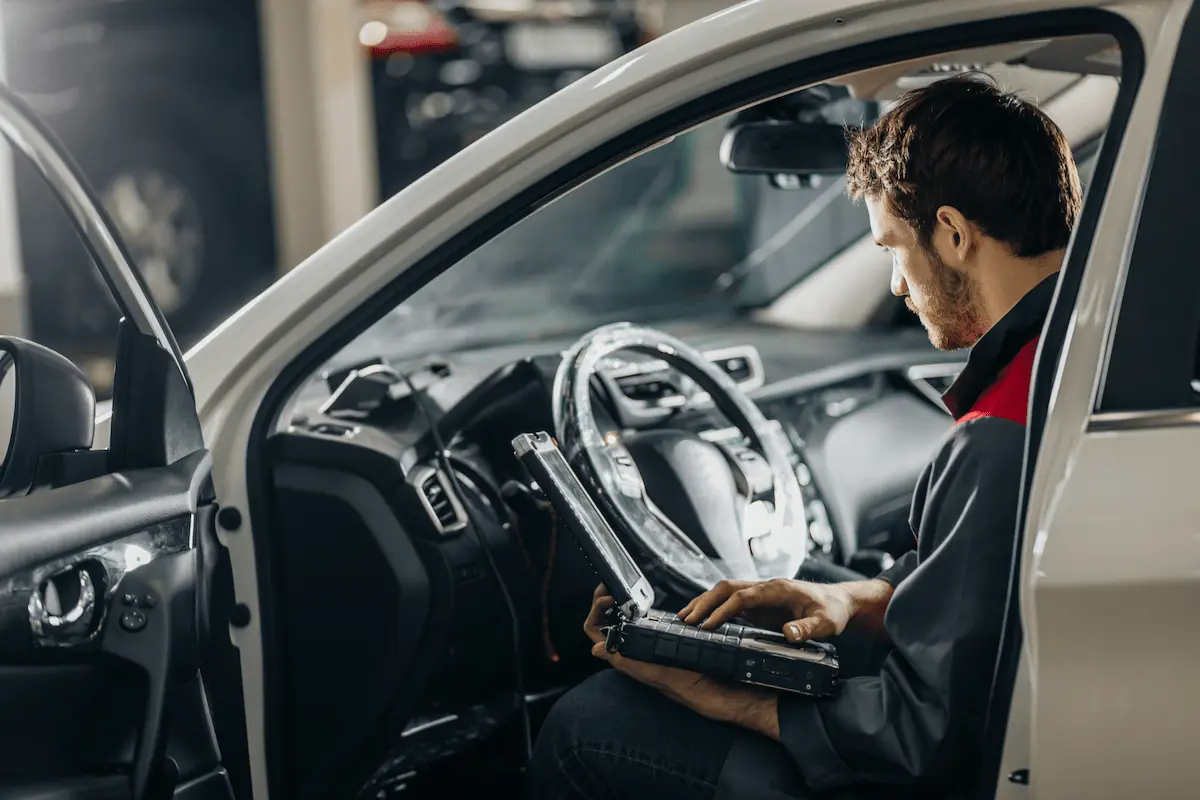
As the collision repair industry grapples with an evolving ADAS landscape, businesses nationwide are anticipating what future vehicle technology could look like and what actions they should take now.
Industry experts shared insights during an ADAS panel discussion held at the September Collision Next event in Anaheim, Calif.
The panel was moderated by Doug Higgins, founder of Collision Advisory. Panelists included Joel Adcock, Revv’s director of strategic partnerships, John Butto, key account manager, ADAS Collision & Glass for Autel, Josh Cascanet, field operations manager at AirPro Diagnostics/Revv, Troy Domstead, network manager at Car ADAS Solutions, and Don Smith, senior director at Elitek.
Participants discussed where ADAS is headed over the next several years, how shops should position themselves, whether to bring calibration in-house or sublet it, who is responsible when a calibrated car leaves the shop and something goes wrong, the cost to add diagnostic and IT talent, and liability issues.
“This wasn't another ADAS panel focused on today's calibration requirements,” said Dan Carranza, founder and chief executive officer of Accelerate Growth Partners LLC and the event organizer. “It was a forward-looking conversation about how technology will fundamentally change the collision repair business over the next five years.”
From evolving calibration capabilities and insurance reimbursement to accountability and strategic investment, Carranza said leaders were asked to question conventional thinking and prepare for a future that may look very different from today.
Why today’s ADAS knowledge gaps matter more than what’s next
Butto noted that ADAS continues to affect the collision industry.
“Where ADAS work goes next is less important than where ADAS work is now,” he said. “ADAS parts and ADAS-related repair processes are still unfamiliar to the majority of the industry,” he said. “If shops do not have a basic understanding of ADAS and how the repair fits into the repair process, it dramatically increases the shop’s liability, risk, and ultimately, driver safety.”
“If you run a shop and you aren't doing calibrations today, or at least thinking hard about it, you're probably missing something,” Higgins said.
Although everybody doesn’t need to go out and buy equipment tomorrow, Higgins acknowledged that many operators don't have the space or people, and subletting is a legitimate choice.
“In-house versus sublet is one of the big decisions, and most shops end up doing some of both,” he noted. “Even the shops that do their own still need a sublet partner for the hard ones, the failures and the software issues.”
Domstead pointed out that access to calibration work is becoming increasingly easier.
“The industry is making a big push to bring all calibration work in-house with a single tooling package or software platform,” he said. What’s getting overlooked, however, is the growing and more complex diagnostic workload.
“Operating an ADAS calibration business in a way that meaningfully supports the overall collision repair process and understands the challenges presented by insurance carriers is getting more complicated every day,” he shared.
While many shops are building internal calibration departments, he acknowledged that others are outsourcing.
“We’re seeing more vehicles with more sensors requiring more calibrations every day,” said Domstead. “All repairers should be asking themselves what calibration services make sense to bring in-house, while others will remain restricted by the resources required.”
The panelists also talked about the evolution of vehicle architecture, including AI computing platforms such as NVIDIA DRIVE AGX.
Cascanet mentioned that manufacturers plan to introduce these technologies in future vehicles, with new architectures expected to begin with the 2027 model year.
“Today’s vehicles can contain more than 100 electronic control modules connected through networks such as Controller Area Network (CAN),” Cascanet explained. “CAN has long been essential for enabling vehicle modules to communicate, but its bandwidth and processing capabilities are limited compared to the high-speed, AI-focused computing enabled by NVIDIA DRIVE AGX.”
DRIVE AGX represents a shift toward centralized computing, consolidating advanced processing functions while analyzing data from a sensor suite of cameras, radar, lidar, and ultrasonic sensors in real time. Depending on the manufacturer’s implementation, Cascanet said these platforms can support Level 4 autonomous driving and advance the transition toward software-defined vehicles. Vehicle-to-everything (V2X) communication is another area of future development.
Key considerations for repairers
To prepare a shop for ADAS repairs, Higgins emphasized the importance of vetting whoever does the shop’s calibrations.
“Make sure they actually follow the procedures and keep the documentation of what they found and what they did,” he shared. “If something goes wrong after the car leaves, that paperwork is your story.”
“Shops have to consider diversifying their current service set and possibly think about OEM vehicle specialization,” said Adcock. “It’s going to be very difficult to master all the repair requirements for 20+ OEMs as this technology continues to evolve.”
He encouraged shops to continue strengthening their ADAS and diagnostic processes and workflows.
“Whether bringing some/more ADAS work in-house or continuing to sublet, having the appropriate training, equipment, and partnerships will all continue to be paramount.”
Ultimately, Domstead said everyone is responsible for the integrity of a calibration.
“Anyone who touched the vehicle should be documenting what was performed and why,” he stressed. “Additionally, any repairer using a sublet for calibration should be vetting the documentation they receive.”
Cascanet said the rapid advancement of vehicle technology will require ongoing training and professional development.
“Technicians will need to build a deeper understanding of software, vehicle networks, and advanced computing systems, giving the term ‘hybrid technician’ an entirely new meaning,” he shared.
Shops must also have or establish comprehensive diagnostic processes throughout every repair, supported by proper training and current OEM service information.
“Diagnostics must go beyond pre- and post-scans to ensure vehicles are thoroughly inspected and systems potentially affected by a collision are identified,” said Cascanet. “As vehicle technology evolves, shops must prepare their technicians and strengthen diagnostic processes to properly identify and repair increasingly complex systems.”
Butto said that change is inevitable in the industry.
“ADAS is not going anywhere fast, and it is not evolving quickly enough to where shops will need to put forward less effort when it comes to ADAS-related repairs and in general,” he commented. “Shops can avoid less issues in the long run by staying educated on ADAS and treating it like any KPI for a shop.”
What collision repair could look like by 2030
Looking ahead to 2030, panelists agreed that collision repair work isn’t going away.
They forecasted that the cars on the road today will still be on the road in five years, so shops will still be calibrating, need the space, and must follow OEM procedures.
What they said will likely change is that vehicles will have more sensors, more software, fewer modules, and technicians who look more like diagnosticians, or even an "IT guy."
“I don't think ADAS is going to look the same in five to seven years as it does today,” said Higgins.
Domstead forecasted that calibration and diagnostics will become deeply integrated into the collision repair process. This includes sensor leveling during repairs, power, and reflection tests before reassembly and programming during module replacement.
“I also think we will start to see more calibrations required due to ongoing maintenance and sensor degradation,” he added.
As vehicles become more autonomous and complex, Domstead predicted OEMs will continue to share responsibility for vehicle performance and will impose stronger requirements to calibrate these systems.
To adapt, he said insurance carriers may establish additional pricing profiles for calibration, programming, and diagnostics.
“Ideally, with the additional documentation requirements we’re seeing, carriers will become more invested in ensuring all required calibrations are performed and documented rather than just the price for each,” he said.
Like others in the industry, Adcock has observed that OEMs are not slowing down on moving to level 3 and 4 (semi- and conditionally autonomous) technology.
“We won't necessarily see more sensors or radars on cars, but they will use AI and sensor fusion to be responsive and responsible for more than just one ADAS function,” he explained.
AI, he said, will produce incredibly quick results and the vehicle will continue to learn/re-learn typical driver responses based on driving conditions, actions and outputs to enhance its functionality.
“The future of calibration will fall to a more diagnostic-led approach vs. just a calibration,” he said. “The industry is already starting to see this.”


Stacey Phillips Ronak