

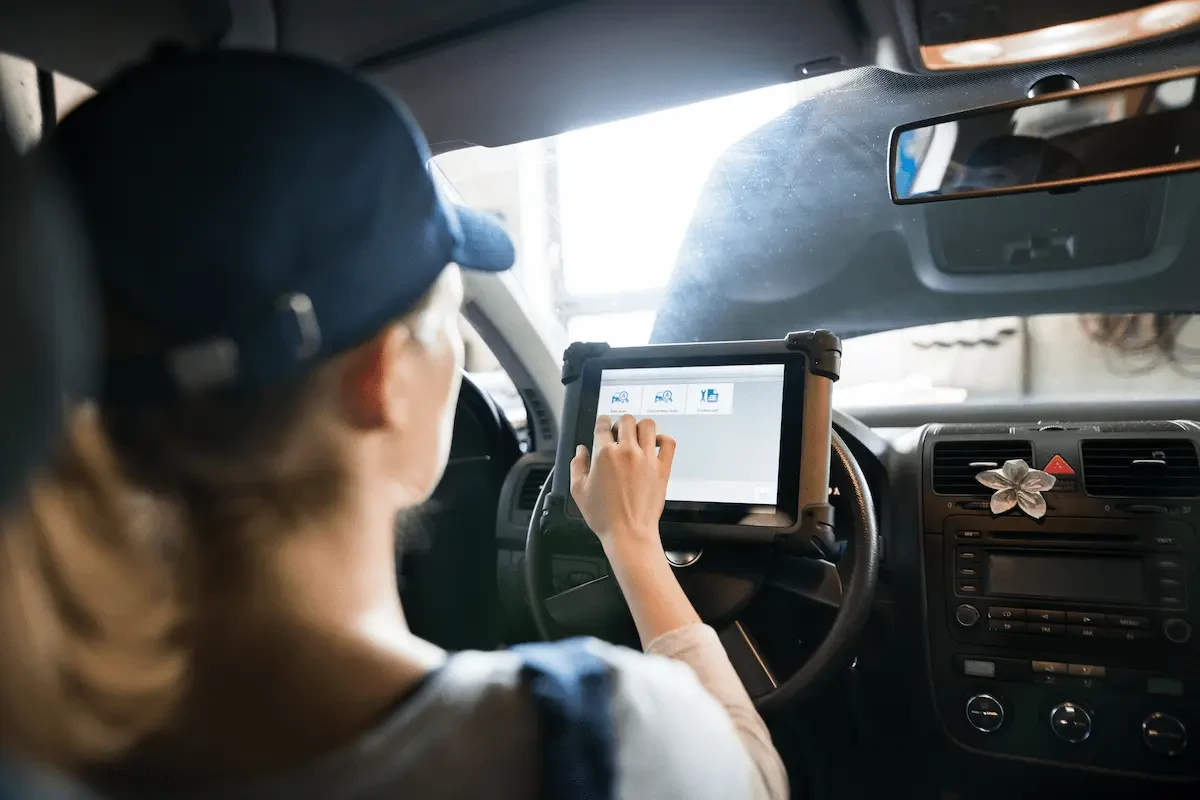
Recent announcements from Hyundai and Volkswagen are the latest sign of how quickly driver-assistance technology is advancing, and collision shops will need to keep pace, according to Brian Herron, CEO of the combined diagnostics business spanning asTech, Opus IVS and BlueDriver, formed when Repairify and Opus IVS completed their combination in July 2026.
Hyundai Motor Group said it will push its in-house Level 2+/2++ driver-assistance software through an expanded partnership with NVIDIA, targeting a fully proprietary system by 2029, two years later than originally planned, Reuters reported. Hyundai Motor Group president Park Min-woo said sensor redundancy is critical to safety, so that if one sensor fails, others can keep the system operating safely.
Volkswagen, meanwhile, is rolling out its first in-house, full-scenario Level 2++ ADAS system, called HS8, across seven new-energy vehicle models in China starting in the third quarter of 2026, with a lidar-based expansion planned for 2027. The system is being developed by Carizon, a joint venture between Volkswagen's software unit CARIAD and Horizon Robotics.
New OEM announcements point to accelerating ADAS complexity
"Today we're seeing automatic braking systems and blind spot and lane departure warnings ... It's not really like fully autonomous driving," Herron said.
What is changing, he said, is new software and intellectual property layered onto existing sensors, pushing automakers toward more Tesla-like driving systems through OEM partnerships and in-house development. He pointed to expected federal action as part of the shift: "there's going to be a target date for a mandate of [AEB], blind spot, pedestrian [detection], and it's looking like 2030 or 2031."
Herron described that rollout unfolding in two stages. "The first way will be the sort of mass equipping of every vehicle with all of these safety and technology systems," he said. "And then I think the second way will be leveraging that technology to then enhance self-driving features ... beyond just emergency functions like braking, but more ... like adaptive cruise control. We're going to see that widespread. We're probably going to see some level of basic self-driving ... We're already offering it along with a number of automakers to sort of follow Tesla's lead there. So the next five years is a very dense roadmap for automakers bringing this technology out."
The gap between OEM capability and shop capability
Herron said the average shop faces a scale problem that dealerships do not. "A repair shop, if they only did one brand, they would still be somewhat disadvantaged, but they're doing like 15 brands or 20 brands, and so ... there's just the scale of the problem in general."
Beyond identifying the correct repair plan, he said, vehicle architecture itself is changing. "They're changing from a decentralized electrical network to more of what's called zonal computing. So there's zone controllers. There might be three or four big computers in a car controlling each zone," Herron said. "That will also bring challenge and change to the repair industry, where we're used to just replacing an airbag control module, or a body control module, or an engine control module. When we get into more of the zonal architecture, it's going to be a much bigger job and possibly less parts, but more software and more computer-related work."
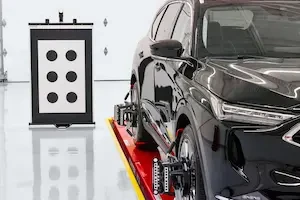
Herron also flagged a quality-control risk among some calibration providers. "There's been lots of players in the industry who have found ways to get the [car to say] it's calibrated, and they may not necessarily be with the correct environment, [level floor], proper lighting, even proper targets," he said. "While sometimes those workarounds are fine, there are other times where they cause the system to have ... a few degrees off in its measurements."
A shop-floor perspective on tooling and calibration
Ben Bowman, owner of Cliff's Body Repair in Scotia, N.Y., who worked on Tesla and Lucid vehicles at a dealership before taking over the independent shop, offered his own read on tooling access and calibration trends.
"For the most part independents have access and can purchase anything that is needed," Bowman said. "The big difference is that usually dealers get pushed tooling where independents have to research and purchase tooling." He said the gap is smaller in collision repair than in service work, particularly on non-luxury brands.
On calibration work specifically, Bowman pointed to gains from more sophisticated technology. "If anything, we are seeing calibrations becoming easier as the technology, software is getting more sophisticated," he said, citing a shift toward dynamic calibrations, which he said are simpler to complete in his shop's geography than in denser areas where holding a consistent 40 to 50 mph can be difficult.
What he does see as a growing priority is measurement. "The more sophisticated vehicles get with ADAS the more important it is to make sure the foundation of the vehicle is correct," Bowman said, adding that shops need stronger processes and equipment for upper body measuring on nearly every vehicle.
He also pointed to alignment equipment as a worthwhile investment, since more vehicles will need at least an alignment check going forward, if not a full alignment.
Remote diagnostics as a path for independent shops
Herron described a common adoption pattern as new vehicle technology comes to market. "A lot of shops, their strategy has been to use a trusted sublet provider, whether it's a dealership ... or a mobile provider to take care of it initially as they learn about the tech, and then they ... start to get comfortable, and then they bring some of that in house," he said. "Next model, your vehicle comes along, and the cycle continues."
Well-funded multi-shop operators are scaling up ADAS capability in-house, Herron said, but independent shops have another option. "[Shops] just need a partner or a list of partners who they can go to when a [Tesla] comes in the door or one of these brand new Hyundai's that ... may have cameras on every body panel," he said. "I think that's probably the best path for independents as they come up to speed, is to rely on those partners to help them."
Proactive, not reactive
Herron said shops that treat ADAS as a forward-looking priority, rather than reacting to it repair by repair, are better positioned for what's coming.
"We've been talking about ADAS in the industry now for about seven years, and there are clearly some repair shops and chains that are proactive and are thinking about this, and there are some who are still more reactive," he said. "The shop really owns the safe, quality repair of the vehicle, so they should find trusted partners who will help them through this. But they should also invest in training and gain their own internal experience."


Lisa McArdle