A car leaves your shop on Thursday, done right. The rail pulled to spec, the quarter blended so nobody could find the seam, every calibration run and documented. Your estimator read the damage right from the first walk-around, and your technician did exactly what the OEM procedure called for.
Now look at the repair order behind it. A bracket that came in for the other trim level and went back on the truck. Two rental days nobody planned for. A blend that was done but never made it onto the invoice. A credit from the return that will turn up in six weeks, maybe. The repair was excellent. The repair order gave some of its value away, and nothing about that was a question of skill.
Over the past year, interviews and workflow mapping with estimators, parts managers, and shop owners in more than 150 collision shops in Texas, plus shops across the U.S. and Canada, turned up the same patterns again and again. One Texas shop was on its seventh supplement on a single claim after 14 days of back-and-forth. Another fields 40 to 50 supplement calls and emails in a busy week. Even the best teams have limited time for the research, checks, and follow-through around each repair, and that is where the value slips away: before the repair begins and long after the car is delivered.
On a single repair order, none of it seems like much. Over a year, it adds up to real money and lost days, along with longer waits for customers and more supplements, disputes, and re-inspections with carriers.
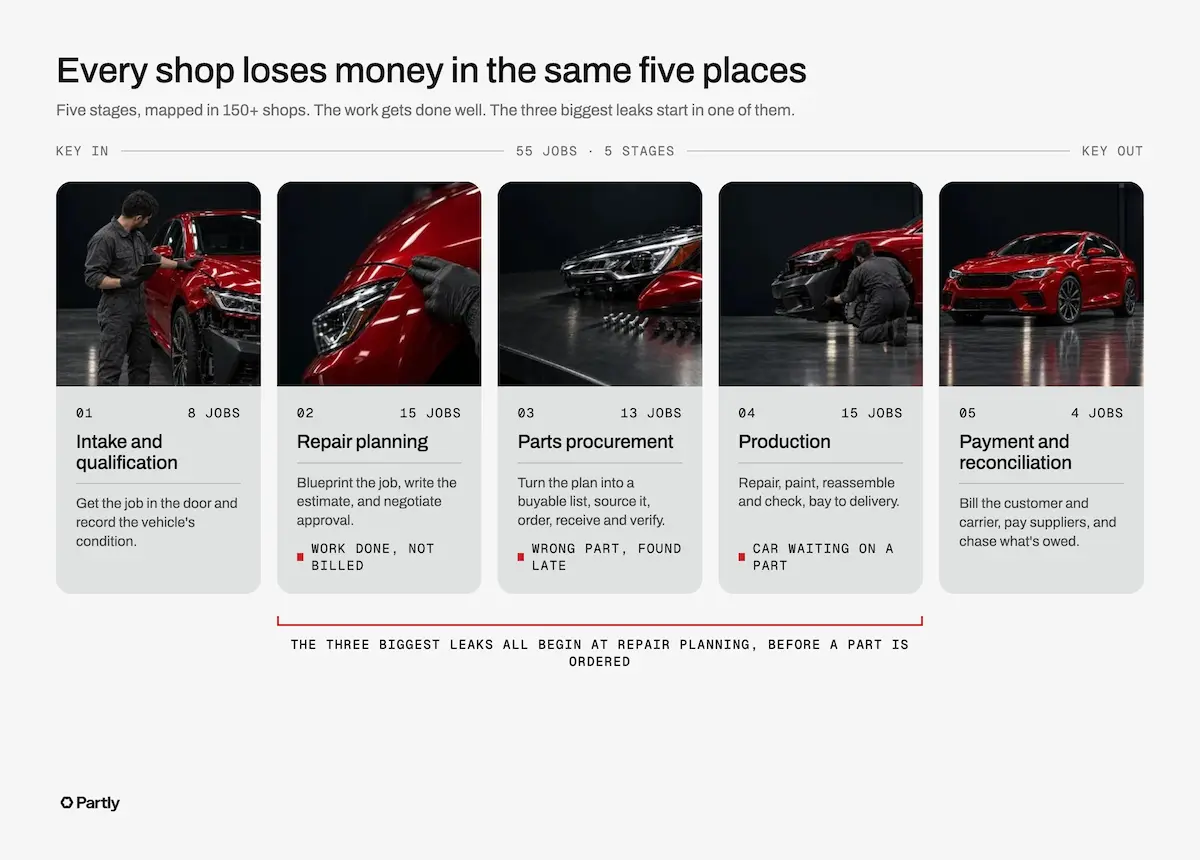
Every collision repair moves through five stages, and the same trouble spots turned up at the same stages in independents and multi-shop operators alike. Whether you run one location or 200, the value usually slips away in the same five places.
Small leaks add up to a month of waiting
The full cost of these leaks has not been widely measured, and work is underway to put firm numbers behind them in the coming months. Until then, conversations with repair teams and public industry sources offer early estimates of how quickly the costs build.
By those estimates, about one in five repair orders involves a supplement or a parts return, and each one adds roughly 1.5 to 2 days to a repair with an average cycle time of about 14 days. Each one also costs about an hour of estimator or office time, about 30 minutes of technician time, and about 20 minutes spent chasing and handling parts.
For a shop writing 100 repair orders a month, that works out to about 20 affected jobs and roughly 30 to 40 extra days of cars waiting. It also means about 20 hours of estimator and office time, 10 hours of technician time, and nearly 7 hours spent chasing parts. Because a wrong part often triggers both a return and a supplement on the same job, those figures are a rough guide rather than a precise total.
KEEP IN MIND: WHERE THE DAYS GO
- At that rate, 30 to 40 extra car-days a month is like one car going nowhere, every day of the month.
- That time shows up in your cycle-time numbers, in rental days on the claim, and in how long your customer goes without their car.
- Of all the costs of a leak, the car waiting is often the biggest.
Much of this is avoidable waste in the system. Reducing it can mean cars move through the shop faster, completed work gets documented and paid, and there are fewer surprises for everyone involved in the claim. Here is where it happens, stage by stage.
Stage 1: Intake and qualification
The photo the carrier asks for weeks later
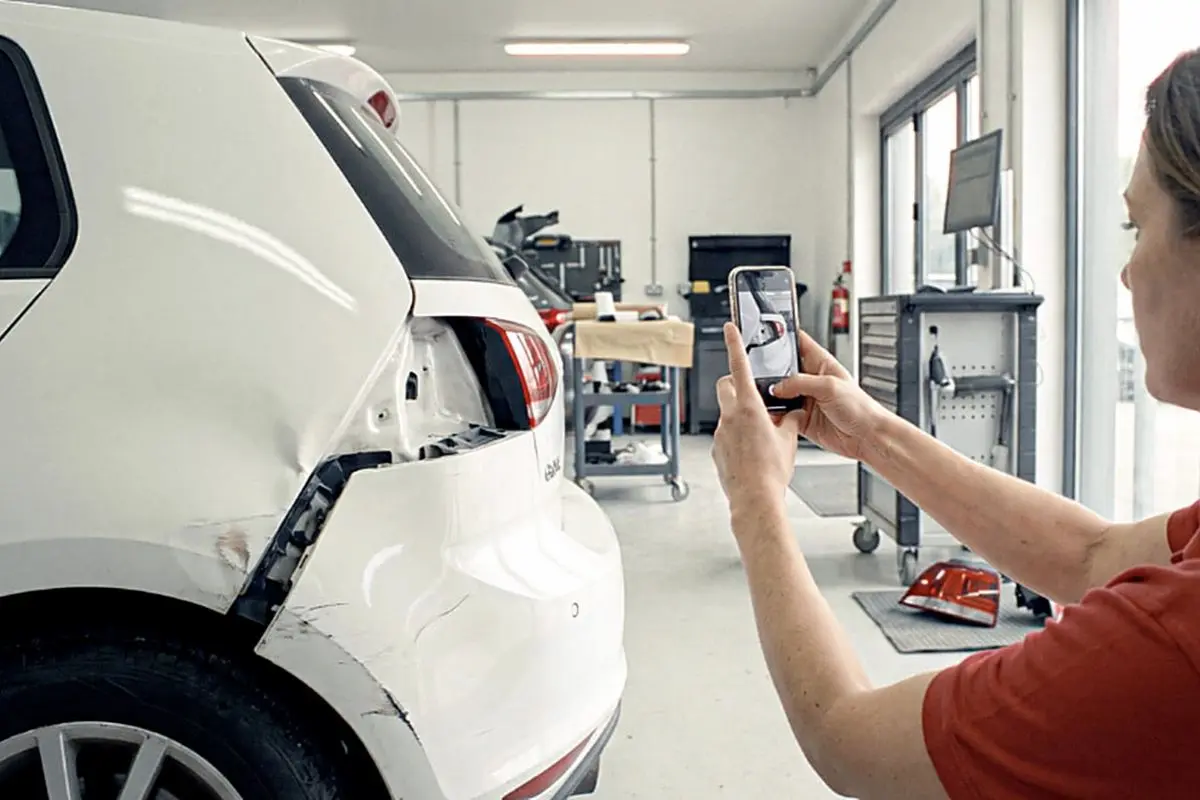
Intake sets the foundation for everything after it: the photos and vehicle details captured at drop-off are what the estimate, the parts order, and the carrier's review all build on. The trouble is that the person taking those photos rarely knows which photo or detail the carrier will ask for weeks later. So damage can get missed, and the job can start behind.
The cost often shows up later. The carrier may come back asking for more photos or information, sometimes after the repair has already begun, and someone can get pulled off other work to go back and find what was missing. Every round of back-and-forth is time the car spends waiting instead of moving toward delivery, and the stages that follow can inherit the same incomplete picture. For one Texas shop, a photo missing at intake means an operation nobody gets paid for at the end.
Stage 2: Repair planning
Work that never makes the estimate never gets paid
Repair planning is often where the costliest losses take root. Three of the most damaging can begin here, well before a single part is ordered: lines that never make it onto the estimate, wrong parts ordered, and cars left waiting on those parts.
Writing a complete estimate asks a great deal of an estimator. The work gets done to OEM spec. What doesn't always make it onto the estimate is the line for it, or the OEM document a carrier needs before it will approve it, and work that isn't documented turns into disputes, supplements, and rework later. "Writing an estimate is writing a story," said an estimator at one Texas shop. Every operation has to be written up so the carrier can follow it, and the ones that never make the estimate often never get paid.
KEEP IN MIND: WHAT ONE ESTIMATE ASKS OF ONE PERSON
- The OEM justification for each line often has to be looked up by hand.
- Manufacturers update their repair procedures regularly, so an estimator who has done a repair 50 times can miss that this one has changed unless the procedure is checked.
- No matter the size of the shop, producing a single estimate can involve 15 or more separate tasks, and the estimator often holds all of them together.
Asked what would help most, an Austin estimator said, "I need that second-grade teacher with a red pen." For the carrier, gaps at this stage can mean more supplements to handle and more re-inspections. For the vehicle owner, they can mean a longer wait. For the shop, they can mean work that was done and never paid for.
Stage 3: Parts procurement
The part that looked right until the box was opened
Many of the problems that start in repair planning show up during parts procurement, often at the worst moment: when the box is opened. A part number that was never double-checked or a fitment difference that was easy to miss can mean a return, a reorder, and a delay. So does a discount that looks good until the returns are counted.
Part of the difficulty is the load parts staff carry. They often jump between several supplier sites one at a time, keeping business rules, carrier rules, and supplier preferences in their heads as they go. At one Texas shop, waiting on parts bids can take 20 to 60 minutes, so on about two jobs in 10 somebody picks up the phone to confirm price and availability. An Austin estimator spends 10 to 15 minutes a job shopping across portals, and a part that looks cheaper on screen can carry freight nobody counted. One Texas parts manager weighs more than the price on the screen. "I don't care if it's 50 cents cheaper," she said. "It's across the highway."
KEEP IN MIND: THE TRUE COST OF A RETURN
From an industry analysis shared by Mike Anderson of Collision Advice:
- Processing a single return costs a shop an estimated $65 in labor, before reorders, partial vendor credits, or production stoppages.
- The analysis assumes production stops on about half of all returns.
- Return rates below 10% are rare.
- A vendor with a 30% return rate can quietly eat up nearly half of a shop's gross profit on parts.
Those costs extend beyond the shop. Vehicle owners go without their cars longer, sometimes with higher rental costs, while carriers see cycle time and loss-of-use charges rise.
Stage 4: Production
The tech is ready, the car is in the bay, and the part isn't there
Production is where the earlier leaks start to show. A wrong part often means a reorder and a car sitting in a bay, and when repair planning is incomplete or a procedure has changed, the gap gets discovered partway through the job and the supplement gets written after the fact.
This is also where the cost of waiting lands. For your shop, a car waiting on parts is a car occupying a bay. Each extra day extends the rental and pulls down the cycle-time results carriers track on their scorecards. On a repair that averages about 14 days, the 1.5 to 2 days a single supplement or return can add would stretch the job by roughly 11% to 14%.
Stage 5: Payment and reconciliation
The money you've earned isn't the money you've been paid
The last leak appears after the car is delivered, when the file should be ready to close. Invoices that don't match what was ordered can hold up payment, invoices are often rekeyed by hand, and vendor credits can take weeks to come back, if they come back at all. At one Texas shop, every vendor purchase order is keyed by hand into both the estimating system and the shop management system. Reconciling all of it before the file closes can take hours.
Like the other leaks, this one is easy to overlook on any single repair order. It often becomes clear only when someone totals the hours and the outstanding credits over a month or a year, and realizes it was money the shop had already earned.
Four checks to run in your shop this week
Seeing a repair as five stages makes it easier to know where to look first. You put everything into doing the repair right. These four checks are about making sure the business shows it.
- Find the work you did but never billed. Trace last month's supplements back to the stage where each began. The most expensive ones usually lead back to the estimate.
- Protect the next job from the wrong part. List last month's returns, what each was caught on, and how long the car waited.
- Keep the margin on parts. Compare return rates by vendor. Once returns are counted, the best discount is not always the lowest cost.
- Recover what you are owed. Check how long credits stay open. Credits that sit for weeks are money your shop has already earned.
None of these leaks comes from a lack of skill. The skill is why the car left safe and whole. They come from the systems around the repair, which can be mapped and reduced. The biggest leaks often happen before a part is even ordered, and that is the one place every shop can look this week.
PartlyRepair AI launches at SEMA, Nov. 3-6. It is built to handle the research, checks, and follow-through around the repair, while your estimator still makes the calls. See how it works in person at booth 31255 in the South Hall Upper.