

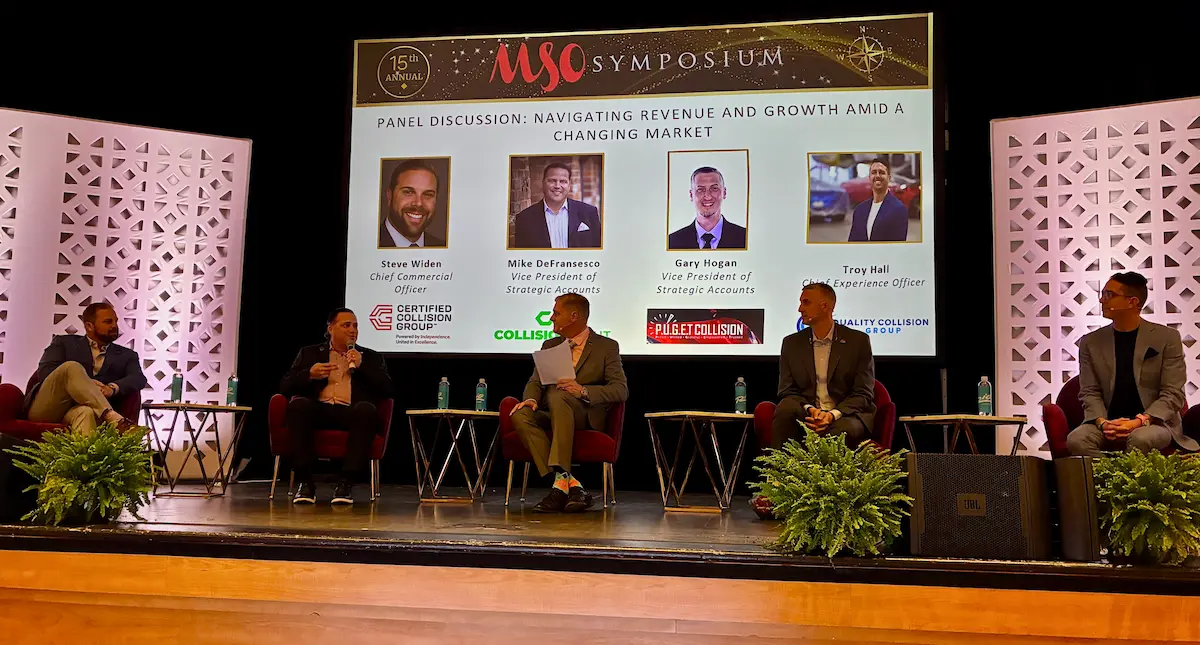
Effective use of artificial intelligence (AI) within collision repair businesses was a frequent topic at industry meetings in Las Vegas in early November during SEMA week.
A panel of representatives from multi-shop operations addressed it at the annual MSO Symposium.
“We’re using it, for example, to capture revenue,” Troy Hall, chief experience officer for Quality Collision Group, said.
He said , for example, that most large MSOs are doing after-hours assistance, using an agent to answer missed calls, essentially. “Most accidents happen outside of business hours, and so you may be potentially losing customers during those hours. Introducing AI is actually easy enough and is generating and capturing or influencing at least some part of our revenue now.”
Others pointed to use of automated estimating.
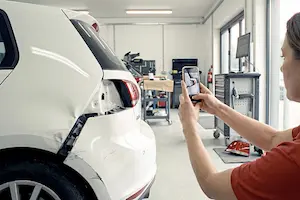
“Typically, our technicians don’t really have an appetite to get started on disassembling a vehicle until they already have an idea of what it is they’re working on,” said Gary Hogan, vice president of strategic accounts for Puget Collision, which operates more than 70 CARSTAR and Fix Auto USA locations in four western states. “Having the ability to utilize photo estimating has been huge because it definitely takes a little bit of that administrative burden off of our team members to get the ball rolling.”
Steve Widen, chief commercial officer for the Certified Collision Group, said AI is helping improve service in terms of keeping customers informed.
“You can build the AI to tell your customer where the car’s at in the process, and they’ll get that update however you want to set it,” Widen said. “You can set it up however you want: Car’s already in, the car’s torn down, or the car is in prep, in paint or it’s in detail. Or, ‘You can pick it up at tomorrow at 4 o’clock.’ So, it’s just however each of our [shop] partners want to lay it out.”
Get the specific data you need
The following day at the Collision Industry Conference (CIC), John Reeves, chief strategy officer for B Street Automotive, which operates 16 shops in the Midwest, said he sees AI leveling the playing field in terms of being able to create the specific data tools you want for your business.
“I’ve built some really cool things with Claude,” Reeves said.
Instead of pulling information from each data provider separately, Reeves said he now has all of B Street’s reports in one place. That lets him sort the numbers by luxury and non-luxury vehicles, look at severity by make and by carrier, and compare parts margins across insurers.
“I can break it all down and look at how we can make better decisions to run the business,” he said.
With 1,300 to 1,500 vehicles in production at any given time, Reeves asked the AI how many files were running up against paint caps on non-DRP claims. It found 53 files that had a paint cap attached when they shouldn’t have, apparently brought in through OpenShop.
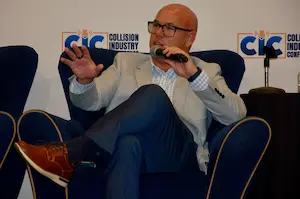
AI can assist with building the specific dashboards you want, he said.
“I’ve built things that are hyper-specific to B Street that would have zero value to [others] because they’re just specific to the way we run our business,” Reeves said.
He added the software vendors B Street relies on should develop secure methods for shops to tap into their own data and create custom tools, since no single provider can design one product that fits every customer’s needs.
AI should meet three objectives
During another panel discussion at the MSO Symposium, Mario Rizzo, the chief operating officer of Allstate, said he believes any use of AI within the industry should deliver on three objectives simultaneously.
“First, how does AI make the customer experience better? How does it help solve a customer's problem? Not my problem or your problem, but their problem,” Rizzo said. “That should be objective No. 1.”
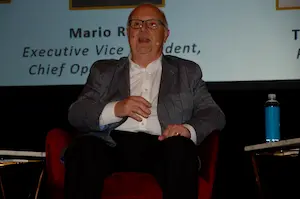
The second goal should be to build efficiency. “But it should do so in the name of affordability,” Rizzo said. “That’s creating value for customers.”
Thirdly, he said, AI should be used to build trust, accountability, and accuracy.
“If you try to do only one of the three or even two of the three, I think you’re going to suboptimize the outcome,” Rizzo said. “I’ve had conversations with state regulators where I’ve led with the reason we’re doing what we’re doing is, first and foremost, to improve the customer experience. And the response I’ve gotten back was, ‘Wow, that’s not the way other companies are talking about AI.’ Most are really hyper-focused on how I’m going to save money and improve efficiency, which is fine, but if you can’t really do all three, I think you’ve missed the opportunity.”
He said he also believes any AI-led customer interaction should not overlook that “sometimes people just want to talk to people.”
“They may not want to talk to a bot, so No. 1, we're going to be super transparent when someone's interacting with AI, particularly if it’s voice-enabled AI, so they know they’re talking to a bot instead of a person,” Rizzo said. “But second, and even more importantly, create really simple off-ramps for people to get them to a person, when they want to talk to a person.”






John Yoswick