


For collision center owners and operators, AI choice generally comes from two directions: how much do you want on your plate, and who do you want to share the meal with? What areas are you looking to augment with the new technology, and who will provide it?
Everything from an estimating appetizer to a full-course operations meal is possible, and vendors range from a solopreneur provider of sales leads working more from AI than with it, to European firms coming to American shores, to a dominant name in shop operations, to in a couple cases body shop owners themselves.
It’s a new menu and a good time to be hungry. Vendors are, and they want to buy you lunch.
Some of the cuisine remains decidedly nouvelle and remember Mom’s advice: chew slowly.
The Fridge
You might already have AI ready, willing and able.
Come January, CCC will have offered AI estimating to customers for two years. Vice President Mark Fincher told Autobody News in August its AI estimating spots “82% of the final bill, in under two minutes, for 20 lines of estimate” from the CCC ONE mobile app.
He said the shop operations software seller includes other tools and plans more, though a strict timeline hasn’t been given.
Taken together — and we repeat, it’s not happening yet and won’t tomorrow — AI tools from the company will touch communication, both outbound and inbound, language translation and detect-the-angry-customer tools, shop reviews, and monitoring live interactions between your human staff and collision clients.
Still way farther down the line are possible benefits from agentic AI — current iterations out in the world fall under generative AI — which are said to take a more proactive approach to problem-solving.
The point for our purposes here is when deciding how to use AI, start with what you already don’t know about what you likely already have. Start running some CCC tools — or those on the operations product you use — to do several things: benefit from the AI work itself, get familiar with the technology, then decide from that if you need more — or less.
Second Breakfast
If it’s more, third-party vendors will be on your to-call list.
If so, smaller companies and start-ups are on the scene, as is often the case with new tech, and some operators prefer to work with that size and scale.
Oregon’s BodyShop Booster is growing in prominence, with the peripatetic Ryan Taylor particularly prompt in returning client calls, and professional in presentation — whether individual and virtual, or to a California Autobody Association confab this summer.
Body by Cochran, a $75 million, 11-shop MSO affiliated with a Western Pennsylvania dealership group, uses the software and another MSO, Brightpoint Auto Body Repair, recently told Autobody News they’d signed on.
A third user, Jack Balyan, owns or co-owns three Premium Collision Center locations in the Los Angeles area. “We have their highest option of partnership,” he said. Balyan’s “other ride” is Otto, a solo effort by started-this-spring founder Ilan Mandil.
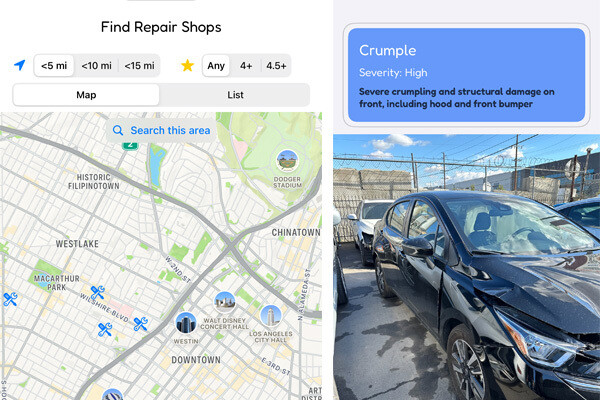 Screenshots from the Otto app showing nearby shops, left, and preliminary damage assessments, right.
Mandil uses AI like so many others — to take photos from which to crunch preliminary repair numbers — but at that point the personal touch kicks in: shops can contact potential clients, i.e., people, personally. Which Mandil also does: he talks with shops personally, visiting some, before admitting them to his app.
CEO Raj Pofale’s Claim Genius has worked with salvage yards and insurers, including claims automation for India, and is moving into the collision shop.
Meanwhile, BayWatch Technologies was founded by two Utah college students as a school project in 2017. It’s a smaller hardware system with infrared lights and a drive-thru model compared with the smart-device picture-taking of many estimatics. Rick Leos, with 35 years in automotive and collision, has guided a lot of its course.
Smorgasbord
Longtime estimatics provider Tractable is a choice similar to ones mentioned above in that its work is done on a smaller device, but it’s reach is big. It’s U.K.-based, which gives some cachet.
It’s also well-funded, and more to the point a collision center could care about, its body shop efforts have been overseen, as with the BayWatch boys above, by veterans including Jimmy Spears and, until recently Mitchell Anderson, who moved on to start-up Symphony, which uses AI to train insurance adjustors.
Tractable at mid-year had raised some $200 million, and announcing adoption by three dozen shops in Canada.
Lots of choices, and so far that’s only so far. Do you want what you already have? Small and agile? Decades of collision industry experience? Now the Europeans want a piece, bringing hardware and the focus on dealership groups and fleets.
It’s a smorgasbord.
The word means butter and geese and sandwiches. Sounds like it could get a bit messy or chaotic, which makes a key aim of the overseas entrants especially apt here: They want to make AI-estimating efficient, with companies like UVEye and Ravin AI offering larger drive-thru gates for extensive, and not inexpensive, damage analysis.
Not Two Cupcakes
But with what’s already “in the fridge,” why get anything else, from vendor large or small? Large all-operations operators emphasize experience; third-party sellers counter with specialized expertise.
One vendor said, “Companies that focus on a single AI solution tend to do one thing extremely well, a solution built to obsess over performance, experience and outcomes.”
Chris Van Der Put, who heads Ravin AI’s U.S. push, in an emailed note, cited quality and workflow.
“An estimate is only as good as the images used to write it,” he wrote. He said Ravin has scanned 150 million VINs, authenticated data, found fraud, can guides uncertain users, on multiple workflows for single vehicles: repair, salvage, selling: “sophisticated vehicle scanning rather than just ‘taking images.’”
Assessing damage should flow into multiple areas, including repair, salvage or selling, he said, as well as being able to compare damage over time and predict possible problems — “managing the condition of vehicles over time, rather than just speeding up a single repair estimate.”
On the flip side, estimating was itself an early AI area and CCC was one of its earliest. Fincher noted, “We’ve been at this for well over a decade,” accessing massive amounts of data, with which to build its AI. Annually, “we do 24 million estimates on our platform [via] tens of millions of images a month.”
Brown-Bagging It
But wait, there’s more.
On the all-in option, what if we told you shops could work with colleagues — compadres, even. Longtime body guys who are building their own artificial intelligence operations software?
 A CrashCodex dashboard.
“As a shop owner, I can tell you firsthand we do need tools beyond” full operations software, Ali Jakvani said. He and several partners run shops in Southern California and are developing a new operations augmentation AI offering called CrashCodex. Currently the partners’ workflow is “scattered across multiple platforms that don’t talk to each other. For years, this fragmentation has blocked real innovation.”
He wants “a set of tools that work in sync, so I can get accurate insights for my business without wasting hours reconciling systems,” he said. Codex at full-strength — early elements are being tested, others being developed — “won’t just cover repair and estimate data. It will unify financials, shop management, compliance, customer workflows into one connected system.” It could even, he said, theoretically and potentially, work with CCC.
 BetterX.
A second in-house developed system is BetterX from South Carolina-based Better Collision Centers. Founder and CEO Jonathon Best began building it for his own growing regional MSO, and is now offering it to other operators. It’s priced in the range of an individual estimating software product and covers more areas.
Ravin’s Van Der Put still makes that latter case. With bundled-in products, shops “still look to complementary solutions that are neutral, portable and purpose-built for moments [a suite] does not fully cover. That is where independent apps earn their place.”
All You Can Stand
Indigestion can set in. Keep the conversation going. Enjoying a meal isn’t just eating.
No need to rush. Chew slowly.
There’s been a fair amount of push-back on AI’s advance — generally, socially, economically and in collision repair. Body techs are concerned about their jobs, managers and marketers don’t like AI-based phone systems.
Consumers don’t get it, culture-watchers don’t want it, and the tech-folk behind it sometimes seem like a cross between unaware and utterly whacked: Where, people ask, will we get the energy grid to run this? If you think EVs will need a lot of juice, meet ChatGPT. Business deals where a chipmaker “invests” in an AI company that can only buy chips with the money from the investment.
As all this relates to AI buying by body shops, an MIT study this summer reported by Fortune magazine found 95% of internal AI pilot programs don’t boost revenue or productivity. Models are good while integration lags. The report said too much AI money goes to sales and marketing instead of cutting outsourcing and operations’ cost in the back office.
Companies in this study found success using AI to solve targeted problems, with specialized external vendors succeeding twice as often as proprietary pilot programs.
Then a McKinsey study covered in the New York Times also saw “no significant bottom-line impact” in 80% of companies using AI, and 40% abandoned pilot AI programs. Some of this is due to jumping in too quickly — that is, spending cash with a zeal not according to knowledge, with overripe expectations that, when dashed, bring disillusionment and buyer’s remorse.
Yet the second study said companies plan to spend nearly $62 billion this year on AI products provided by tech companies. Those sellers, including Meta, Amazon, Google and Microsoft, will put $400 billion to AI this year, according to several late-October media reports.
BodyShop Booster’s Taylor said spending could be starting in collision. He believes the adoption cycle is accelerating, and will do so faster than certain other innovation eras because AI, not being a physical product, doesn’t have to, in a sense be “made” or shipped.
“We’re starting to have a lot of conversations with some of the bigger players, vehicle manufacturers, stuff like this,” he said. “They’re really starting to pay attention to what’s happening in AI.”




Paul Hughes