


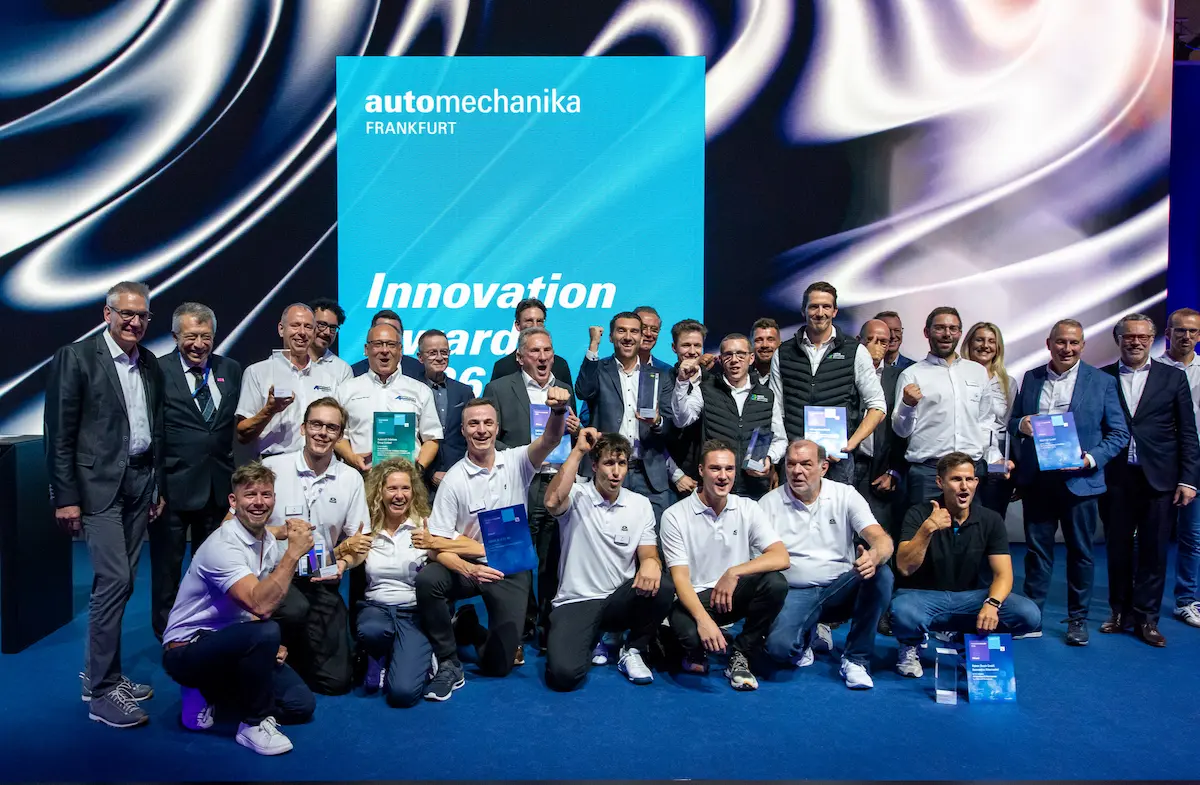
This year’s Automechanika Frankfurt trade fair, held Sept. 8-12 in Germany, showcased a wide range of solutions and services for body shops and the automotive aftermarket industry. Organized by Messe Frankfurt, the biennial event had several highlights, including the Automechanika Innovation Awards.
From a record 185 entries, the 17-member international jury recognized innovations in 10 categories on the first day of the show. They addressed key themes in the automotive aftermarket, including artificial intelligence (AI), digitalization, electromobility, and sustainable and cost-effective repair and remanufacturing concepts.
“An idea becomes an innovation when it makes a difference in practice — when it improves processes, conserves resources, opens up new possibilities or solves a specific problem,” said Michael Johannes, brand manager, Automechanika at Messe Frankfurt Exhibition GmbH.
“The products and services presented by the Innovation Award winners demonstrate the impressive level of technical progress being made in the automotive aftermarket,” added Detlef Braun, member of the executive board of Messe Frankfurt GmbH.
The nominated products and winners were showcased in a special exhibition in the Innovation4Mobility area. Three of the award winners are featured below.
Body & Paint
CARTEC Autotechnik Fuchs GmbH received an Innovation Award in the Body & Paint category for its SmartBoxBlower Robotik, a fully autonomous sanding solution for paint preparation. The company developed it to efficiently process bumpers in small spaces with optimal accessibility.
“The dream for a painter is that he can focus 100% on the painting process,” said Daniel Fuchs, managing director of CARTEC Autotechnik Fuchs GmbH. “That is exactly what we have achieved with the SmartBoxBlower Robotik.”
Technicians can clamp a bumper into the machine and then activate it with a few commands. An oscillating, multi-axis system autonomously takes over the entire process.
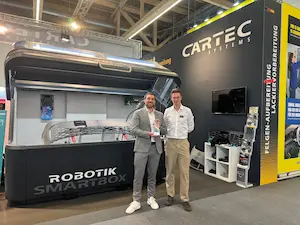
“We call it OscilloMotion technology,” said Fuchs. “We move and rotate the nozzle with the sandblasting in all different directions so we can reach the part from different angles.”
By removing manual sanding from the workflow, Fuchs noted that the system provides significant physical relief to paint preparation staff and eliminates human inconsistency. “It also helps body shops combat widespread skilled labor shortages,” he added.
Fuchs said the equipment is user-friendly and offers maximum efficiency due to its compact size.
“The SmartBoxBlower fits into almost any workshop and enables the professional sanding of bumpers, rims, and other small parts,” said Fuchs. He estimated that automated processing reduces the time required by up to 80%. Depending on the bumper size, the process takes about seven or eight minutes.
Based in Germany, CARTEC develops, produces, and distributes sustainable body shop and smart-repair technologies. It is globally recognized for proprietary systems such as the WheelDoctor and the SmartBoxBlower series.
The SmartBoxBlower was first utilized as a manual version two years ago by refinish companies in Austria, Germany, and Switzerland. CARTEC introduced a robotic version in 2026 with a smart Auto-Pilot function.
Fuchs said the secret technology behind the SmartBoxBlower is an advanced eddy-current process. “Rather than regular sandblasting, it’s comparable to an eccentric sander,” he explained. “The eddy-current process ensures uniform, seamless abrading without time-consuming manual work and with reproducible results.”
The company is preparing for international sales; by the beginning of next year, it plans to optimize the SmartBoxBlower for other countries, including the U.S.
“The system is completely assembled and only needs to connect to electricity and compressed air and is ready to go,” said Fuchs.
Smart Workshop & Service Solutions
An Innovation Award in the category of Smart Workshop & Service Solutions was given to MAHA for its autonomous inspection robot, MAIA. Show organizers said that no other category attracted more entries in this year’s competition.
“This award is a very special moment for us,” said Dr. Peter Geigle, CEO of the MAHA Group, based in Haldenwang, Germany. “MAIA shows what can be achieved when technical expertise, the courage to pursue new ideas and a clear focus on real-world applications come together.”
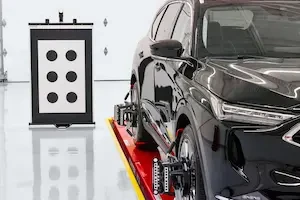
MAIA can move around a stationary vehicle using AI to perform inspection tasks, including body and tire scans. One of its main features is MAHA Surface Check — vehicle inspection technology that records precise vehicle dimensions and body defects. The robotic assistant also collects a wide range of vehicle data.
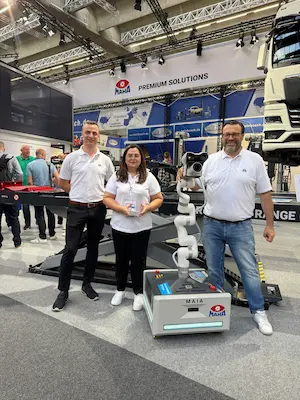
“MAIA can turn around the car and make detailed photos from the surface,” Geigle shared.
Because images are captured while the vehicle is stationary, Geigle said camera distance and viewing angles are controlled, ensuring highly reproducible results. The goal is to provide shops with a transparent process.
“The big advantage is that you have an assistant that does certain tasks faster and more efficiently than a technician could and you get the same test result every time,” said Geigle.
“It's a modular system,” explained Yannic Bachmann, M.Sc. Research. Bachmann said MAIA’s modular design will allow additional tasks such as ADAS calibration in future expansion stages.
“Depending on your use case, you can configure your MAIA to match exactly what you want,” he added.
MAHA demonstrated the robot in passenger cars and trucks at its Automechanika Frankfurt booth, along with 14 additional industry solutions.
The company, a manufacturer of vehicle testing and lifting equipment, automates vehicle inspection processes by combining robotics, sensor technology and AI.
Geigle said MAHA began development of the robot about two and a half years ago. It was nominated for an Automechanika Innovation award in 2024. Over the last two years, MAHA has advanced the functional prototype and tested it in various applications.
MAIA is currently being piloted at the BMW Airport Service.
“MAIA’s analysis gives our employees more time to focus on meaningful conversations with customers,” said Lilian Volk, digitalization expert at BMW Munich.
“At the same time, technicians can focus entirely on the repair itself,” added Andre Glanz from workshop planning. “This reduces communication effort and minimizes unproductive time in the workshop.”
Through its U.S. subsidiary in Pinckard, Alabama, MAHA plans to bring MAIA to the U.S. market.
AI Solutions & Digitalization
Robert Bosch GmbH introduced a new generation of its ESI[tronic] diagnostic software utilizing an AI-based assistant. The company received an Innovation Award for the software in the category of AI Solutions & Digitalization.
Heinrich Freiherr von Schwerin, the product’s lead software engineer, described the AI assistant as an interactive chat-bot-style interface. Technicians can enter a vehicle’s issues and trouble codes and the AI scans Bosch’s database, global repair information and OEM documents to find a solution.
Freiherr von Schwerin said this allows technicians to find the right document faster and diagnose the problem so they are more productive and take less time to fix vehicles. He said it’s a useful tool for all technicians, even those who are less experienced.
Bosch’s presence at this year’s trade fair was themed, "Master the job every day." The company presented many offerings for current vehicles, including spare parts, diagnostic solutions, shop tools, and equipment.
"Mobility is changing rapidly,” said Rupert Hoellbacher, chairman of the Bosch Mobility Aftermarket divisional board. “Our ambition is to accompany repair shops as partners on this journey — not with individual products, but with an intelligently connected, integrated system that helps them work successfully today and leverage the opportunities of tomorrow's mobility.”
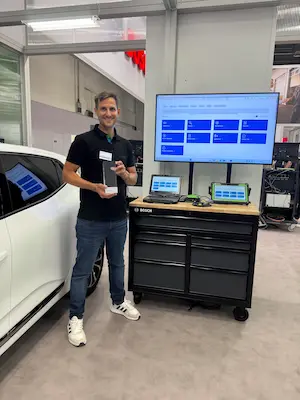
The company often heard from customers that it’s hard to find the right information at the right time when repairing a vehicle. “It’s similar to going to a library knowing the information is there, but you don’t know which floor, which shelf, which book or which page,” explained Freiherr von Schwerin. As a result, the company enhanced the ESI[tronic] software to help customers find what they need.
“Our AI is now working for you in the library, picking the right information and presenting it to you,” said Freiherr von Schwerin. This includes a Word document containing qualified Bosch data that can be saved as part of the final repair documentation.
“Although AI gets better and better, it still sometimes makes mistakes,” Freiherr von Schwerin noted. “That's why it's so important for us that we always ground the information.”
If the AI Assistant is unable to find details on some very old cars or new cars, it generates information based on world knowledge from the Internet. Although it is not qualified data, Freiherr von Schwerin said it provides a starting point.
“The user can then decide if that information should be applied or not,” he said.
The AI-based assistant is expected to begin a phased rollout across different countries later this year as part of the ESI[tronic] 2026/4 software release. It will be included at no additional cost for shops with the Advanced- and Master-tier software licenses.




Stacey Phillips Ronak