Pre-diagnostic alignments and tire run-out tests land in the middle of the payment ranking or below in the 2026 "Who Pays for What?" Frame & Mechanical Operations Report.
Shops that negotiate for a pre-diagnostic alignment are paid "always" or "most of the time" 35% of the time. Shops that negotiate for a tire run-out test are paid that often 24% of the time. On the billing side, the report finds that 66% of shops still sublet their wheel alignments.
The survey, conducted by Collision Advice and CRASH Network, drew responses from 473 shops in 49 states during April 2026.
Pre-diagnostic alignment ranks 11th of 21, with little change from last year
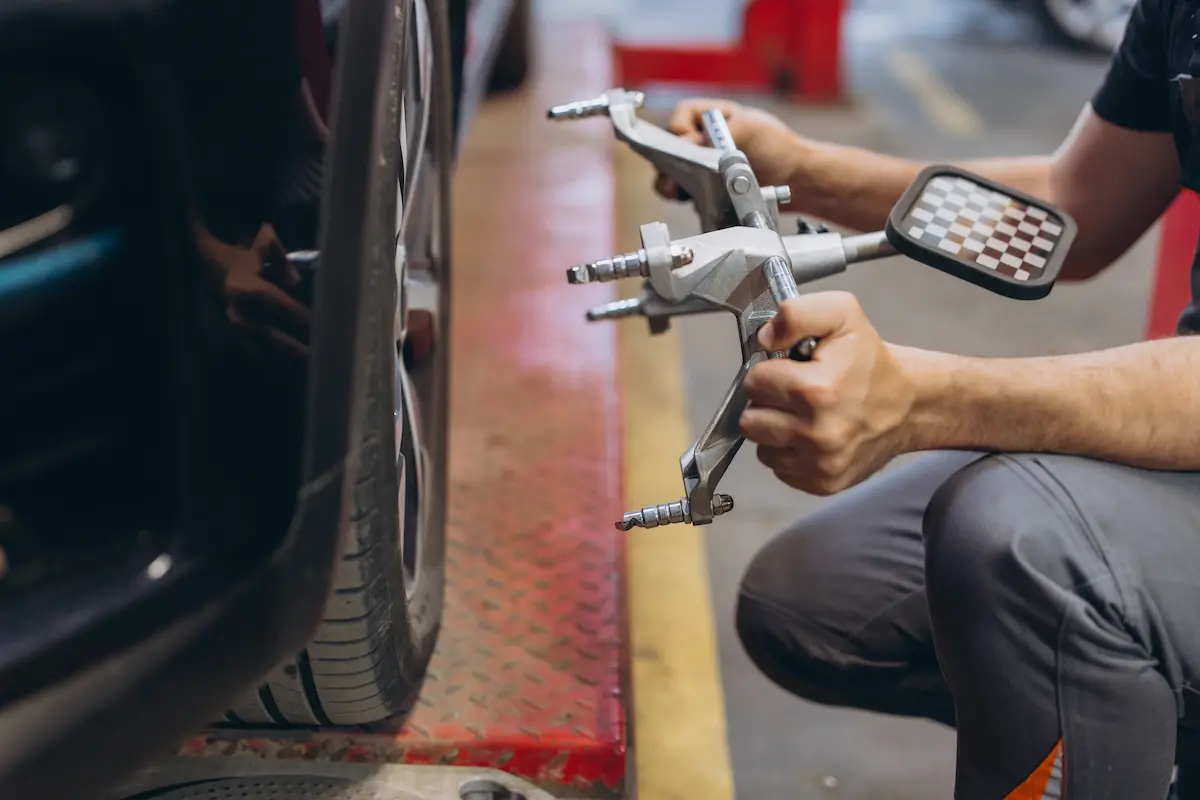
The report defines a pre-diagnostic alignment as one conducted during the repair planning process or prior to repairs, to determine whether any suspension components will be needed as part of the repair.
The 35% payment rate is 0.9 points below last year's, a change within the survey's margin of error. On the report's composite ranking of 21 procedures, pre-diagnostic alignment places 11th, just behind final verification of measurements.
Results by insurer fall in a narrow band, from 32% at Liberty Mutual to 40% at USAA. Overall, 28% of shops have never negotiated to be paid for the procedure.
DRP status and region produce wider gaps than insurer does
DRP shops report payment "always" or "most of the time" anywhere from 33% of the time (Geico) to 58% (USAA). Non-DRP shops range from 25% (State Farm) to 38% (Progressive). Geico is the only one of the eight insurers where non-DRP shops report a higher rate than DRP shops. The DRP samples are smaller, with 29 to 114 responding shops per insurer.
The regional spread is wider still. Southwest shops report payment 58% of the time. In the Mid-Atlantic the figure is 4%, and no shop there reported being paid "always." The report notes that its margin of error grows for regional and DRP breakdowns because of their smaller sample sizes.
Anderson ties pre-diagnostic alignment to ADAS and steering angle sensors
"The ADAS in today's vehicles are reliant on proper suspension alignment as well as steering angle sensors," wrote Mike Anderson, president of Collision Advice, in the report. "This procedure is something we expect to become more prevalent in the future."
He points shops to a spreadsheet from Hunter Engineering on not-included alignment operations, which he said he helped the company build.
One shop found flat spots on about one in four post-accident vehicles
"We at Collision Advice work with a shop that did a study checking the tire run-out on every vehicle that came into their facility after an accident," Anderson wrote. That shop found flat spots on the tires of about one in four of those vehicles.
According to Anderson, the type of vehicle and tires, the type of collision, and the weather conditions at the time of the accident can all affect the result. "As we see more electric vehicles come into our repair facilities, tire run-out tests will become even more critical," he wrote.
Tire run-out tests are paid 24% of the time, and 67% of shops have never asked
The report defines the tire run-out test as using a gauge or wheel balancer to check tires for flat spots. The test ranks 16th of 21 on the composite chart. Its 67% "never asked" share ties stall cure time for the highest in the survey.
DRP shops report payment as little as 6% of the time (USAA) and as much as 35% (Nationwide). Non-DRP shops sit between 23% and 30% across all eight insurers. Unlike pre-diagnostic alignment, DRP shops report a lower payment rate than non-DRP shops at six of the eight insurers.
Sublet share has held between 65% and 68% since 2023
In 2026, 66% of shops sublet alignments, 23% do them in-house and charge a flat fee, and 12% do them in-house and bill book time at their mechanical rate. The sublet share was 65% in 2023, 68% in 2024, and 66% in 2025.
Within the in-house group, 23% of shops reported flat-fee billing this year, compared with 19% in 2025, while 12% reported billing at the mechanical rate, compared with 15%. Both changes fall within the survey's margin of error. The report also measures the in-house group on its own: of shops that do alignments in-house, 66% charge a flat fee rather than their mechanical rate.
Forty percent of shops employ a dedicated in-house mechanic, as opposed to a body technician who also does mechanical work. Where alignments are sent out, transporting the vehicle to a sublet provider is one of the survey's best-paid procedures, at 70%.
Anderson expects more shops to bring alignment work in-house
"Remember that alignments and ADAS calibrations are often intertwined," Anderson wrote. He noted that checking the alignment is often a necessary first step for calibrations, and that any vehicle with ADAS that gets an alignment might then require some calibrations.
"I believe more shops will be looking to bring this work in-house as labor as a percentage of overall sales declines because parts (as a percentage of sales) increases," he wrote. "Otherwise, gross profit percentages will decline, and that will need to be reversed for shops to be profitable."
The report lists two SCRS Quick-Tip videos on pre-diagnostic alignment: "Get it straight! Pre-diagnostic Alignment and measurements" and "Why Pre-Diagnostic Alignment is Critical to the Repair." CRASH Network subscribers can also read "Performing tire run-out tests."
The full Frame & Mechanical Operations Report is available to download now.