



Collision center software-as-a-service provider CCC Intelligent Solutions Holdings Inc. is developing several new AI-based elements for CCC ONE, including tools touching front- and back-office work based around AI, with a view into other AI types like generative and agentic.
Neither is strictly new in concept, especially for hardcore techies and early adopters, or companies couldn’t sell services from them. But agentic AI as an iteration reverses the relationship between human and non-human. Instead of individuals asking ChatGPT for a reactive result, artificial intelligence takes a bit of initiative if prompted.
If generative AI can manufacture a film script to one’s specifications, agentic AI can agent it, pitch it to producers. Generative AI is the waiter who brings your mostly accurate BLT — “I said no mayo’’ — while agentic AI is the butler with a hot meal waiting when you get home.
Both are, well, artificial. But one’s more responsive than reactive. That’s the idea anyway.
“AI is not a ‘tomorrow,’” said CCC product management VP Mark Fincher, whose portfolio includes body shop customers. “It’s an evolution and it’s not just CCC.” The industry already uses generative AI, and “it’s going to go agentic.”
Language Lessons
The first element of new AI applications from CCC falls under consumer experience, improving efficiency “to get them into the shop: outbound/inbound communication, before they get there and once they’re in.” CCC plans to add translation of other languages, and better perception in any lingua: preferences, responses, word choice and tone, “to meet a customer where they are.”
This includes difficult interactions.
“We have a list of words, including curses,” indicating an irate customer. Artificial intelligence will also monitor live interactions to coach human employees.
Next comes a prime area of AI boosterism: automating tasks. Again, though, with agentic behavior, the idea is not just doing a task set before it, but anticipating needs.
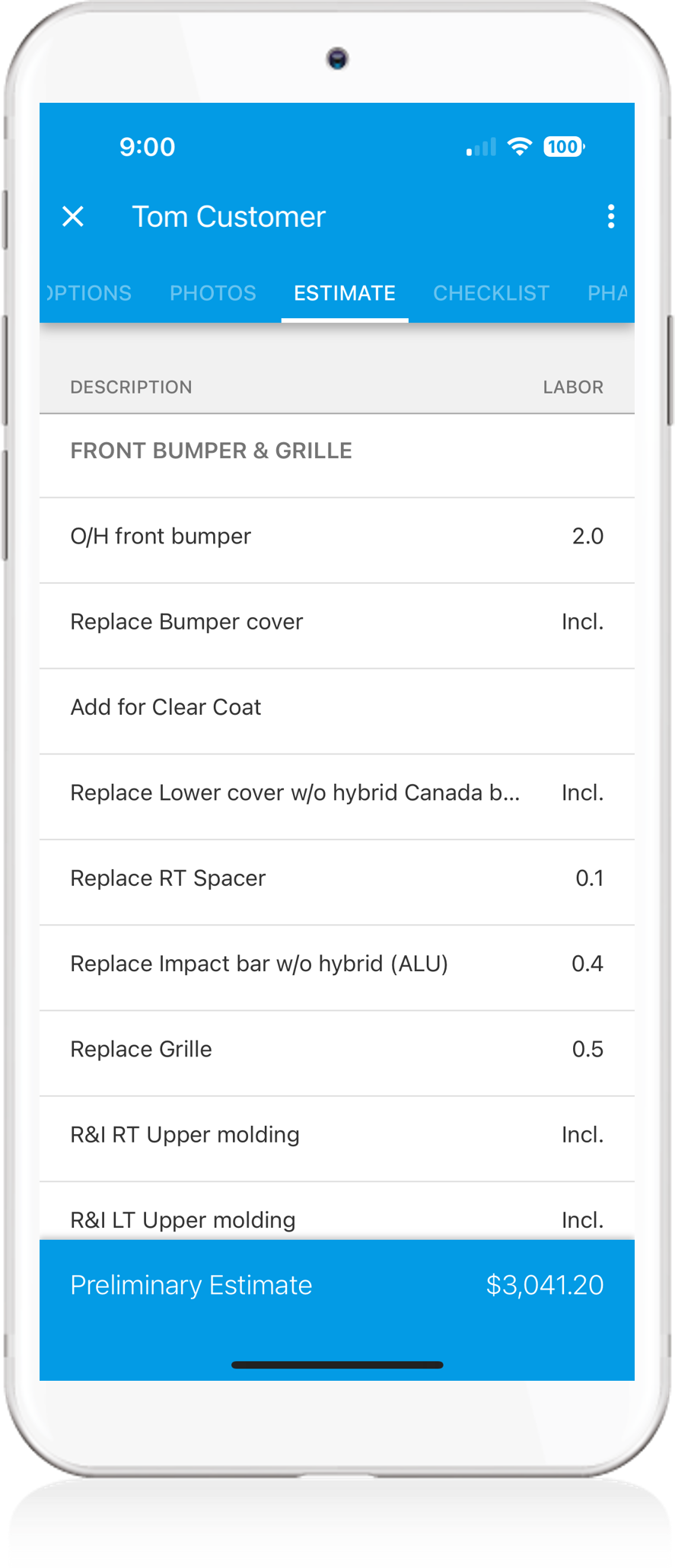 Example of an AI-generated estimate.
“Think about ChatGPT,” Fincher said. “You tell it to ‘build a five-day itinerary in Paris’ and you love walking, biking and sailing. And it’ll do it. [Now] agentic will let you make modifications and book all your activities.”
But what if you like talking to people about your trip, and getting some inside skinny on the most gallic cafés in Montparnasse? Fincher said there’s always a “‘human-in-the-loop” but certain tasks are obvious: “100% of the time when the car’s going to be late, I have to tell the customer. So how can we make that possible.”
Think work updates on parts and paint, and the potential for higher-impact time — explanation and empathy, say — with your customers.
A third area in development involves back office work, such as document management. Current standard is the facial recognition as on phones or OCR with words. “You point it at the piece and it can decode data. Next up, then, involves, for example, “discerning among invoices. Bring it into a system, digitize it, reconcile it: you ordered 10 parts, you got 10 parts, you pay for 10 parts. The accountant doesn’t have to look at it again.”
Something New, Something Old
When ready, the new “parts” will go into a vehicle that has plenty of the now-usual ones. If we were in France just before, now think of England, which with America are kissing cousins and yet, “two countries separated by a common language.”
Agentic artificial intelligence could become integrated with current generative AI, which CCC has been working on for several years. But it’s not necessarily so in the minds of users. At a recent gathering of 100 shops, Fincher said, “none knew that we were in market with AI, though we’ve had it for a year and a half.”
Shops want to know “what’s real, what’s tangible, what can I use,” in AI, he said. “So many tech companies and SaaS providers are just infusing the term into their materials.”
Three things CCC software does yesterday: AI estimating, cost prediction and AI assistance for related tools. “We released AI estimating to our collision repair customers in January 2024,” Fincher said. It’s the take-the-photo, upload-and-identify activity, which is among the most popular, not to say crowded, with third-party vendors such as Ravin, Claim Genius, and Tractable and BayWatch.
Fincher’s “human-in-the-loop” is still present and “can agree or disagree, or enhance what the AI [accesses]. It’s not going to guess and the human knows.” Artificial intelligence can also speak to additional operations and possible action items, such as “diagnostic operations for pre- and post-scan.”
“This AI is capturing 82% of the final bill, in under two minutes, for 20 lines of estimate” from the CCC ONE mobile app, Fincher said. Assessments, or pre-estimates as they’re coming to be called, are accurate to north of $3,000 for average final bills.
Repair cost prediction means consumers can get a repair cost range, from a shop’s website or from Carwise — CCC’s “Angie’s List for collision repair” aimed at consumers, free for shops using CCC, and “seeing 5 million visitors a year.” In this, the guiding idea is lead generation — nice during slowdowns, Fincher added.
The final been there, done that in place is an AI assistant — a chatbot — on Carwise, which if enabled works with prospective customers, asks questions, gives OEM certification info, compares shops and so on.
Amplify, CCC’s website building and reputation management element aggregating shop reviews from multiple sites, also can use AI. Here it checks to see if you responded to reviews, or it can be set to automatically reply to them, writing content as needed.
No Finish Line for Now
Ask real estate developers when they’ll be done building and they’re likely to respond, “never.” Sometimes it seems like that for software development, too: maddeningly so perhaps on a project a company wants to ship, and in a macro sense for AI as well. When will iterations end? Well, barring the whole thing failing, never.
“We’ve been at this well over a decade,” Fincher said, accessing massive amounts of data to build its artificial intelligence. CCC ONE writes 24 million estimates annually from “tens of millions of images per month.” Company software is in some 30,000 shops.
In quarterly earnings reports, the company consistently highlights its research and development, more recently in greater doses in AI, both generative and agentic; its tapping of tech expertise for Board of Director positions; and growing AI adoption in collision repair. In July, a press release for its most recent results said several larger insurance companies expanded their use of CCC’s AI products beyond estimating “to include earlier stages of claim handling later stages of audit review.”
More insurer use of AI affects body shops in multiple ways, but at the very least it is that: more. Fincher’s area is collision repair, another vice president leads the insurance vertical, but boots on the ground, there is overlap.
CCC aims to “help insurers and shops move cars quickly with proper repair. AI comes over the top of this for triage, effective and efficient routing, to reduce cycle time, improve accuracy and get customers back into the vehicle with a smoother experience.”
He said AI can help shop staff “focus on higher-value tasks, on the most important thing, versus tasks they so often get consumed with.”
Meantime, that means shops can think about how they want to work with AI — and should do that, anyway.
CCC hasn’t said when the new elements will bow, but Fincher said, “Customers will start to see solutions.”







Paul Hughes