

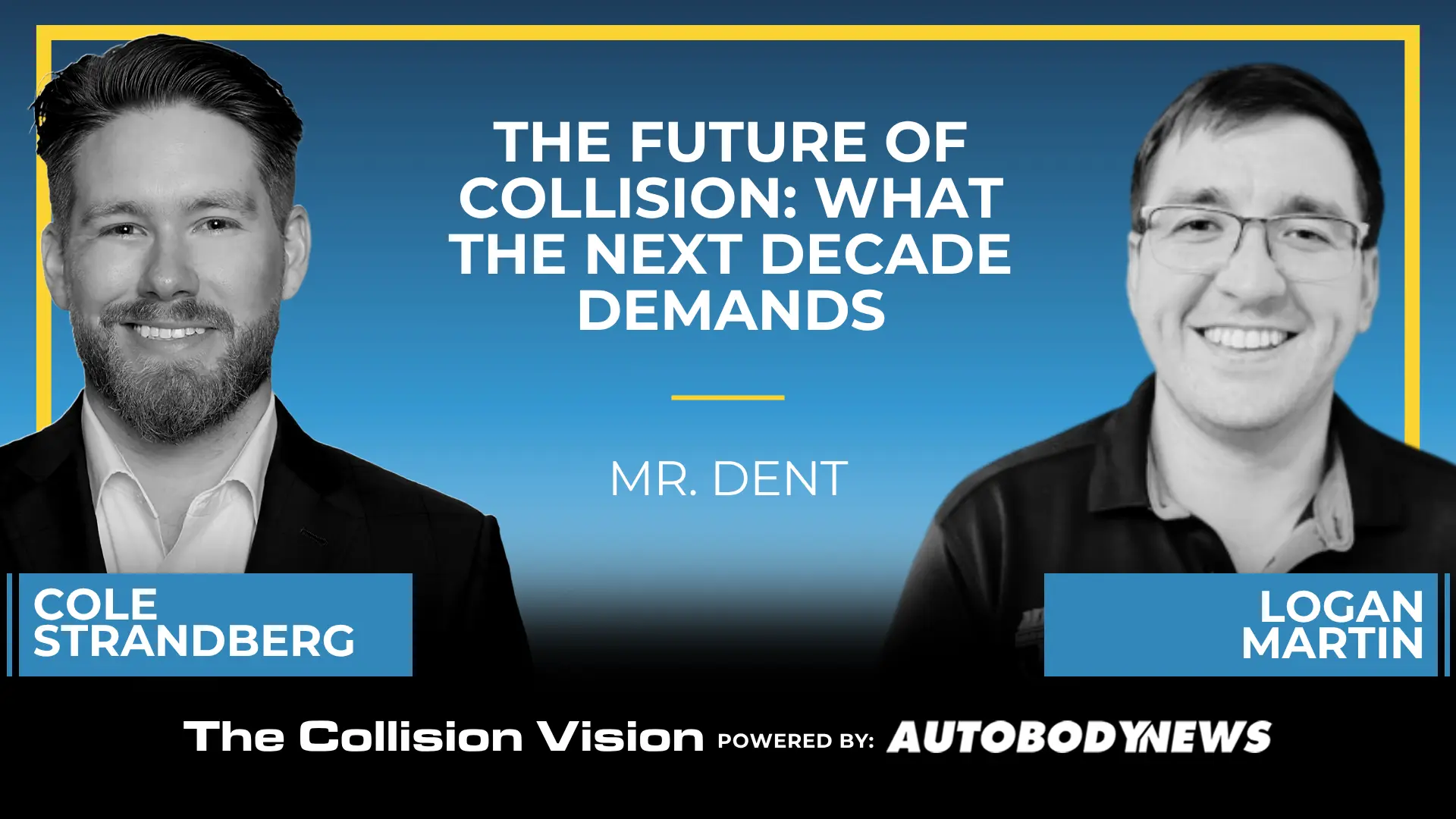
On a recent episode of The Collision Vision, host Cole Strandberg sat down with Logan Martin of Mr. Dent Collision Repair.
Martin’s parents started Mr. Dent in 1993 in West Plains, Mo., offering paintless dent repair alongside collision repair. Martin studied accounting and worked as an accountant for three months before deciding desk work wasn’t for him. When his father raised the idea of a second shop, Martin became a 50-50 partner in that location, which opened in 2017.
A third location followed in 2021 when the Martins bought the Ozark, Mo., shop from the Bellm family. It later moved into a new greenfield facility. The company has also broken ground on a fourth location in Republic, Mo. Martin said his father would still be considered CEO, while his own role resembles that of a regional COO.
On the episode, he talked about where vehicles and claim counts are heading, how Mr. Dent finds and keeps technicians, and why he thinks regional operators are well positioned.
Martin expects a widening gap between average and great shops
Asked how business has been going, Martin said Mr. Dent has avoided many of the headwinds facing the industry. He credited some weather events and the company’s execution at the store level. He also said he believes the industry is in a lull that will last a while.
“I feel like these next five years [are] going to be a big separation between the good stores and the average stores and the great stores,” Martin said.
He compared the moment to the arrival of unitized vehicle structures in the 1970s and 1980s, which he knows from his father’s stories. When vehicles moved away from body-on-frame construction, Martin said, “that separated a lot of people because it required a different skill set to fix.”
Martin said operators should plan for fewer accidents as advanced safety features spread. “If you’re not sitting here as a collision repair operator and looking into the future, five years, and you don’t think that claim count is going to go down or accident is going to decline, I think you have your head buried in the sand a little bit,” he said.
He is also watching what robotaxis and driverless vehicles could mean for car ownership. He said he has seen projections that point in different directions. “To me, that is the biggest unknown is what vehicle ownership could look like in five to 10 years,” he said. He expects metro markets to feel those changes well before rural Missouri does.
Key takeaway: Martin said he expects the next five years to sort shops into good, average, and great, much as the move to unibody construction once did. He said operators should plan for declining claim counts, while the effect of autonomous vehicles on ownership is the biggest open question.
Bringing sublet work in-house addresses a rural market problem
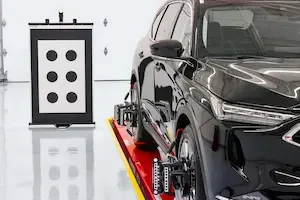
Mr. Dent has moved calibration and mechanical work in-house. Martin said the decision came from seeing room for improvement in how the company processed vehicles. “Being in a rural market it can sometimes be difficult to get the services that you need in a timely manner,” he said.
He credited Hunter Engineering with helping bring that work in-house and said doing so “helps us with cycle time.”
He also sees the capability as preparation for driverless vehicles, which he expects will need ongoing maintenance. He is not sure whether that work will go to collision shops or mechanical repair shops. “If that falls towards the collision repair side, we’ll be well-versed in being able to handle that and take care of it,” he said.
Asked who is asking shops to prove a repair was done right, Martin said insurers and other third-party payers still drive most documentation requests. He said most consumers don’t ask for it, but documentation benefits shops from a legal and liability standpoint.
He has noticed one change on the consumer side. “We are seeing customers come in more educated than what they have been in the past with the use of AI,” he said.
Key takeaway: Martin said in-house calibration and mechanical work improved cycle time in a rural market and could position the company for future autonomous vehicle maintenance. Hesaid payers still drive documentation demands, but customers who research their repairs with AI are arriving better informed.
Martin says scale has made Mr. Dent a better repairer
Strandberg asked how single-location shops can keep up with vehicle complexity. Martin said he expects more single stores to specialize, as some auto repair businesses already have by focusing on foreign, domestic, or specific brands.
At Mr. Dent, he said, growth has improved training and know-how. “When you’re fixing that many cars, chances are somebody’s seen that problem,” he said. He gave examples such as a quad-coat paint code or a calibration issue someone at another store has already worked through.
He said the company’s industry connections have also expanded. “We’ve done nothing but get better as we’ve gotten bigger. And I think that’s a trend that not a lot of people talk about,” Martin said.
Key takeaway: Martin said running more stores has given Mr. Dent a deeper shared pool of repair experience and stronger industry connections.
OEM certifications pay off through the dealer service drive
Strandberg asked what separates an OEM certification that earns its return from one that doesn’t. “What we found is the dealer relationship is crucial with any OEM certification,” Martin said. In his markets, he said, many customers call the dealership service drive for a referral rather than use OEM shop locators.
He sees a possible change ahead as more people use AI tools as search engines. In those results, he said, “we’re seeing that it’s pulling a lot from these OEM locators.” That could give certified shops an advantage, though he added, “I’m not 100% sold that’s the way it’s going to go.”
On building dealer relationships, his advice was short: “Man, you just got to add value.” He said many dealers already have a shop they’re happy with, so the work takes patience. “Those dealership drives, they take a long time,” he said.
Key takeaway: Martin said OEM certifications earn their keep through dealer referrals, and AI search tools drawing on OEM locators could make them more valuable.
Marketing builds a business customers seek out by name
Martin said the industry often waits for someone else to supply its work. “I feel like this industry is guilty of relying on somebody to send you work, whether that be an insurance partner, a fleet partner, or a dealership partner,” he said. He said that model has worked for a lot of shops.
He said building a brand through marketing produces something stronger. “In my opinion, you build a lot healthier business that way because then ... they’re coming to Mr. Dent for Mr. Dent,” he said.
He said marketing has two requirements. The first is quality creative. “If you’re paying for an ad with crappy creative, you’re just wasting money,” he said. The second is a budget large enough to reach customers often. He aims for about once a week, using organic and paid social media together.
Location matters too. Martin said the Ozark store’s move to a greenfield site facing six lanes of highway traffic produced a strong jump in business. “I didn’t give near enough credence to highway visibility before,” he said. The Republic store will sit on the main road into town.
Key takeaway: Martin said strong creative, steady frequency, and highway visibility help a shop build its own customer base instead of relying only on referral partners.
Apprentice investment carries real risk and earns real loyalty
Asked how Mr. Dent finds people despite the technician shortage, Martin was blunt. “There’s nothing that fires me up more than when people are like, ‘Oh, we can’t find nobody. There’s nobody who wants to work in America anymore.’ Like, to me, that is the laziest view that a person can have,” he said.
He said employers should look inward first. “Maybe you need to look at yourself as an organization, which is what we did, is like, are we actually providing an opportunity?” he said.
Mr. Dent has rolled out apprentice training programs over roughly the past 12 to 18 months. Martin expects to staff much of the Republic store with people developed inside the company.
He was candid about the cost. An apprentice recently quit after the company had sent him to a training course costing roughly $15,000, on top of nine months in its mentorship program. “We probably had a smooth 30k in him,” Martin said. Mr. Dent doesn’t use retention contracts. Instead, apprentices earn their spot, often after proving themselves in roles like the wash bay. Martin said the first year can cost $30,000 to $40,000 per apprentice once mentor pay, tooling, and training are counted.
He said the return is loyalty from young workers who want a path to a six-figure income. “If you finally can lay out a path and you have checkpoints and ... they see a future where they can make that, then people will run through brick walls for you,” he said. He called it “loyalty that you’re not going to be able to buy.”
Key takeaway: Martin said a structured apprenticeship can cost $30,000 to $40,000 in its first year, but a clear career path builds loyalty money alone can’t buy.
Regional MSOs combine local knowledge with room to advance
Strandberg said he has found a hiring sweet spot at the regional MSO level, between single stores and national consolidators. Martin agreed and pointed to direct access to ownership. “Every employee has me or my dad’s phone number,” he said. He said Mr. Dent could be approaching 80 employees a year from now.
He also said regional operators know their markets better. An owner-operator, he said, is “going to know the market better than a CEO sitting in Dallas somewhere.”
Martin acknowledged that regional groups won’t get some national MSO advantages, such as certain DRP agreements and size-based discounts. Still, he said, “that is your competitive edge is the fact that, hey, you can provide upward mobility that a single store can’t.”
Key takeaway: Martin said regional MSOs can offer career growth single stores can’t and local market knowledge national operators lack.
Martin’s outlook calls for fewer shops and less competition
In a closing rapid-fire round, Strandberg asked for the biggest change in collision repair five years from now. “A lot less claims, a lot less wrecked vehicles,” Martin said.
On spending shops will regret, he pointed to overpaying for something they can’t add value to. Before opening or buying a store, he said, the question is “can I bring value to this and make this better or can I not?” He said the same test applies to bringing on an apprentice.
On where shops underinvest, he named people and marketing. “Picking up a phone and doing some organic content is 100% free,” he said. He added that operators often treat their people as “a soft cost.”
Asked whether there will be more or fewer shops in 2031, he said fewer and described the next five to seven years as a rough stretch. He said shops that come through it will face less competition: “If you can ride the wave and you get to the other side of it, you’re going to have less competition.” He added, “I don’t think that collision repair is going anywhere. I do think it’s going to get smaller.”
Key takeaway: Martin said falling claim counts will shrink the number of shops, but those that make it through will face less competition.
Throughout the episode, Martin returned to the same few priorities: plan for fewer claims, invest in people and marketing, earn dealer relationships, and grow only where the business can add value.
He said people can follow Mr. Dent through its website and its Facebook and TikTok accounts, or reach him on LinkedIn. “I’m an open book to pretty much anybody,” he said.
Lisa McArdle