Sooner or later, collision repair groups working with AI run into the same question: should they build their own tools or buy them? The answer affects what they spend, who they hire, and how much upkeep they sign up for. Research from last year leans toward buying. For its report, The GenAI Divide: State of AI in Business 2025, MIT's NANDA initiative reviewed more than 300 public AI projects, interviewed 52 organizations, and surveyed 153 leaders. Among the organizations it interviewed, projects built with outside vendors or partners made it past the pilot stage about two-thirds of the time, compared with about a third for internal builds.
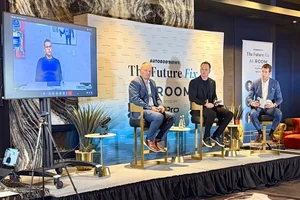
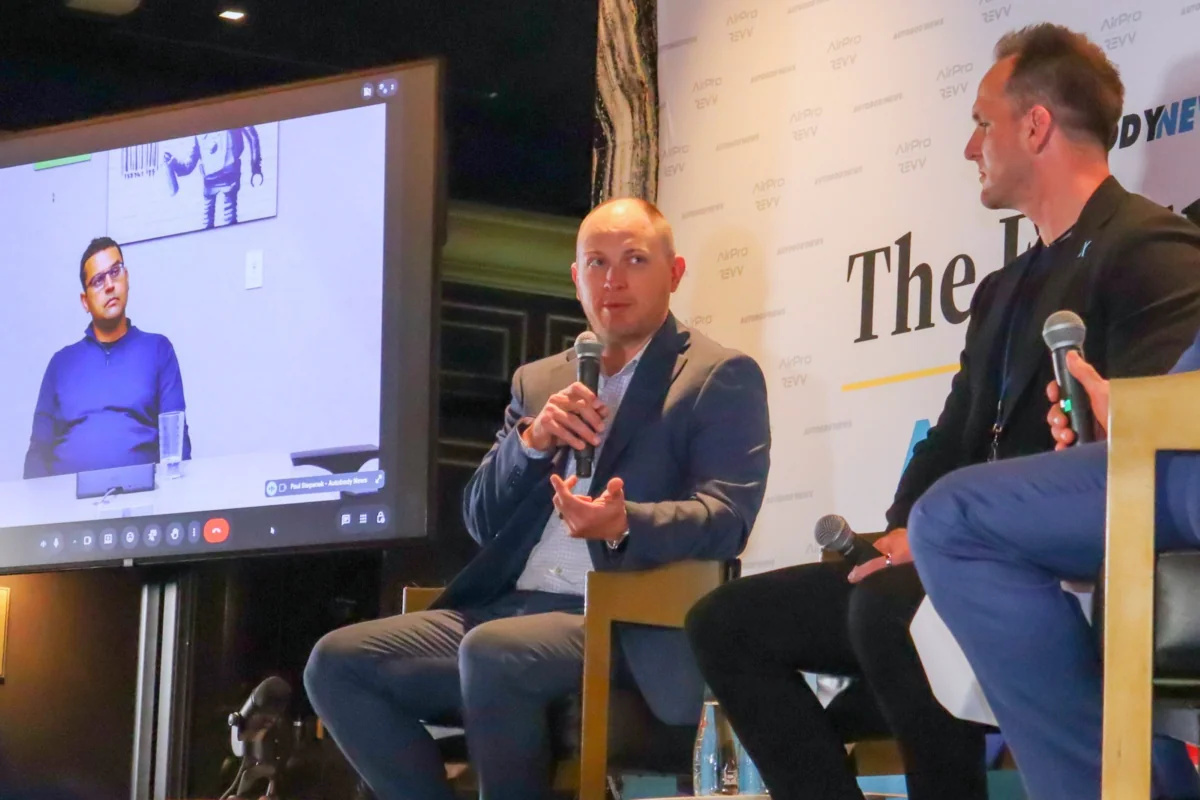
Two operators who spoke Nov. 3 at the Autobody News Future Fix AI Room, presented by AirPro + Revv, in Las Vegas build their own anyway. Taylor Moss is vice president of strategic development at Quality Collision Group (QCG). Jonathon Best grew Better Collision from one shop to 10 and is founder and CEO of BetterX. On the panel with Jinal Dalal, a director of engineering at Google who leads AI and machine learning infrastructure, they discussed which operators should build their own AI and which should buy it.
Dalal sorts operators by scale and structured data
Dalal said the decision comes down to two things: how many shops an operator runs and what data it has about its own operations. Before bringing in AI, he said, an operator should know how much of that data is structured. Shop photos, for example, become far more useful once they're converted into data that can be searched by part, VIN, and repair type.
He then sorted operators into three groups:
- Groups with a small number of shops. "If you don't have this data to begin with, then clearly you need to start with some kind of a buy," Dalal said. These operators need an off-the-shelf tool they can make useful from day one.
- Groups of 100 to 1,000 shops. These operators usually have a lot of data sitting unused that needs converting. They're also big enough to run experiments with vendors or partners on their specific use cases.
- Groups at the 1,000-shop level. They can use their data to customize the whole process, and those gains show up in margin. They should still buy anything already solved at scale, such as a chat interface or a newsletter tool, where their own data wouldn't change the outcome.
The number to test, Dalal said, is the error rate. "There is tremendous amount of misunderstanding, especially around error rates, that you will not understand until you actually run some experiments," he said. His advice was to validate a system against one specific metric for about a month before counting on it.
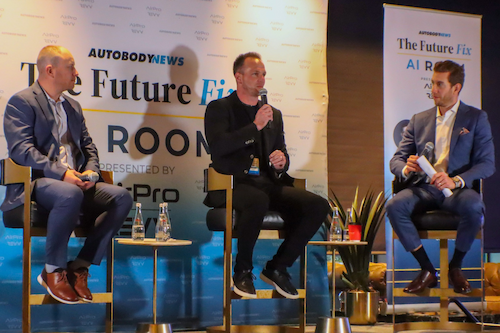
Panelists Taylor Moss and Jonathon Best with Nathan Gregory from Autobody News.
A 10-store group usually buys, unless it has a builder
"This is what my whole job is: do we build, do we buy," Moss said of his role at QCG.
For a group of about 10 stores, his answer leans toward buying. "For a roughly 10-store MSO, I would say there's gonna be a lot of buying happening, unless you have a really interesting product-minded person like Jonathon leading your organization," he said.
His other exception is a need that no vendor or partner can meet. "If that's the case then you absolutely need to build," Moss said, because a process that's valuable to one operator may not fit how others work. Building can also mean hiring a contract developer, which blurs the line. "Is a contractor building or is a contractor buying?" he said.
Best, whom Moss named as an example, started with the phone. Earlier in the panel, he said Better Collision's first build aimed to raise the share of incoming calls that turn into repairs, with each captured job worth about $5,000 on average. "That was a metric that didn't really exist that nobody was looking at in the industry," he said.
Better Collision also set out to tame the software it has to run, nine to 12 tools the group uses to appease its insurance carriers. "It's just sprawling and exhausting," Best said. The group tried to pull those tools into one system, found it didn't have the bandwidth, and hired an engineering team.
That work has gone on for more than a year at massive expense, Best said. "We've built and if it breaks we just keep breaking it and building again," he said. With the tools in one place, the team then automated as much of the shop's administrative and repetitive work as it could.
Bigger groups have more room to build, up to a point
Moss sees much more room to build at 100 stores or more, which includes QCG's roughly 100 locations. Groups that size can bring people on staff, and AI now lets them build quickly, he said.
That pace is a change for Moss. When he founded Estify and Repair Logic, building software for collision repair shops took years and teams of people. "I think we built more in this past year with my time at QCG than I built my whole career in a dozen years before that," he said.
"Building internally makes sense, but you really need a strong product person," Moss said. The largest groups have even more opportunity, he said, but also the challenge of getting each store to adopt the tools.
To decide where QCG's AI investment goes first, Moss listed the group's biggest opportunities and biggest costs when he joined and sized each one, assuming even 10% capture of an opportunity would be a win. Then he assigned each a probability of success, such as 50% or 10%, and ranked the list. "We have hundreds of things that we could work on with AI, but it's like which ones move the needle enough to actually invest in," he said.
Even the largest groups shouldn't build everything, Moss said, pointing to a chat app built on a model like Gemini or Claude. Those already exist. "Is that a good use of your time? Probably not," he said.
Best raised a related question for the largest consolidators: is there any benefit to building a frontier model, the large AI system underneath today's tools? Dalal said no. Improving a frontier model takes months and a great deal of infrastructure, and open-source models that can be fine-tuned will be freely available over time. "It's not a very prudent thing to do from a cost standpoint," he said.
Building with AI is never finished
Teams consistently underestimate how long it takes to test whether an AI system works reliably, Dalal said.
A first working version comes quickly and is valuable for proving an idea, he said, but getting it ready for production takes almost twice as long as teams expect. Without ongoing testing and feedback loops, a system can break as soon as a new model arrives or the underlying data changes. Operators should factor that ongoing support into the build-or-buy decision, he said.
Asked what an operator should never build, Best didn't name anything. "I don't think anything's off limits," he said. "If we can automate it we wanna automate it." Moss agreed, though he allowed there "might be a few" areas AI can't touch. "I don't think there's any part of this business that doesn't make sense to have AI do something for it," he said.
Dalal came back to the question later in the panel. "I think we have to try everything with AI even if it is expensive today," he said. Costs are falling so fast, he said, that steps done by hand today could be handled by AI agents at far lower cost within about six months. Even at Google, a project that failed for six months started working once a new model arrived.
Best said the pace is constant. "There's a 20-year problem today and tomorrow by lunchtime it was solved," he said. Earlier in the panel, he put the stakes this way: "You're not gonna go invest into a button and then now you have the button. It's a commitment. It's a lifelong commitment for your company."
Moss said the pace shouldn't stop anyone from starting. "There are very small bets you can start to make, start to learn, start to implement, start to test," he said. "You do need to be doing those things, or else you will get way behind."