

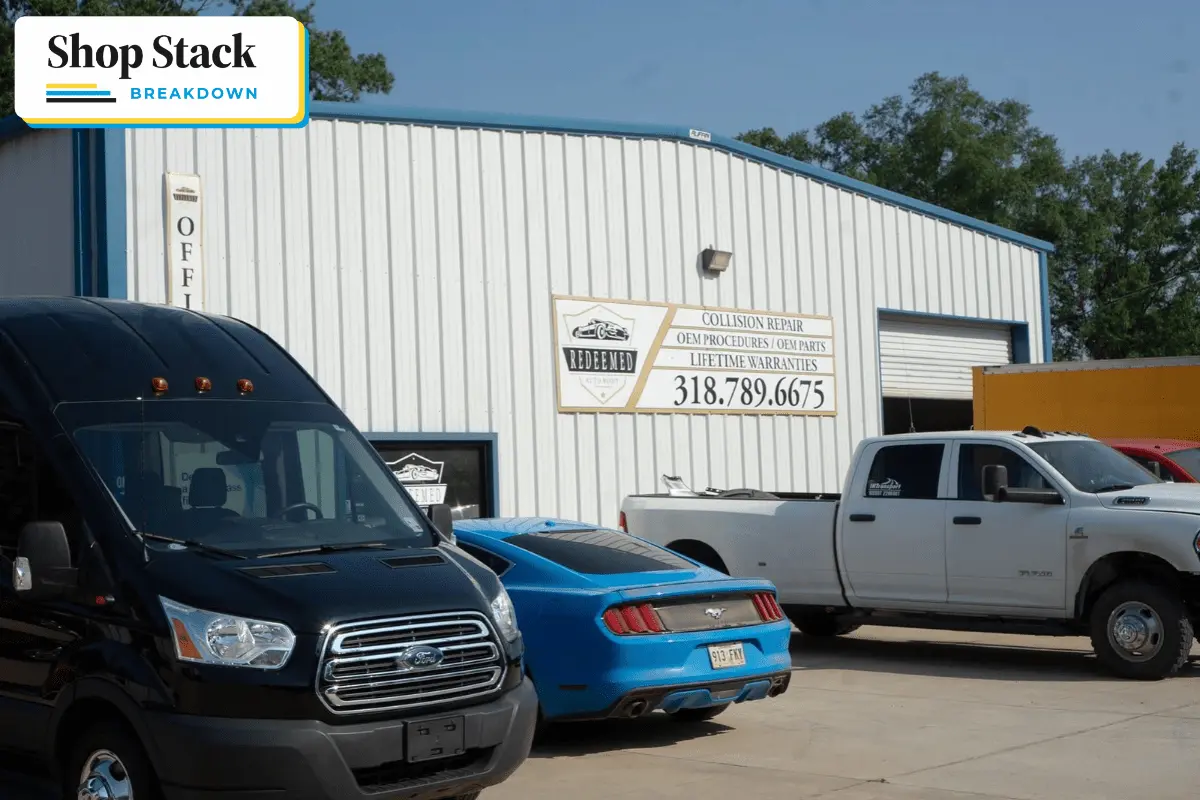
Walt Silmon, owner of Redeemed Auto Body in West Monroe, La., traces his start in collision repair to a job as a carhop at Sonic about 20 years ago.
A regular customer from the restaurant who drove a 1970 Dodge Challenger and restored cars at his own shop invited Silmon over and later showed Silmon how to fix the damage on an old truck Silmon owned. Silmon took his first body shop job around the same time and worked his way up before opening Redeemed about six years ago.
“I started with no money and no help and no equipment and no nothing,” he said. He said he wanted to “create a good shop environment for myself and for other people.”
Today, the single-location independent shop has five employees. Silmon described his vantage point as that of “the small shop, newer shop.”
Silmon runs the business on CCC for estimating and shop management and on Podium for customer communication and payments. He is also using an AI tool to build his own follow-up system, which he said is meant to keep any customer from being overlooked.
THE STACK
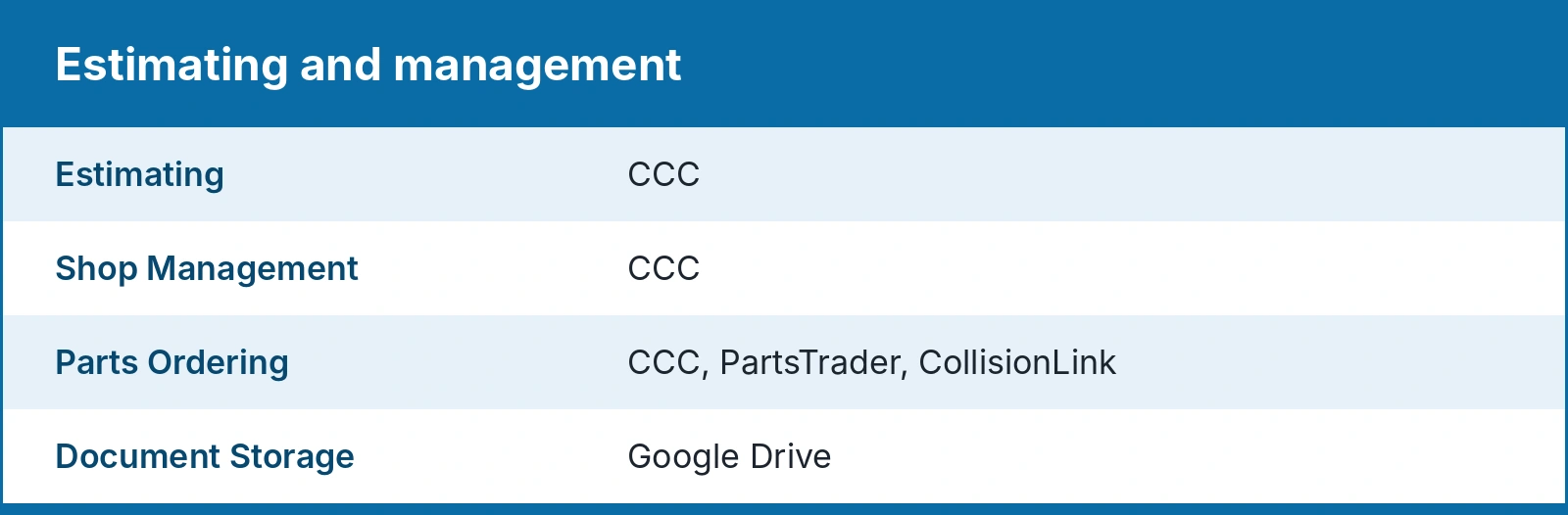
Redeemed runs estimating and shop management through CCC, and parts orders start in CCC. “We always try to run everything through CCC just because it makes invoicing and purchase orders easier,” Silmon said.
When the shop needs a better price to help a customer get all-OEM parts on a job, it looks elsewhere. Silmon said Redeemed buys from its preferred GM and Ford vendors only through CollisionLink, because those vendors normally give the shop good deals. For other parts, the shop uses PartsTrader to see offers from several vendors at once.
Silmon called Google Drive, which he has used since opening, his “digital filing cabinet.” He said only job invoices go into CCC, and nearly everything else is stored in Drive. Typing any detail from an invoice, even one from three years ago, will likely bring it up within seconds, he said.
One piece of Redeemed’s stack doesn’t come from a vendor. Silmon is building his own internal accountability system, designed to catch every new job and flag when a customer needs a call or a job needs to move.
“I really just wanted to create some sort of a system that automatically picks up the new jobs, so it’s in the system, and then it’ll automatically remind us to do something with that job or remind us to contact that customer,” he said.
He is building it with Grok, an AI tool he said turns his descriptions into working software. To add a feature, Silmon said, he describes every detail he can think of, shares screenshots of examples he likes, or draws a picture of how a page should look. The tool then builds it “without you having to know how to write code or know how to create a website or anything,” he said.
Changes work the same way. Silmon tells the tool what to do differently, giving instructions like, “Hey, instead of it doing this, whenever this happens, do this, or you know, take this away and add this.”
When the shop creates a new work file in CCC and saves and closes it, the system pulls in the job information and requires the team to act on it. Silmon said each job carries a needs-contact or needs-movement button, meaning staff must either call the customer or move the job forward. The reminder resets based on the job’s stage. Vehicles on site come due for a customer update every two days. New leads and jobs waiting on parts before scheduling reset on about a seven-day cycle.
Silmon said that between walk-in estimates, phone calls, and emails, it is easy to forget a callback, a parts order, or an estimate. If a shop writes estimates for 10 people and fails to call two back, he said, those two are lost.[JF1]
The system is for staff only, but Silmon said customers appreciate the timeliness.
“I think clear, honest, and proactive and consistent communication can cover so many bad situations or anxieties or whatever during this repair process for every customer,” he said.
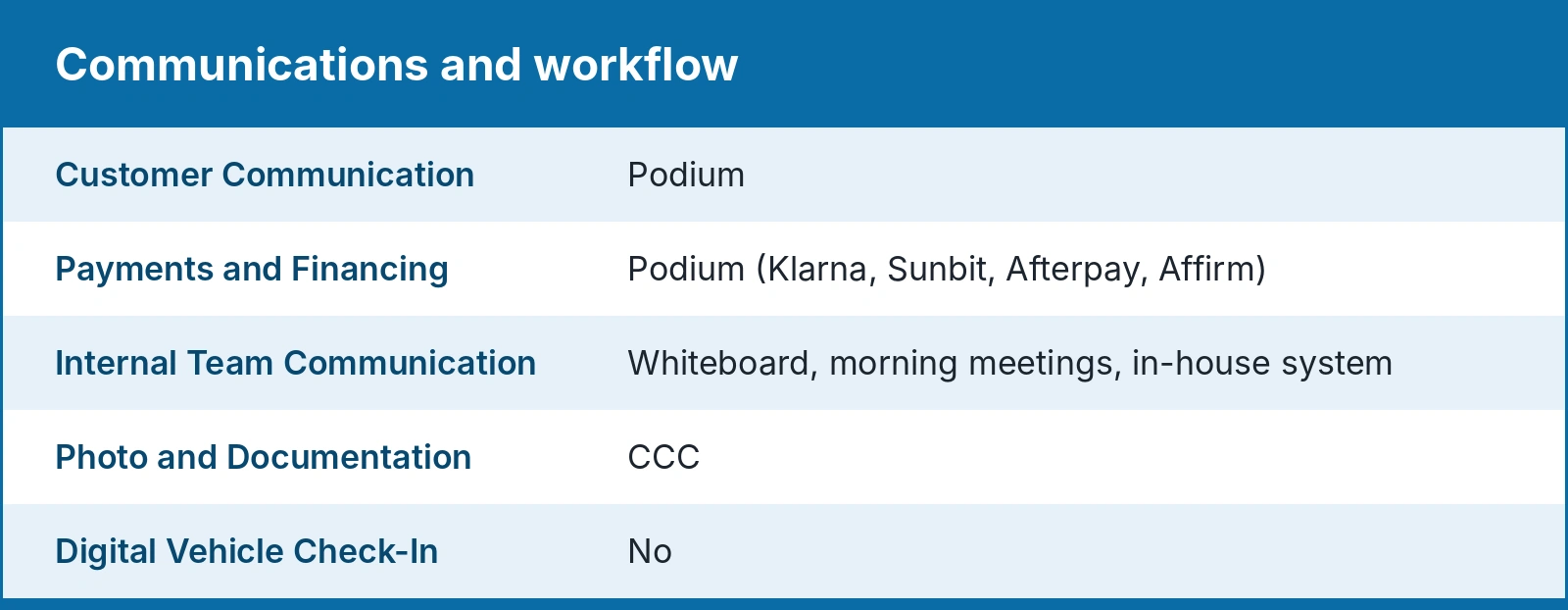
Redeemed handles customer communication through Podium. Silmon said he considered switching to RingCentral, but stayed with Podium for its payment processing and payment assistance options.
Podium’s CCC integration sends customers an automated review invitation when a job is closed out. Silmon said the shop used to send those invitations manually. “I think more shops need to get more reviews,” he said.
Podium’s payment assistance runs through Klarna, Sunbit, Afterpay, and Affirm. Silmon said it helps customers cover deductibles, costs insurance doesn’t pay, or repairs they choose to pay for out of pocket. In a feature on what he is hearing from shops around the country, CCC’s Craig Stevens pointed out that consumer financing remains missing at many collision shops.
An analog whiteboard remains part of the daily routine. Silmon said the shop is small enough to still use one. At each morning team meeting, the shop writes out the goals for the day and the week.
“I think it’s still a good, old-school way to have a morning meeting and keep everybody accountable on a daily basis,” Silmon said.
He is also building a page that updates as jobs change and can be displayed on a big-screen TV in the shop, mirroring the whiteboard digitally. A similar size-driven approach shows up at Cliff’s Body Repair in Scotia, N.Y., where the team meets with technicians twice a day to go over where jobs stand.
Redeemed doesn’t use a separate digital vehicle check-in tool. Instead, staff document each vehicle in CCC with photos and job information.
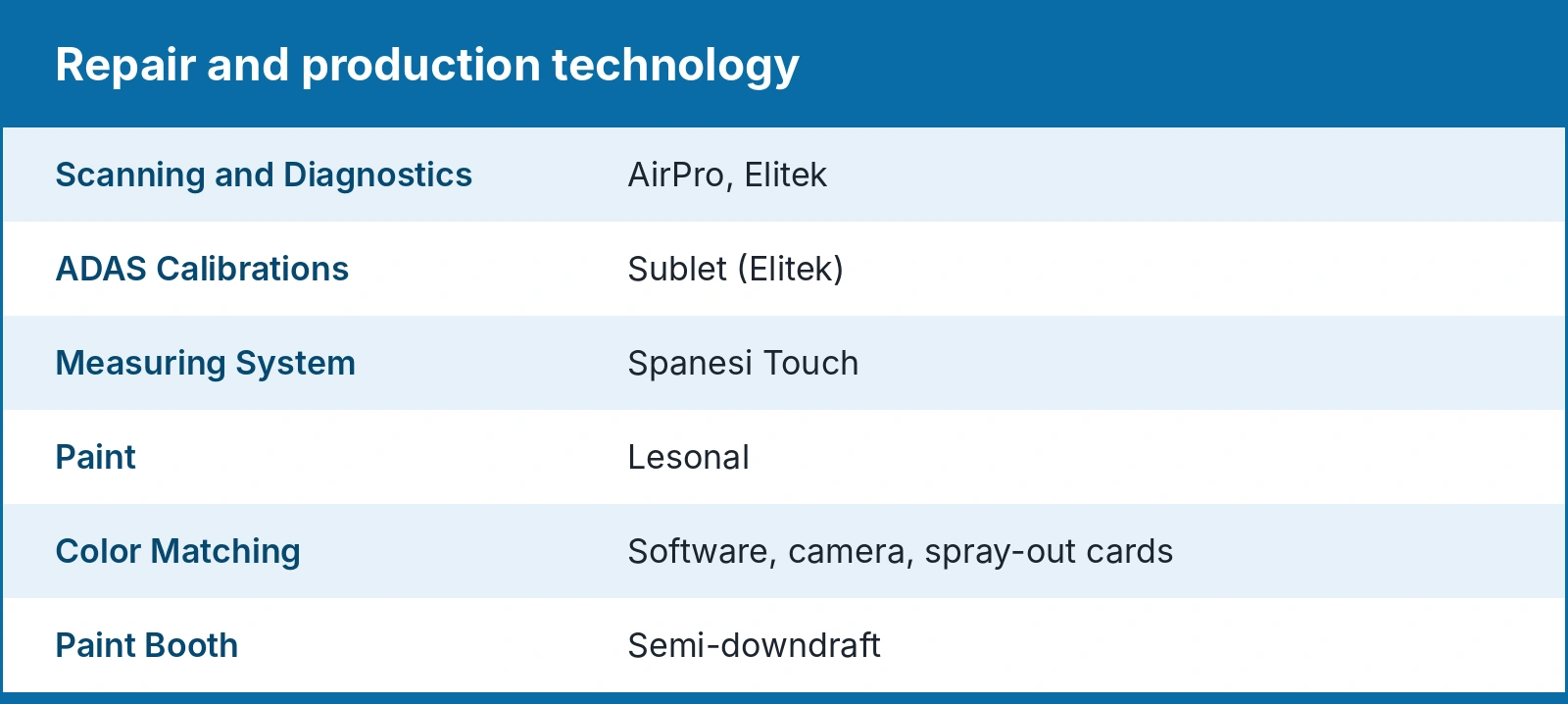
AirPro is the shop’s first option for scans. “Their customer service is amazing,” Silmon said.
When AirPro can’t complete a job, the shop calls Elitek, which sends a technician to the shop for calibrations and scans. Silmon said he prefers that route over the local dealers.
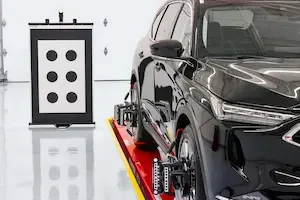
For measuring, Redeemed uses Spanesi Touch. Silmon said the tool is especially useful during appraisal because it can measure a vehicle wherever it sits: on a two-post lift, on the ground, or in the parking lot with a wheel removed. He said it can also measure parts off the vehicle, such as a steering column on a rack, and check wheel camber.
“Everything’s measured in millimeters now, and millimeters make a difference,” he said, adding that the system is easy to set up and use.
The refinish department runs a semi-downdraft booth and Lesonal paint. Painters match color using software, a camera, and spray-out cards, following the paint maker’s product data sheets.
What technology could you not live without?
Asked which piece of collision shop technology he could not run the shop without, Silmon pointed to the estimating system.
“The estimate system is basically how you make your money,” he said. “If we didn’t have the estimate system kind of helping us generate our income, then we wouldn’t have anything at all.”
Silmon called CCC “the king of estimating” and said “it’s the best tool that we have.”
He described a clear division of labor across the stack. “CCC takes care of the numbers and the metrics of each job and then my customer management system makes sure we keep up with people,” he said.
If it came down to a single platform, though, the choice is easy for him.
“If we can only keep one thing out of our software stack, I would keep CCC just because I can do everything else with a cell phone and a pen and paper,” he said.
Want to see your shop’s setup featured in Shop Stack Breakdown? Every edition profiles a collision repair shop and the technology behind its operation. Fill out our intake form and we will be in touch.








Lisa McArdle