

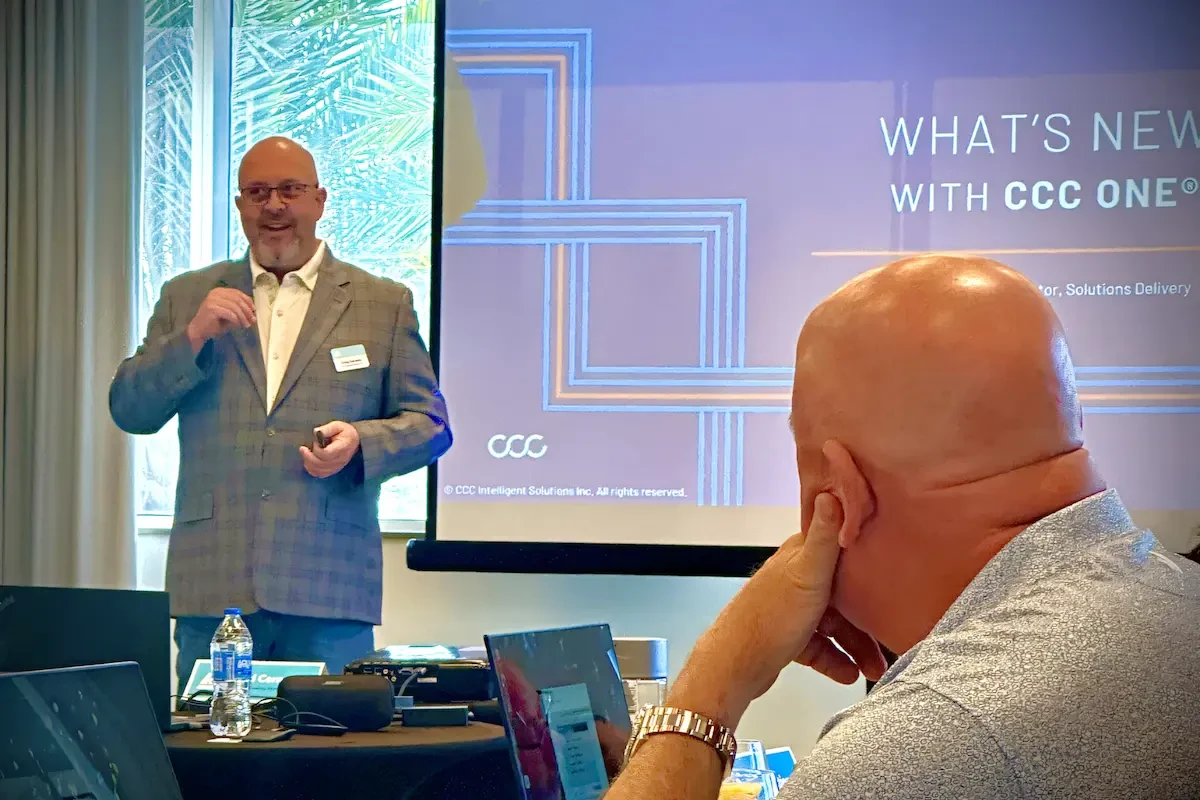
Craig Stevens has spent 33 years in this industry: 12 on the carrier side, then a jump to collision repair, and the last decade at CCC Intelligent Solutions, where he now serves as director of solutions delivery. For the past year, he's been crisscrossing the country through a video series and live presentations, collecting unfiltered feedback from shop owners, estimators, and technicians. What he's found is both encouraging and sobering.
"The two biggest things I hear out there all the time, whether I'm one-on-one at a shop or in front of an audience, are: what are you hearing across the industry, and what's new that I should know about?" Stevens said. "They want to know if there's regionalized information they're not hearing. And they want to know what's coming around the corner."
What follows are the lessons Stevens believes shops most need to hear heading into 2026.
Your digital front door matters as much as your actual front door
Stevens explains there’s often a gap between shops that are exceptional at fixing cars and shops that are good at running a business. They are different things, and both are really important.
"A lot of collision repairers got in the industry to fix cars and aren’t as studied on all that comes along with running and marketing a business," he said. "They're good at fixing a car. Many of these guys are artists in what they can do with bringing a car back to life.”
The example he returns to repeatedly: a customer has an accident at 10 p.m. and turns to Google. No matter what happens next, that search result is the first impression — and for many shops, it's where the relationship can end before it begins.
"No matter how beautiful your shop is, no matter how charismatic your front-end people are, you're still dependent upon that Google search to capture that initial interest," Stevens said. "They could be sitting there in a search and never find you if you’re shop isn’t served up in the findings."
That means claiming and actively managing your Google Business profile, responding to every review whether positive or negative, and understanding the basics of how search ranking works. Stevens acknowledges the subject matter would have seemed foreign to him not long ago.
"If you ever told me 20 years ago that I'd be talking to you about SEO, I'd say you were crazy," he said. "But now all of a sudden it's just something we all have to understand."
Beyond reviews and search visibility, Stevens encourages shops to make sure their website gives customers something to do, specifically the ability to submit photos of their vehicle. A customer who can start the intake process from their phone at 10 p.m. is one you've captured before they wake up the next morning and find a competitor.
Self-pay is climbing, and shops need a financing solution
Stevens has been tracking a meaningful uptick in consumers paying out of pocket rather than going through their insurer, a trend he says is showing up in CCC's industry data. The reason isn't surprising: people are concerned a claim will raise their rates, or their deductible makes a claim impractical.
"Consumer pay is going up," he said. "And if they're going to pay out of pocket, the next challenge is how are they going to afford it.”
Stevens points out that shops are behind other service segments on this. Tire shops offer financing. Transmission shops offer financing. The infrastructure exists and customers are accustomed to using it. Yet many collision repair shops still don't have a consumer financing option in place.
"You get paid, and now they're dealing with a finance company," Stevens said. "They're not saying, 'Can you hold on the repairs for a week?'"
Several financing products are available that aren't tied to any specific platform or vendor. Stevens' point isn't to advocate for any one solution but to push shops to have one. The customer who needs financing to fix their car isn't going away. The question is whether your shop is positioned to serve them or whether they'll find one that is.
AI is entering the estimate lane, and it's not what shops are afraid of
Every presentation Stevens gives comes with the same question from the audience: Is AI going to replace my job?
His answer is no. The more useful conversation, he says, is about what AI is actually doing in the shop right now.
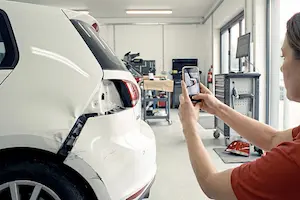
Stevens described CCC's AI-enhanced mobile estimating tool within CCC ONE as one concrete example of how the technology is being deployed. The mobile app already has 82,000 individual users, allowing shop staff to photograph a vehicle and begin a work file before they walk back inside. The AI layer builds on that: it compares damage photos against a database of historical estimates and outcomes and generates a probability-weighted repair recommendation.
"It'll say there's a 95% chance that fender is going to have to be replaced," Stevens explained, "because it looked at AI models and said a very similar picture with the final bill resulted in a replacement of that fender."
What interests Stevens most isn't the technology itself but the staffing implications. For years, putting someone in front of a customer to discuss damage and dollars required significant estimating experience. That's no longer strictly true.
"It loosens up the shop from individual roles," he said. "My charismatic front-end people can capture the job, build the trust, have a relationship with the customer and give them an idea of how much they're looking at before we even bring the car in."
Tenured estimators, meanwhile, can concentrate their time on vehicles already in the shop and presenting more complex damage. The broader point Stevens makes about AI is one he repeats across all of his presentations: the technology is being built to help people do their jobs better, not to eliminate them. But shops that ignore it are at a disadvantage to competitors who do.
Training degrades faster than most shops realize
Stevens has a way of describing the training problem that tends to produce knowing looks from shop owners in his audiences. He calls it the degradation of training.
"Johnny, when he was leaving, trained Jenny," he said. "But Johnny trains Jenny on the way he uses it. And when Jenny goes to train Timmy, Jenny's like: I don't do this, this, or this. Just click here and put this in here. That's it."
The result: shops that received thorough training several years ago may now have staff operating with a fraction of that knowledge, filtered through several rounds of informal handoff. Add industry turnover on top of that, and it compounds further. Stevens makes the point directly when he's in front of a live audience.
"I'll stand in front of an audience of 200 people and say, ‘By a show of hands, how many of you know every nook and cranny of CCC ONE and how to use it?’" he said. "Almost nobody raises their hand."
For shops, the practical takeaway is twofold. First, don't assume that because someone was trained, they're still operating at that training level. A quick audit of how staff are actually using your estimating platform, compared to how they could be, often reveals significant gaps.
Second, look for training resources that exist outside the person-to-person chain. CCC's migration of CCC ONE to a web-based platform has made this somewhat easier: updates now roll out to all users simultaneously rather than requiring a field visit or manual installation. That also means new features arrive faster than any internal training process is likely to keep up with, making ongoing, accessible training more important than ever.
The talent pipeline isn't broken, but it needs attention now
Stevens spends significant time with vocational programs and SkillsUSA, and what he sees concerns him. A collision repair class might start the year with 35 students. By senior year, that number is closer to 10. Of those, a handful compete, and perhaps one or two actually enter the industry.
The wage competition is real. A student who finishes a collision repair vocational program can often make significantly more starting out at Amazon, UPS, or even a fast-food chain.
"Are they going to stay in collision repair if they see a dollar sign and they're going to make more?" Stevens said. "That's a problem."
But Stevens is equally quick to say that money isn't the whole story. What he consistently hears from shops with strong retention is that technicians stay where they feel supported: where I-CAR certifications get funded, where the equipment is adequate, where someone invested in their development rather than just running them through a trial period.
"It doesn't always come down to the dollar," he said. "Is it easy for me to do my job? Do I have all the tools? Is it a safe environment? Is it a clean environment?"
His message to shop owners is that they can't afford a passive approach to this anymore. Stevens visits vocational programs regularly and encourages shop owners to do the same, building relationships with instructors and positioning their shops as desirable destinations before students have made their career decisions. He's equally blunt about what happens when new hires do arrive: the old model of running a young technician through a lengthy, menial initiation period before giving them real work is a retention killer.
"You've got to bring this kid in, put them under a mentor, somebody that you can trust," he said. "If we don't keep growing this talent, there won't be a business."
The bigger picture of the industry
Stevens' message across all of these topics circles back to the same core tension: shops are often excellent at the craft and underdeveloped in the business. The good news, he says, is that the gaps are identifiable and the fixes are within reach for most operations.
What strikes him most, after years of touring shops and standing in front of audiences, is that the hunger is there. Shop owners and technicians want to get better. They show up on Saturdays for six-hour training sessions and don't leave early. They take notes. They ask good questions.
"I'm humbled that these shops show up and they're there for six or seven hours," Stevens said. "Nobody leaves. They ask great questions, they take notes. And we really try to use that time to educate them on the tools they already invest in."
For Stevens, that engagement is the whole point. Not the product demos or the QR codes at the end of a presentation, but the conversation that happens when a shop realizes it has room to grow.
"I'll say things like, if you're not using our product, I'm OK with that," he said. "But you should absolutely be involved in what products you're using and make sure they're serving you as a business to help you be successful."
After 33 years on both sides of this industry, that's still the lesson he leads with.



Jess Fritsche