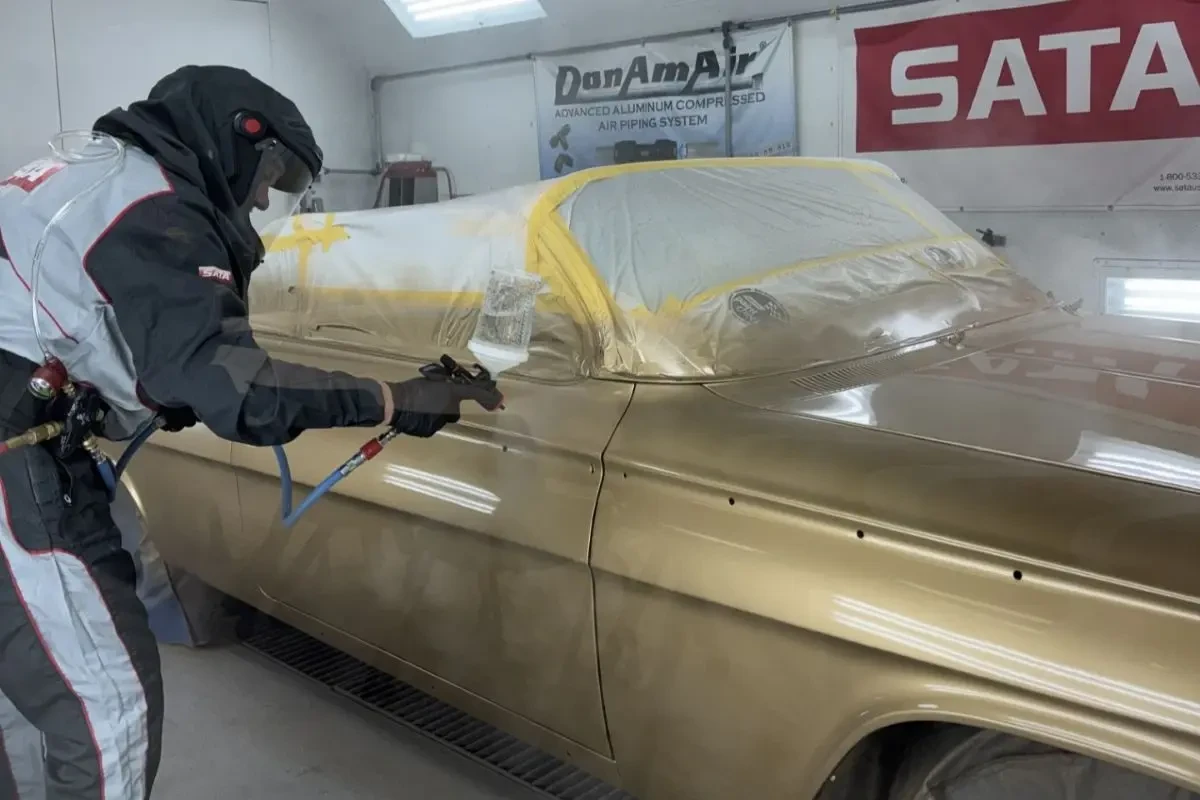
Solvent and waterborne define what shops spray today. A wave of low-VOC reformulation is coming for both, and the shops that get their equipment ready now will feel it least.
For most of the country, the paint on the shop floor still tells a familiar story. Solvent-borne basecoat is the workhorse in a large share of collision shops, and the first article in this series covered how to get the most out of it. That's the reality most painters know, and it isn't going anywhere overnight.
But it's only half the picture. Waterborne isn't a preview of the future. It's a technology painters have been spraying every day for two decades. California legislation that took effect in 2008 pushed waterborne basecoat into the mainstream, and it's been a relevant force in the U.S. market ever since. Environmental regulation drove that shift more than anything else, with OEM alignment and strong color-match performance on newer vehicles reinforcing it.
Today, that means two technologies side by side. What's coming will reshape both, and the shops that understand where solvent and waterborne stand right now will be the ones ready for the changes ahead.
Waterborne Rewards a Cleaner, Better-Controlled Setup
Waterborne doesn't behave like solvent at the air cap. It atomizes differently, carries different application requirements, and expects more from the equipment feeding it. A gun and process dialed in for solvent won't automatically deliver with waterborne, and any painter who's made the switch knows the learning curve is real.
Part of that curve is how unforgiving waterborne is about what's in your air line. Oil vapor that integrates into solvent layers behaves very differently under waterborne, where it floats to the surface and shows up as defects or fisheyes. The same contaminated air a solvent painter never noticed becomes a rework problem the moment the shop moves to water.
That's the bigger lesson waterborne teaches. Spraying it well is as much about your gun setup, your air quality, your air volume, and the equipment behind the gun as it is about the paint itself. The material is only as good as the system delivering it.
Shop Floor Insight: If you're moving toward waterborne and suddenly fighting fisheyes or surface defects you never saw with solvent, don't start by blaming the paint. Check what's coming through your air line first. The oil vapor that meshes with the solvent, waterborne puts right on the surface.
Two Sets of Rules, Depending on Where You Spray
Shops don't all play by the same rulebook. In the U.S., what you can legally spray falls into two broad categories: the national rule that governs most of the country, and stricter low-VOC markets such as California, parts of Utah, and Maryland.
For most shops, the transitions between these worlds happen quietly. Paint companies work hard to roll out new compliant products without forcing you to change or modify the equipment you already own, and most of the time that effort succeeds. You pick up the reformulated product and keep working.
The exceptions are where shops get caught, and California sits at the center of the current wave of change.
Why the Products You Spray Are Changing
The pressure this time is coming out of Southern California. The South Coast Air Quality Management District's Rule 1151, which governs automotive coatings, has been amended to move the industry away from solvents that were previously exempt from VOC limits. No paint company is exempt from the effects.
The mechanism matters, because it's the reason your products are being reformulated at all. A solvent that manufacturers had leaned on to hit their VOC targets has been reclassified and now counts against a product's VOC, the Volatile Organic Compound total that regulators cap. Once that exemption went away, the coatings built around it had to be redesigned.
This isn't a California-only story. When a major paint company reformulates a line, the change tends to ripple nationwide and even globally, because manufacturers don't build and stock a separate product for a single air district. The rule is regional. The reformulated products that come out of it aren't.
The Timeline, and Why Color Is the Hard Part
The changes arrive in stages rather than all at once. The unders come first. Many primers, along with adhesion promoters and single-stage coatings, have to meet their new limits by January 1, 2028, and primer sealers and surfacers follow a year later, on January 1, 2029. Basecoat color and gloss clearcoat get the most time, with both moving to a lower level than the industry has worked with before by January 1, 2030. These dates reflect the rule as it stands today, with the regulation still being finalized. Some product categories haven’t been assigned a timeframe, and you should expect further detail as the deadlines get closer.
The basecoat side gives you a sense of the scale. The color coating limit drops from 3.5 to 2.1 pounds per gallon, a real change to how the material is built.
Color is the reason basecoats get the longer runway. Lowering VOC isn't a matter of pulling solvent out and calling it done.
Think of a matched color like a recipe that's been balanced ingredient by ingredient over years. Take one component out and you can't just leave the gap, you have to rebuild the whole thing to taste the same. Here, that means replacing liquids with solids, and it changes how every one of the tens of thousands of matched colors behaves when it's sprayed.
Each one has to be reworked, on paper and through physical spray-out, before it can be trusted in a shop. That's a much bigger undertaking than reformulating an undercoat, which is why color sits at the back of the timeline with the most runway to reach compliance.
What It All Means at the Air Cap
For you, the abstract regulatory story becomes concrete at the gun. Higher-solids reformulated products spray with a different consistency and a different feel than what you use today. They don't always behave the way your current product does, and that difference shows up in the booth.
As solids content climbs, fluid-tip sizing tends to move the other way. Higher-solids paint takes more energy to break into a fine droplet, so you'll often find yourself stepping down in tip size to atomize it properly.
The practical consequence is that a setup you dialed in perfectly for today's paint may not deliver on what you’re spraying tomorrow. Equipment that's been your reliable standard may need to change as the products do.
This is where air delivery earns more attention than it usually gets. Regulating air pressure at the wall, rather than choking it down at the gun, preserves the air volume a gun needs to atomize properly.
As finishes grow more demanding, that difference gets easier to see, in pattern fullness, in metallic mottling, in how easily a panel blends, and in clearcoat texture and defects. Precise, repeatable control of both air pressure and material becomes more valuable with every step up in difficulty.
Practical Test: When you move onto a reformulated, higher-solids product, watch your first few panels closely. If you're fighting mottle, patchy blends, or texture you didn't get with the old material, resist the urge to just muscle through it. It's usually a sign your tip size and pressure setup need to catch up to the new chemistry, not a sign you've lost a step.
Getting Ahead of the Changes
None of this is a reason to panic, but it is a reason to pay attention. The shops that come through the transition smoothly will be the ones that treat it as a system change rather than a product swap, looking at tooling, process, and painters together.
The practical move is to adapt as new compliant products become available rather than waiting for a deadline to force your hand. Adjust on your own timeline and you avoid scrambling when the new materials land and the old ones disappear. The changes will roll out over the next several years, which means the advantage right now belongs to you if you're paying attention early.
The coatings are going to keep evolving. Making sure the equipment behind your gun can keep up with them is the part you control.
4 Moves to Make Now
1. Know which category you're in. Whether you spray under the national rule or in a low-VOC market shapes how soon reformulated products reach you and how much your process has to shift.
2. Treat your air supply as part of the finish. As you move toward waterborne and higher-solids products, clean, high-volume air matters more, not less. Contamination and starved volume show up on the panel.
3. Watch your tip and pressure setup as products change. Higher-solids materials often want a smaller tip and dialed-in pressure. A setup that's perfect today may need adjustment as the chemistry moves.
4. Adapt early, on your terms. Bring in new compliant products as they become available instead of waiting for a deadline. The shops paying attention now will transition without the scramble.