For collision shops weighing whether to bring ADAS calibration in-house, the first question is almost always about space. A common assumption is that the setup requires an oversized, dedicated footprint, and that perception alone is enough to keep many operators from exploring the option any further.
It's a reasonable concern. Nobody wants to sink capital into equipment they don't have room to use. But the industry's shorthand around space requirements has gotten ahead of the reality, and for most collision operations, the footprint needed for in-house calibration is more accessible than the common assumption suggests.
What Subletting Is Really Costing You
Subletting calibration work is the default for many collision operations, and it's a reasonable starting point. But over time, the model creates friction that shows up in ways shop owners may not be tracking directly.
Cycle time is the most visible cost. Every vehicle that leaves the facility for calibration adds days to the repair, whether the delay comes from waiting on a mobile provider's schedule, coordinating transport to a calibration shop, or routing through a dealership service bay. In a business where cycle time affects CSI scores and overall throughput, those added days affect more than just the one job.
There's also the question of oversight and liability. When calibration happens offsite, documentation comes back from a third party, and the shop has to trust that the work was completed correctly. If it wasn't, the exposure stays with the original shop regardless. Subletting doesn't shift liability. The shop that delivered the vehicle is responsible for the full repair, including calibrations, no matter who performed them.
And then there's the revenue picture. The calibration itself is billable, but so are the companion services that go with it: pre- and post-scans, alignment verification, seat belt resets, steering angle sensor resets. When all of that work travels to another provider, the revenue travels with it.
For shops processing meaningful ADAS volume, the amount adds up faster than the sublet invoices suggest.
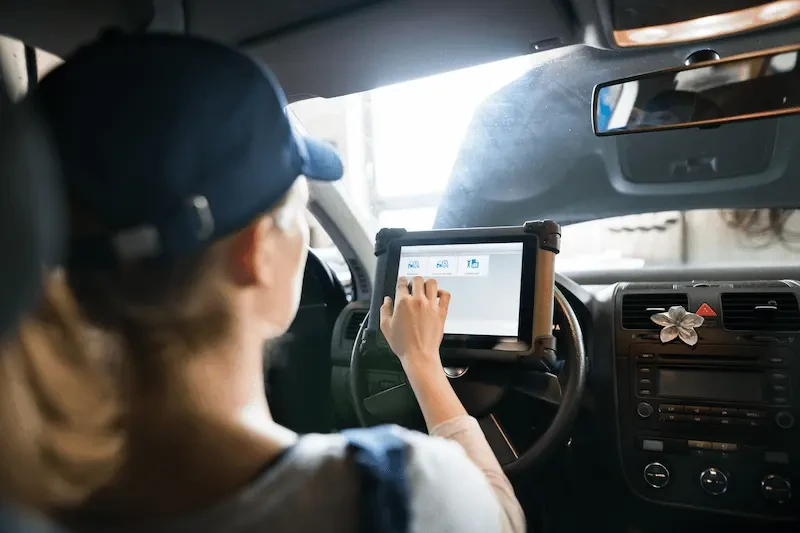
It's also worth noting that performing these services in-house requires a diagnostic tablet with the right vehicle coverage to trigger calibrations and initiate the companion procedures. That's a planning detail covered in more depth below, but it's essential to get right before making a purchasing decision.
The bottom line for your shop:
- Pull your last six months of sublet invoices and add up the total. Then estimate the companion services (scans, alignment, resets) that went with those jobs. That combined figure is closer to what in-house calibration would capture.
- Ask your sublet provider for copies of the calibration documentation they're generating. If it's thin, that's a visibility gap worth understanding.
Understanding Static vs. Dynamic Calibration
Most of the conversation around calibration space is about static calibration: targets positioned on a frame, a controlled environment, and defined distances between the vehicle and the equipment. That's the type of calibration that requires dedicated bay space and drives the space-planning questions most shop owners are asking.
But not all ADAS calibrations are static. A significant share of procedures, particularly from domestic OEMs, are designed around dynamic calibration, where forward-facing cameras and lane-keeping systems are validated through road tests at specified speeds and distances rather than through static targets in a bay.
The distinction matters for space planning because the two methods carry very different variables.
With static calibration, the shop controls the environment. Floor levelness, lighting, target placement and obstructions are all manageable with proper setup. The requirements are defined by the OEM, the conditions are repeatable, and the results are fully documentable.
With dynamic calibration, the variables shift outside the shop's control. Road conditions, weather, lane marking visibility and traffic patterns all influence whether the procedure can be completed to spec on a given day.
Adding to the complexity, there is no harmonized standard across OEMs for when static or dynamic procedures apply. Some procedures specify calibration explicitly after certain repair events, while others use terms like "inspect" or "calibrate if necessary," which can introduce interpretation into the process.
For shops evaluating the move to in-house calibration, the practical takeaway is that the space investment is primarily about static calibration capability, which gives the shop a controlled, repeatable, documentable process. Understanding which calibrations fall into each category for the vehicles you service most often is a valuable part of the planning process.
What the Space Actually Requires
Once the focus narrows to static calibration, the space picture gets straightforward.
Roughly 88% of ADAS systems can be calibrated in a standard bay measuring 16 feet wide by 30 feet deep, provided that space is unobstructed and controlled during the procedure.
There are exceptions. Certain OEM-specific calibrations, like Ford's around view monitoring system, can call for up to 30 feet by 40 feet. But these are a smaller share of the overall work, not representative of what a typical calibration bay needs to accommodate.
Space requirements are set by the vehicle manufacturer, not the equipment vendor. Every OEM publishes positioning specifications for calibration procedures, and shops can research their specific needs using OEM service data, aftermarket information systems and free online reverse lookup tools before committing to any investment.
Collision shops do tend to need more room than glass or general mechanical repair facilities, since collision work involves servicing all calibration types, including around-view and blind spot monitoring. Even so, the footprint most shops need is closer to what they already have than what the outlier specs suggest.
Making the Most of the Bay You Already Have
One practical approach shops are using is a multi-use space where mechanical repair, wheel alignment and calibration all share the same footprint, rather than dedicating a single-purpose bay to calibration alone.
Flush-mount lift configurations make this practical. A technician completes an alignment with the vehicle on the rack, lowers the lift, and repositions for calibration in the same bay. For collision shops, this fits the existing repair flow naturally since post-collision alignment is already part of the job.
Calibration becomes the next step in the same space rather than a separate appointment at another facility. Specialized lifts built for this use case can handle mechanical repair, wheel alignment and 360-degree calibration within a single bay of roughly 32 feet by 16 feet.
A well-designed multi-use bay does more than solve the space question. It eliminates handoffs that add cycle time. It keeps calibration and documentation under the shop's roof. And it pairs calibration with alignment and scanning work the repair already requires, keeping companion revenue in the operation.
Putting Together a Plan
The move to in-house calibration doesn't have to happen all at once. Shops often start with lane departure warning calibrations and expand into radar, lidar and 360-degree camera work as the team builds confidence and volume supports it. A phased approach keeps the initial investment contained and creates room to learn before taking on more complex procedures.
Before committing to a system, there are a few questions worth working through:
What does your current ADAS volume actually look like? How many vehicles per week come in with calibration requirements? What's the annual sublet spend? Which companion services are being handed off along with the calibration?
A clear read on those figures is often what turns the question from "should we" to "when."
What's included with the system you're considering? ADAS calibration equipment alone doesn't perform the calibration. A diagnostic tablet with comprehensive vehicle coverage is what actually triggers the procedure.
Without that coverage, shops either can't initiate calibrations or end up carrying individual OEM subscriptions for every manufacturer they service. Ask what coverage comes standard, how often it's updated, and what happens when a late-model vehicle shows up that isn't supported yet.
Who's already done this, and what did they learn? Talking to shops that have made the transition is one of the most valuable steps in the planning process. Ask about their setup, workflow, and what they wish they'd known before starting. Most equipment providers, Autel included, can facilitate those introductions. And if the timing isn't right today, put a date on the calendar to revisit the question in six months with fresh volume data.
For shops ready to take the next step, Autel offers a full range of ADAS calibration solutions. The Autel ADAS Bay Max lift supports multi-use bay configurations, and the IA900 and IA1000 2-in-1 wheel alignment and ADAS calibration systems come paired with an Autel Ultra S2 or MS Ultra diagnostic tablet for OEM-level specifications and the most comprehensive ADAS vehicle coverage in the aftermarket. For late-model coverage or situations where OEM software is required, Autel Remote Expert and Guided ADAS bridge the gap.