


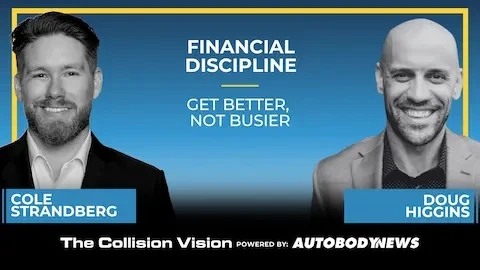
On the latest episode of The Collision Vision, host Cole Strandberg sat down with Juan Carlos Gasga Perez, owner of Premier Auto Body in Holly Springs, North Carolina, and the technician and educator behind Auto Body Strong, which has gained popularity on Facebook and Instagram. He said the growth has followed him documenting "the processes and procedures that happen here in the shop."
The conversation moved from his start washing cars at a Mercedes-Benz dealership through 21 years in the trade to owning his own shop, but the throughline was consistent: what "doing it right" requires from a technician, and what it costs a shop that skips it.
Ownership means seeing the cost of waste
Asked what ownership taught him that he hadn't appreciated as a technician, Gasga Perez didn't point to a repair technique. He pointed to materials. "As technicians, we're not geared to worry about how much material we're using," he said, describing open seam sealer containers and grabbed-and-forgotten supplies as common waste in body shops he's worked in .
That lesson shows up physically in his shop's layout. "One thing you'll never see in any one of my shops is cabinets. There's no cabinets up on the wall. I am a firm believer that cabinets are a big, big waste of money," he said, explaining that stored inventory tends to pile up unused rather than get tracked.
Key takeaway: Owning the shop changed how he sees material costs. Premier Auto Body runs with no wall cabinets and minimal on-hand stock specifically to avoid the waste he says technicians rarely have to think about.
Content only grows if it gives people something to use
Gasga Perez said Auto Body Strong started as a personal page for his modified Audi before he began filming shop work, and that its growth tracked directly to a shift in what he posted. "The next level is making sure that if you want to continue to grow, you got to make sure that you're giving people some content with some value in it," he said.
He was specific about what that means in practice: naming the tool or technique in a video, not just showing the result. "When you put a seam sealer video out there... I did it with this tool, or did it use this ... That's what people want, because then that's what will cause them to share that video to somebody else so that they can see the name of this product, or how something is done differently."
Key takeaway: The videos that keep an audience aren't the ones that just show a satisfying repair. They're the ones specific enough, naming the tool or the method, that a viewer wants to pass them along.
A repair built like it's headed to court
Asked what "doing it right" means to him now versus as an employee, Gasga Perez tied the answer to documentation rather than technique. "Proper documentation is definitely where it starts. If you don't have all the documentation, all the facts, something that you could stand on, something that's going to hold up in court if it ever goes down that road," he said.
That standard extends to which cars the shop takes on. "Not every car is going to be a car that we're going to work on," he said, adding that not every customer who walks in "is a customer that's going to fit Premier Auto Body's mentality and how we do things"
Key takeaway: A shop's documentation, not just the quality of the repair itself, is what he says actually holds up when a dispute happens.
The estimate is where the research happens
Gasga Perez said his estimator, Larry, is expected to have OEM procedure details ready before Gasga Perez even asks for them. "I should be able to come to you and literally ask you, hey, what welding wire are we using on this? Or ... where are we cutting the seam?” he said, describing that upfront research as standard practice at Premier, covering one-time-use parts, required calibrations and OEM-specific safety inspections (35:52, 36:19).
He was direct about why that legwork pays off. "A lot of time gets spent here at Premier up front doing that leg work. It is a lot of work upfront, ... but it does bring in profit with it, because you're charging for all these things ... that a lot of times other body shops don't charge, because they didn't take the time to look at what they were doing up front," he said.
Key takeaway: Researching OEM procedures before the estimate is written isn't overhead in his shop, it's billable work. He frames the shops that skip it as leaving money on the table rather than saving time.
Procedures shift enough that memory isn't reliable
Gasga Perez described finding a sectioning location had moved between two repairs on the same model, a year apart. "I've literally fixed the car before and knew beyond a shadow of a doubt that I read that a sectioning spot on core panel was in a certain area, and a year later I go back to it and I check it and it's in a different spot," he said, adding that OEMs increasingly specify exact millimeter measurements rather than reference photos.
Because of that, his shop keeps a dated record of which version of a procedure it followed for a given repair. "We always keep a record of the sectioning, the procedures that we did for that car, stamped for that time, because we know that is a potential change," he said.
Key takeaway: Even a procedure a technician has followed correctly dozens of times can change without notice. Premier date-stamps which version it used on each repair rather than relying on what a technician remembers from the last job.
Equipment earns a spot in the shop by being repeatable
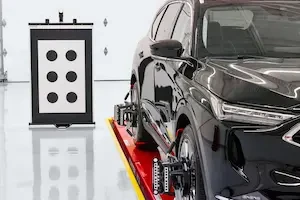
Gasga Perez named PointX and Car-O-Liner's measuring systems specifically, along with the CTR9 resistance spot welder, as the tools he trusts. "I love PointX, I love their vision system, I love Car-O-Liner's measuring stuff. I think it's top-notch," he said.
On what makes a tool worth keeping, he pointed to consistency he can feel rather than a spec sheet. "The CTR9 ... that's the resistance welder. It's one of my favorite ones. When that thing welds, I know beyond a shadow of a doubt, the way it sounds, the way it acts, the way it works, that I am putting a good, solid weld in that car," he said, adding that Car-O-Liner's build quality overall, from finish to organization, factors into that trust: "Everything is organized, everything is done with a purpose ... there's some thought put into them, and that goes very, very far with me".
Key takeaway: He judges equipment by whether its performance is repeatable enough to trust by feel, not by marketing or specs. A resistance welder that sounds and acts the same weld after weld carries more weight with him than any brochure claim.
The technician shortage comes down to retention
Asked what the industry is getting wrong about attracting technicians, Gasga Perez separated the two halves of the problem. "I think that we are getting people to come into the industry. I think what we're getting wrong is retaining people," he said.
He linked that to unrealistic pay expectations set before technicians ever start. "We're not painting good outlines for younger technicians... telling them, ‘hey, look, if you stay in this and if you work hard, this is what this may look like. There is potential for you to make good money. There's potential for you to buy a home,’" he said, then pointed to a culture of instant results as the deeper issue: "We live in a world where we want everything fast... the auto body industry is something that will make you money, but it doesn't come fast," noting that some schools set expectations of "$70,000 off the get" that don't match reality.
Key takeaway: He doesn't think the industry struggles to bring people in the door. He thinks it struggles to keep them once the pay doesn't arrive as fast as they were told it would.
The throughline: good repairs, told honestly
Asked what he wants his legacy to be, Gasga Perez returned to the same standard he'd applied throughout the conversation, to repairs and to content alike. "Good repairs. Good repairs surrounded with positivity. I don't want people to see Auto Body Strong as a negative guy. That's not who I am," he said, adding that he wants viewers to walk away with a specific correction about the trade: "It's not just guys that are rolling around in filler and bondo. There is some brains that need to be put up there to be able to fix these cars and fix them correctly."
Across documentation, OEM research, equipment and hiring, the standard Gasga Perez described was the same one he says he's trying to put on camera: repair work that can be proven correct, done by technicians the industry gives a real reason to stay.


Lisa McArdle