

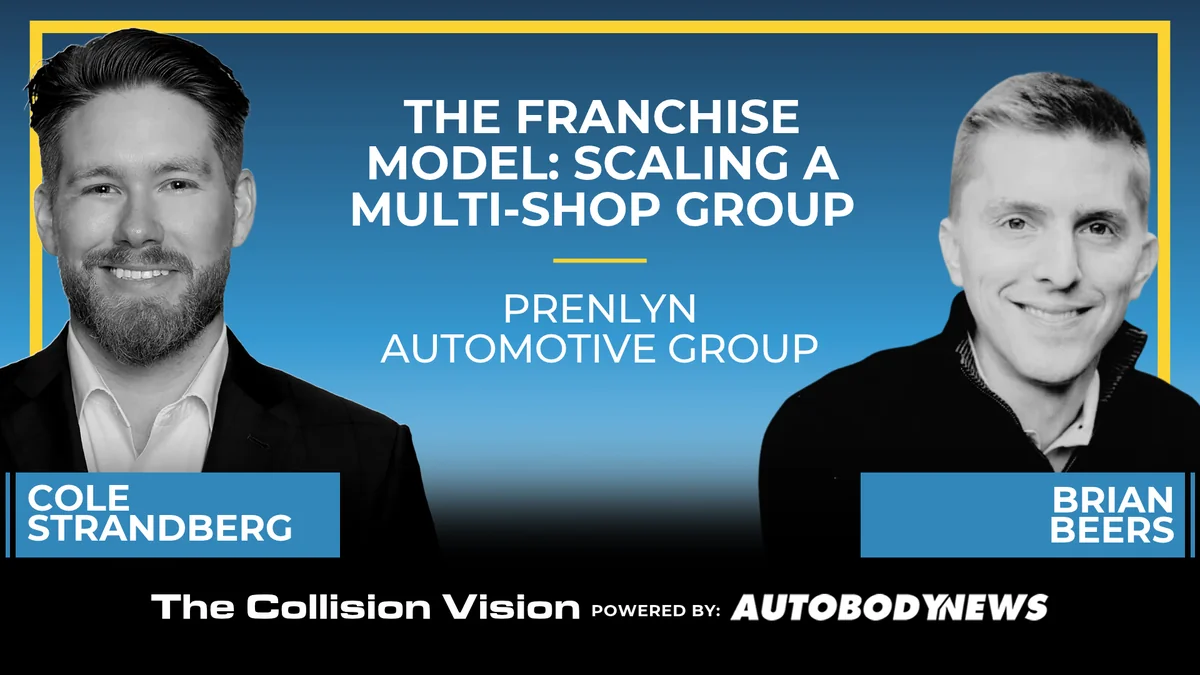
Collision repair operators looking to scale can learn from other segments of automotive service, according to The Collision Vision host Cole Strandberg. Strandberg said auto repair consolidation today resembles where collision repair stood 10 years ago.
To explore that idea, he sat down with Brian Beers, a multi-unit Midas franchisee. Beers and his brother own 36 Midas auto repair locations based in Philadelphia. The group has no investors or outside partners.
Beers' father, Tracy Beers, became a Midas franchisee in 1976 at age 22, going into the business with his own father. He later partnered with his brother-in-law, and together they grew the business to six locations in Philadelphia. Beers joined after college in 2010 with no mechanical background. In 2016, he and his brother bought their first two locations from a retiring franchisee. A 2022 Modern Tire Dealer profile identified Beers as president of the family's Prenlyn Automotive Group.
On the episode, Beers discussed franchising, acquisitions, market density, and how owners can step back from daily operations as they grow.
Growth required savings, confidence, and a well-matched partner
Asked when he knew he was ready to grow, Beers said, "I mean the big thing was money." He and his brother saved their salaries for years before buying stores, then took on debt and personally guaranteed notes and leases. His first daughter was born six months after the first purchase.
"You really got to have confidence in yourself, confidence in the business model, confidence that like you know we're going to be able to like make this thing make money," he said.
He said the brothers work well together because their strengths differ. "We're complete opposites. So, I think that's pretty important," he said. Beers handles sales and public-facing work, while his brother, whom he described as "the computer nerd," focuses on numbers, systems, and process.
He said the partnership also works because both brothers agreed to reinvest profits into more stores rather than take money out. "With any business partner, you need to have personalities that align," he said.
Key takeaway: Choose a partner whose skills complement yours, and agree in advance on how profits will be reinvested.
A 36-store group can still operate like a small business
Despite its size, Beers said the company still sees itself as "a small scrappy business." When the group bought its 36th store in February, Beers, his father, and the company's CEO, a former Army Ranger, helped renovate it themselves.
He said the company has a defined leadership structure, including a CEO and a CFO, but remains flat compared with large chains. "Guys that work for us feel like they still work for like a family-run company," he said. Most of the group's stores are 15 to 20 minutes apart.
Key takeaway: Add the leadership structure growth requires while keeping owners visible and involved, so employees still feel they work for a family business.
Franchising provides access to real estate and deals
Asked about the Midas relationship, Beers said his franchise agreement bars him from owning any auto repair business outside the Midas brand. He said real estate and deal flow also factor in. "Real estate is by far the hardest part in this game," he said, noting that his stores need high-traffic retail sites, while collision shops can sit somewhat off main roads.
He said Midas has roughly 1,000 to 1,100 U.S. locations and owns or leases much of that real estate. "Being a franchise gets me access to do these deals to buy these stores that really are going to stay a franchise," he said.
Brand recognition also speeds up new locations. His 36th store took over a site where a national competitor had closed. Beers estimated the competitor had been doing about $50,000 a month, and the new Midas store reached $170,000 in September.
He said a strong franchisor also brings consumer trust, because "auto repair has a high trust barrier," along with marketing, lead generation, and guidance on changing technology.
Key takeaway: When weighing a franchise or network, look at its access to real estate, deal flow, brand trust, and marketing support, not only its fees.
A strong network turns acquisitions into direct deals
Beers compared a franchise system to a country club. "You think of a franchise as like a country club, right?" he said. He said he can call a fellow franchisee who also runs 36 shops in the Northeast to compare results.
That network also produces acquisitions. When another franchisee wants to sell, Beers already knows the business and is pre-approved by Midas to grow, so no broker is needed. He said the company pays cash or uses seller financing, and "we can get a deal done in like 45 days." For the seller, he said, "it's quicker, it's easier, it's confidential."
He said many sellers value a smooth exit over the highest price. "Most small business owners when they want to get out, they just want to clean out, right?" he said. About 30 of the group's 36 stores came through acquisitions, and only one involved a broker. "Every other deal was direct. We knew each other," he said.
Key takeaway: Build relationships with owners before they are ready to sell, and offer speed, confidentiality, and flexible terms so you become their first call.
Owners hit a ceiling when they remain the hero
Beers said owners often start out as "the superhero," handling every task, and that approach works until the business outgrows it. "I really see it happening in doubles," he said, describing pressure points at one location, then two, then four or five, then 10 and 20.
He said owners must change roles at those points. "We got to stop being like the superman and instead we got to be like the architect," he said, describing a leader who designs how jobs are estimated, sold, and completed. At his company, district managers each oversee six stores.
"What got me here isn't going to get me to the next level," Beers said. "Now I need to focus on being more of the person to train than it is the one to do."
Key takeaway: Stop solving every problem personally, and focus instead on designing systems and developing leaders who can solve problems without you.
Hiring is the hardest responsibility to delegate
Beers said the hardest task to hand off was hiring. "You need a good manager and good tech. If you have that pair, like the store can make money. If not, you're going to lose money. It's pretty binary," he said. A wrong hire can set a store back six months, he said. "Still like the hardest part of our business is just finding good people," he said.
He has also stepped back from acquisitions, which he enjoyed. The company's CEO now leads all acquisitions and new store development and has led the last five deals.
Key takeaway: Treat the manager-and-technician pairing as each store's most important decision, and build a hiring process that works without the owner.
An honest time audit frees owners for higher-value work
For owners trying to grow from a few stores toward 10, Beers said the starting point is time. Everyone has the same 168 hours a week, he said, and "a lot of it comes down to honestly just auditing your time."
He said many owners spend hours answering phones, doing bookkeeping, and posting job ads, which are tasks someone could handle for less than $20 an hour. His company employs about 20 people in Latin America and the Philippines who post job ads and screen candidates, so managers see only qualified applicants. He compared the approach to a surgeon who makes the cut instead of doing the prep work.
"Just look at your time and realize, where am I spending it?" he said. He suggested starting with work that "just drains my energy and it ... doesn't really make me that much money."
Key takeaway: Track where your hours go, then hand off low-value tasks so you can focus on the work that drives revenue.
A clear buy box makes acquisitions repeatable
Beers said repeatable acquisitions start with defined criteria. "I think the first thing is having a very clear buy box," he said. His company targets stores within its geographic footprint, on major retail roads, between 3,500 and 6,000 square feet, with the look and feel of its existing locations.
"If we can simplify it becomes way easier to multiply it," he said. Clear criteria let real estate brokers prospect on the company's behalf, and Beers said he can tell within two or three minutes whether a deal is worth pursuing. Because customers rarely drive more than about 15 minutes for auto repair, the company can place many stores in a small area.
Key takeaway: Define exactly what a target location looks like, including market, road, size, and layout, so you can evaluate deals in minutes and act quickly.
Density improves retention, reputation, and oversight
Beers said the group has chosen depth over geographic reach. "Quality over quantity is important to us," he said. He said he has seen operators lose per-store volume and margin as they get larger. "We're in [a] people business that just happens to fix cars.”
He described an order of operations for growth: buy existing Midas stores first, then convert independents, then take over vacant buildings. Density also helps keep employees. He said a commute of 20 to 30 minutes is about the most people will sustain long term, and owning more nearby stores lets the company move workers closer to home.
He said density also protects the brand. "By me owning a highly concentrated amount in my market, I control the reputation of Midas in Philadelphia [and] New Jersey," he said. He and one other franchisee control about 80% of the area's Midas stores. Close proximity lets the company visit 10 stores in a day and gives it leverage with vendors on rebates.
Buying locations wherever they are might look better on paper, he said, but "in practice I think creates a lot of friction which ultimately leads to lower performance in the end."
Key takeaway: Grow densely within a market before expanding outward to improve employee retention, reputation control, management oversight, and vendor leverage.
Mindset separates owners who build from those who stall
Asked how he identifies people capable of growing beyond one location, Beers said, "a lot of it comes down to ... mindset stuff." He contrasted owners who blame outside forces with those who ask how to get around challenges.
"I focus on the things that we can control," he said, pointing to how a shop answers a customer's call. He said that when he had two stores, he looked at operators with 30 or more and asked himself, "if those guys can do it, like why can't I do it?"
Key takeaway: Focus on what your shops control, such as how each customer is treated, and study larger operators as proof of what is possible.
Beers now focuses on growth, content, and simplifying
Beers said he now has "near zero involvement in the day-to-day operations." He described the auto repair business as a source of cash flow that funds other ventures. He spends much of his time producing content, which he said draws partnerships and deals, including a real estate and shop deal close to signing. He is also involved with franchise brands outside automotive, including an artificial turf company and a mobile dessert concept.
He said passion for the business matters more than passion for cars. "You got to be passionate about the business," he said. Asked what he does best, he said, "I think I'm really good at just taking complicated things and simplifying them."
Key takeaway: Simplify every process, from deals to hiring, so others can learn it, execute it, and repeat it.
Beers' advice centers on building a business that runs without the owner
Throughout the episode, Beers returned to a few priorities for operators who want to grow: audit how you spend your time, define a clear buy box, build density in one market before expanding, and shift from solving every problem to designing the systems and developing the leaders who solve them.
Beers publishes weekly videos on YouTube and can be reached on Instagram.





Lisa McArdle