

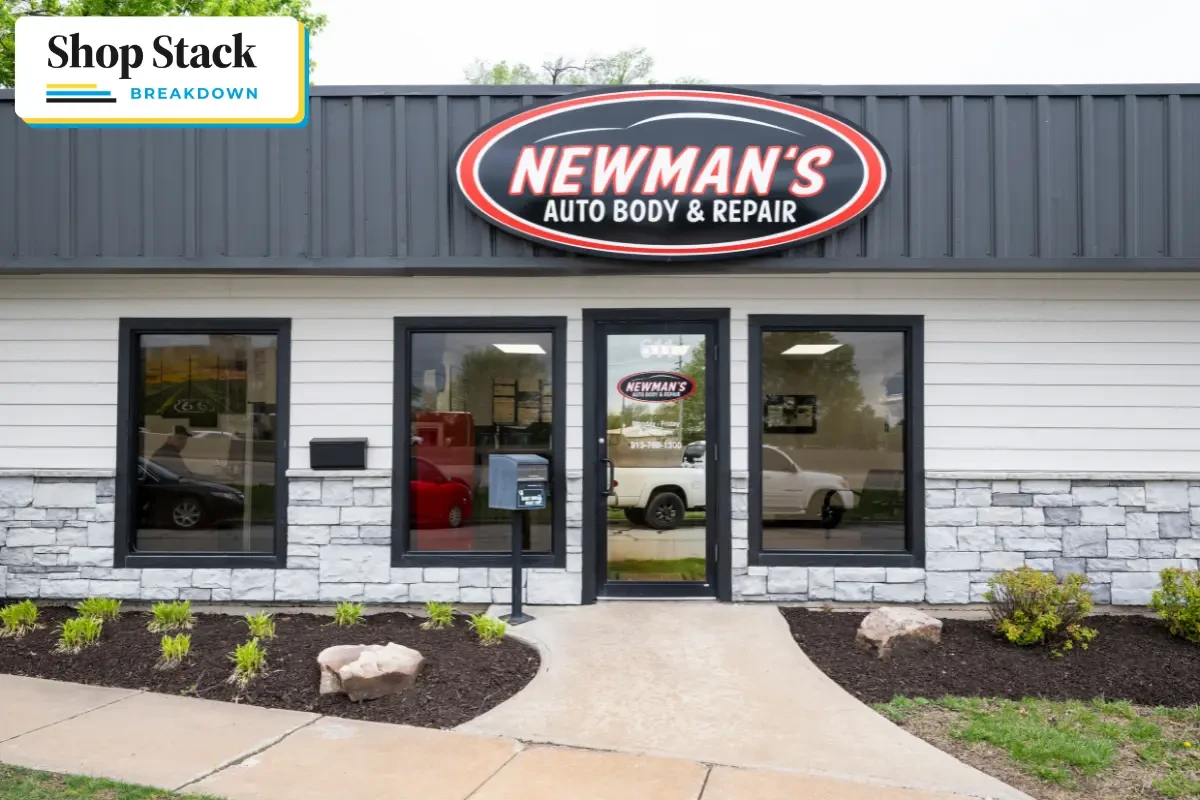
Zack Newman opened Newman’s Auto Body & Repair from scratch roughly 14 years ago, after growing up around the industry without originally planning to join it. His father managed a body shop at a dealership, and Newman spent time there as a kid, but he did not set out to work in collision repair himself.
After college, Newman took a job running a small satellite paint supply store for his father's jobber. To better sell the products in the store, he taught himself how to use them, tinkering on side projects that grew from small jobs into restorations and repairs, work he did out of a shop he built at home while still working at the supply store.
The side work eventually grew enough that he hired a full-time employee. After an attempt to buy an existing shop fell through, Newman found a building in a good location and opened Newmans Auto Body & Repair from the ground up.
The original location, built on a main highway frontage road, eventually outgrew its roughly 4,000- to 4,500-square-foot footprint. A dealer Newman had already been doing work for offered him space inside a Mazda dealership, leading to the shop's second location. Newman’s Auto Body & Repair now operates two locations in Olathe, Kan., with 18 employees, and holds OEM certifications with Mazda and Subaru.
THE STACK
Estimating and Management
· Estimating: CCC One
· Shop Management: CCC Workflow
· Parts Ordering: CCC One, PartsTrader
· Accounting: QuickBooks
· DRP/Insurer Portals: None
Newman runs estimating through CCC One and shop management through CCC Workflow, though he described the setup as a hybrid rather than a full adoption of the CCC ecosystem. He does not use CCC's customer communication tools, opting for Podium instead.
“I don't fully take advantage of the CCC deal. I've kind of got a weird kind of hybrid deal that I work out myself,” Newman said. “We use CCC for some of that stuff.”
Most parts orders run through CCC One, with PartsTrader used selectively when a part carries OEM-specific pricing. Newman said he prioritizes giving customers the choice between aftermarket and OEM parts on every job, regardless of which the insurer initially approves.
“If the insurance company chooses to pay for aftermarket parts, we give them the option to pay the difference with the OEM parts on every job, just so they know,” Newman said. He estimated that about 75% of customers choose to pay the difference for OEM parts, which the shop then orders through CCC One.
Communications and workflow
· Customer Communication: Podium
· Internal Team Communication: Group texts
· Photo and Documentation: CCC One
· Scheduling/Capacity Planning: Custom, based on hours
· Digital Vehicle Check-In: None
Newman uses Podium as the shop's primary customer communication platform, visible across all estimators rather than tied to a single point of contact. He said the shared visibility helps prevent customers from being missed if the estimator they have been working with is out.
“All the estimators can see it across the board,” Newman said. “If something gets dropped or a customer's asking a question, everyone can see it to make sure that we get to them quickly.”
Customer contact typically begins online, with many customers requesting an estimate or appointment through the shop's website before ever speaking with staff. From there, Podium carries the relationship through scheduling, a reminder sent roughly a week ahead of the appointment, and status updates sent roughly every two days during the repair. Estimators can use saved templates or write updates individually depending on the situation.
Newman said the shop previously used Podium for four to five years before switching to Body Shop Booster, a platform built specifically for collision repair shops with heavier AI-driven automation. The shop has since moved back to Podium.
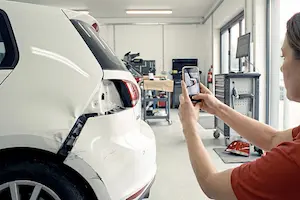
For vehicle intake, Newman said the shop does not use a digital vehicle check-in platform. Estimators instead walk around the vehicle with the customer, photographing it on a phone and within CCC One while discussing the vehicle's condition in person.
The shop's production tracking is also built in-house rather than through a dedicated platform, relying on a manual production board system Newman described as simple but effective for the shop's needs.
Repair and production technology
· Scanning and Diagnostics: Autel
· ADAS Calibrations: In-house (Autel, asTech, AirPro)
· Measuring System: Shark, Spanesi Touch
· Paint Mixing and Color Matching: PPG Envirobase
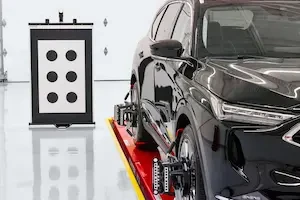
Newman performs ADAS calibrations in-house, primarily using Autel equipment for the majority of jobs. AsTech and AirPro systems are reserved largely for OEM certification requirements that call for a specific calibration platform.
“The OEM requirements usually are for the certifications. I've got to have an asTech or the AirPro to be on the program, so we'll use them for that,” Newman said. “Most of the time, though, we're just using the Autel. It's the one that we use for all the calibrations and everything.”
Measuring work is split between two systems depending on the type of damage. The shop's Shark system, an underbody beam-based setup, is used for lower-frame, full-frame, or suspension-related damage. Upper-body damage, including radiator support and front- or rear-end work, is measured with a Spanesi Touch system.
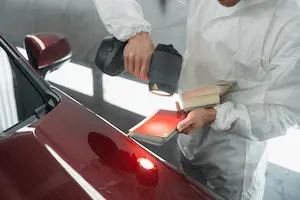
For paint, Newman runs PPG Envirobase across both shop locations, both of which use downdraft spray booths, with a larger booth at the dealership-based second location that can accommodate multiple vehicles at once. The shop also uses PPG's automated mixing system, which Newman said improves toner usage compared to manual mixing.
What technology could you not live without?
Newman pointed to Podium as the platform he considers essential to running the business, citing the speed of customer response it allows for. “Everyone wants everything right now nowadays,” Newman said. “I think Podium is really nice for just updating, being able to get back to customers quickly.”
Before bringing in new equipment or software, Newman said he now relies heavily on a 20 group he has belonged to for roughly the last year and a half to two years, reaching out to other shop owners for real-world feedback before committing to a purchase.
"That's been a huge job, because before I didn't have a lot of that, and I might just have to jump off and try myself, and then find out I did or didn't like it," Newman said. "I'll reach out to other shop owners that I know."
Want to see your shop's setup featured in Shop Stack Breakdown? Every edition profiles a collision repair shop and the technology behind its operation. Fill out our intake form and we will be in touch.



Lisa McArdle