
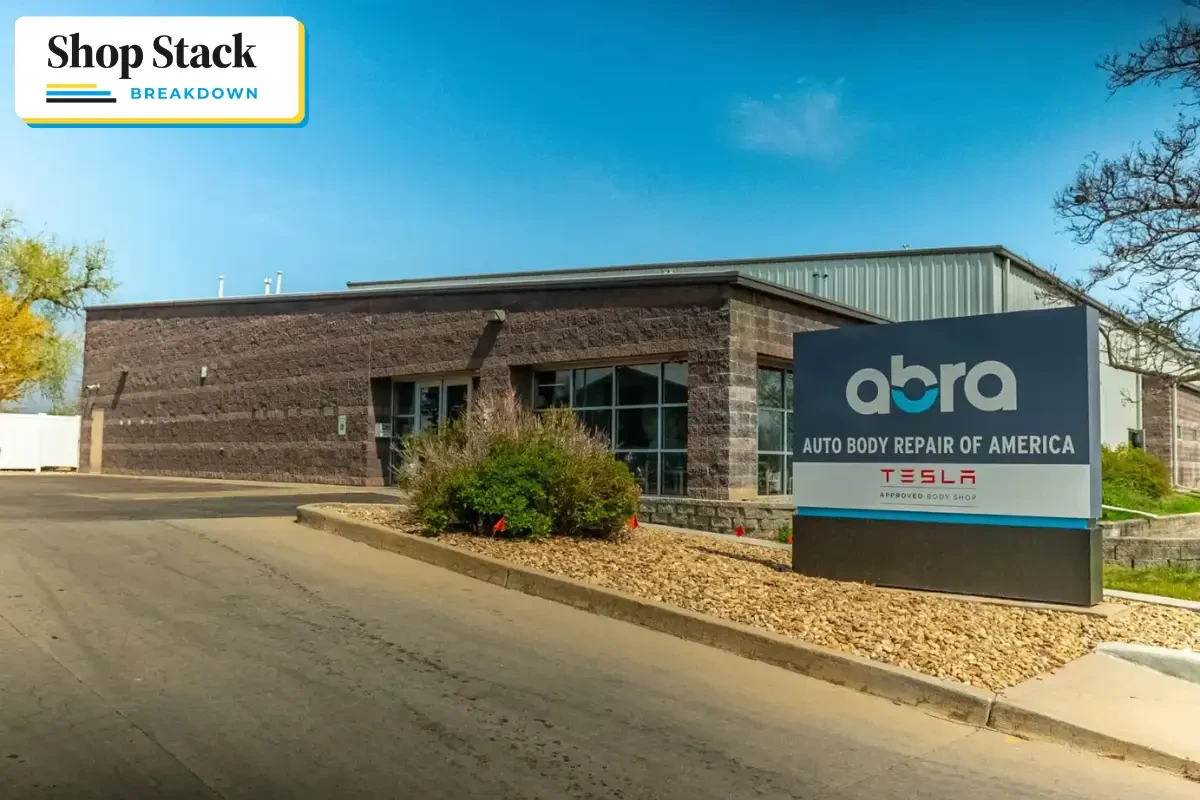
Micah Elsom started in collision repair working with his father, a body shop owner in Texas, before moving into the office side of the business and eventually into corporate multi-shop operator roles. That work took him from California to Colorado in a role overseeing multiple locations.
Elsom later took over day-to-day management of an Abra franchise location in Greeley that "just needed some help" and "had a lot of business there, it just wasn't being managed." He said the team cleaned up processes, worked through the COVID-19 pandemic, and rebuilt how the store operated.
Around 2021 or 2022, looking for work outside the gas-and-oil-driven market of Northern Colorado, Elsom said the shop began taking on Tesla repairs after a relative of the owner had a damaged Tesla, using contacts Elsom had built up in a prior corporate role. "It was a little nerve-wracking for some of the people, because they were intimidated by the car being an electric vehicle," Elsom said, but the EV work helped sustain the business through the rest of the pandemic.
The shop later added a second location in North Fort Collins through a Driven Brands program that handled outreach for available Abra locations. A third location, independently run rather than franchised, followed. Elsom described that store, The Carriage Shop, as "our OEM structured store," built around a heavier concentration of manufacturer certifications. Elsom partnered into the business in 2023 and now serves as vice president of operations. Warren Yoder is the company's primary principal.
Yoder Collision Network now operates three locations in Colorado, including Abra Greeley, Abra Fort Collins, and The Carriage Shop, with 38 employees. Certifications are spread across the network.
THE STACK
Estimating and management
- Estimating: CCC One
- Shop management: CCC Workflow
- Accounting: QuickBooks
- Parts ordering: OPSTrax, CCC, PartsTrader
- DRP/insurer portals: State Farm, Geico, Liberty Mutual, USAA
Elsom said the shop's certification requirements directly shape equipment purchases. "If we're going to get into something that carries a lot of heavy CapEx, that might be something that I want to wait on," he said.
For a certification like Mercedes-Benz, which the shop is currently pursuing, Elsom said he works through the manufacturer's required equipment list to determine what existing tools qualify and where new investment, such as lift or frame-bench jigging, will be needed.
"It does make you think about the operation a little differently, too, because if I decide to bring in this European car, there's the equipment piece, but there's also the training piece," he said.
On the decision to run both estimating and shop management through CCC, Elsom pointed to the platform's integration between the repair order and production tracking. "The nice thing about CCC being an all-in-one system is you're managing the RO, and you have your production platforms integrated with the RO, so there isn't any additional merging," he said. "There's a lot more accuracy when you're running reporting. You have performance tabs actually in the management system, so you can monitor your margins through labor, parts, and sublet as you close files, and you're building your P&L, your financial statement, toward the end."
He added that CCC also surfaces repair-method guidance during estimating, including flags for parts that may require calibration, inspection or replacement based on the area of damage.
Parts ordering platforms are chosen based on the vendor and the insurance carrier, Elsom said. "With our GM vendors, they would prefer to see it go through OPS," he said. "CCC has a direct ordering system in there that works with companies that have electronic ordering in place, so it gives you an option internally. Collision Link seems to be a little more broad, and that works well with Toyota and some of the other import vendors."
For some carriers, PartsTrader does double duty as both a procurement tool and a performance scorecard, Elsom said. "For some of our insurance partners, Parts Trader is not only a parts procurement platform, but it also is a compliance tool they utilize to measure certain KPIs in their scorecards," he said. "For instance, Geico and State Farm, we would primarily use Parts Trader, because that's what they want to see, that's how they measure some things."
He said vendor star ratings inside the platform factor into which suppliers get used. "If you see somebody that's got one-and-a-half stars, you know there's probably some issues, especially if there's multiple reviews on it."
Communications and workflow
- Customer communication: UpdatePromise
- Internal team communication: CCC, Slack
- Photo and documentation: CCC
- Scheduling/capacity planning: CCC, OnBoard Scheduler
UpdatePromise is managed primarily by each location's general manager, Elsom said, since Yoder's stores don't run dedicated production managers. As vehicles move through CCC's phase tracking, from check-in to parts ordered to repair and paint, automated updates go out to customers based on the hours built into each phase. Elsom said the key is stopping automated updates when a repair is delayed.
"We need to stop it, because there's a way to put it on hold," he said. "Contact the customer, advise them that we have a part that unfortunately went on back order. We have a release date, so now you're putting everything on pause until it comes back in." He said the goal is keeping repair-plan timestamps accurate rather than "having somebody show up that thinks their car is going to be done, and it probably should have been, but it's not."
Slack is used for general team-wide communication, Elsom said, while CCC's internal task system handles more operational back-and-forth, particularly at the larger Greeley location. "Rather than having writers running back and forth all the way to the parts department, they'll generate these tasks and ask the questions, so they can get updated," he said. "It has that function to where you can communicate internally to make things happen."
For scheduling, Elsom said two of the three locations use CCC's built-in calendar, while The Carriage Shop uses OnBoard Scheduler, which he said gives a fuller view of weekly capacity. "It's almost like looking at a doctor's calendar, because it shows anything that's an appointment, if it's just an estimate only, a job that's supposed to leave, or it's an actual drop," he said.
Capacity is tracked by hours rather than vehicle count, with boxes turning red once a day or week is overbooked. Getting the two systems to work together, he said, "is a little bit of a trick."
Repair and production technology
- Scanning and diagnostics: asTech
- ADAS calibrations: Sublet
- Module programming: Some in-house via asTech
- Measuring system: Car-O-Tronic (Car-O-Liner); Chief Velocity and Pulse
- Paint mixing and color matching: Sherwin-Williams Ultra 9k
·All three locations run asTech in-house for pre- and post-repair scans, with a mid-repair scan available as well, Elsom said. He said asTech's remote-assist capability separately allows some in-house module programming, such as reprogramming a replaced blind spot monitor.
"If we're running something that is OEM, like a blind spot monitor on a vehicle that's been replaced and has to be programmed, asTech, not all the time, but occasionally has the capacity to help us program that," he said. "They can dial into the system and into the car, and it'll either program, clear out, reprogram or calibrate to certain levels, and we can run dynamic calibrations out of it."
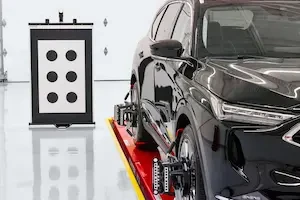
For measuring, Elsom said The Carriage Shop uses "a combo of both" Car-O-Liner's Car-O-Tronic vision measurement system and the shop's sonar-based Chief Velocity and Pulse systems, and that Car-O-Tronic has been the more accurate of the two. "It's not only over-technical with it, but the ease of use is nice. It's a quicker setup," he said. "I feel like it's much more accurate than the ones we have through Chief... these are targets that are lined up under the vehicle that work off of a sonar, and you can get the measurements, and they'll be fine. The problem is, if you have the door open and it's windy and the targets start moving, or if there's anything else that may interfere with it, it could create some problems."
He said the system's arm-based measurement tool, which staff call "the banjo," gives an immediate read on misalignment and a quicker measurement. Elsom said Car-O-Liner's system is planned to expand to all three locations going forward.
Yoder switched its paint system to Sherwin-Williams' Ultra9k in January, moving away from prior high-line brands. Elsom said the switch took roughly a year of internal discussion. "You associate Sherwin with industrial coatings, so architecture, painting houses, things like that. People associate it more with house paint than they did automotive," he said. "It took about a year of discussions with me, but also with other owner-operators using it, to figure out whether it was the right thing to do."
He said painters have largely come around on the product. "Across the grid, I think for the most part painters are happy with it. They understand it better."
On evaluating new equipment generally, Elsom said return on investment isn't always the deciding factor. "It's hard to really put an ROI on it unless it's something really specific to a goal," he said. "For us, it's really how accurate is it, how is it going to help me produce a safe, OE-compliant repair, what's training going to look like down the road."
He said he'd rather spend more upfront than shortcut on equipment. "The return for me is just the confidence of knowing that we're putting something out there safe, and we're not just doing this transactional business. We're building cars the right way."
What repair technology are you excited to add next?
Elsom pointed to aluminum glue-pulling systems as the shop's next likely investment, after seeing live demonstrations of the equipment's metal-finishing capability.
"We watched them actually connect their glue pulling systems to these panels, and watched how they pulled out, and really their metal finishing to a point where you don't have to use a lot of top coat to make panels look clean," he said. "Aluminum is a special metal. It's light, but it's strong, but it's also not as malleable as regular steel." He said the systems avoid overworking aluminum panels during repair. "The glue pulling systems, honestly, are just exciting. Those will probably be my next investments at the stores."
Want to see your shop's setup featured in Shop Stack Breakdown? Every edition profiles a collision repair shop and the technology behind its operation. Fill out our intake form and we will be in touch.


Lisa McArdle