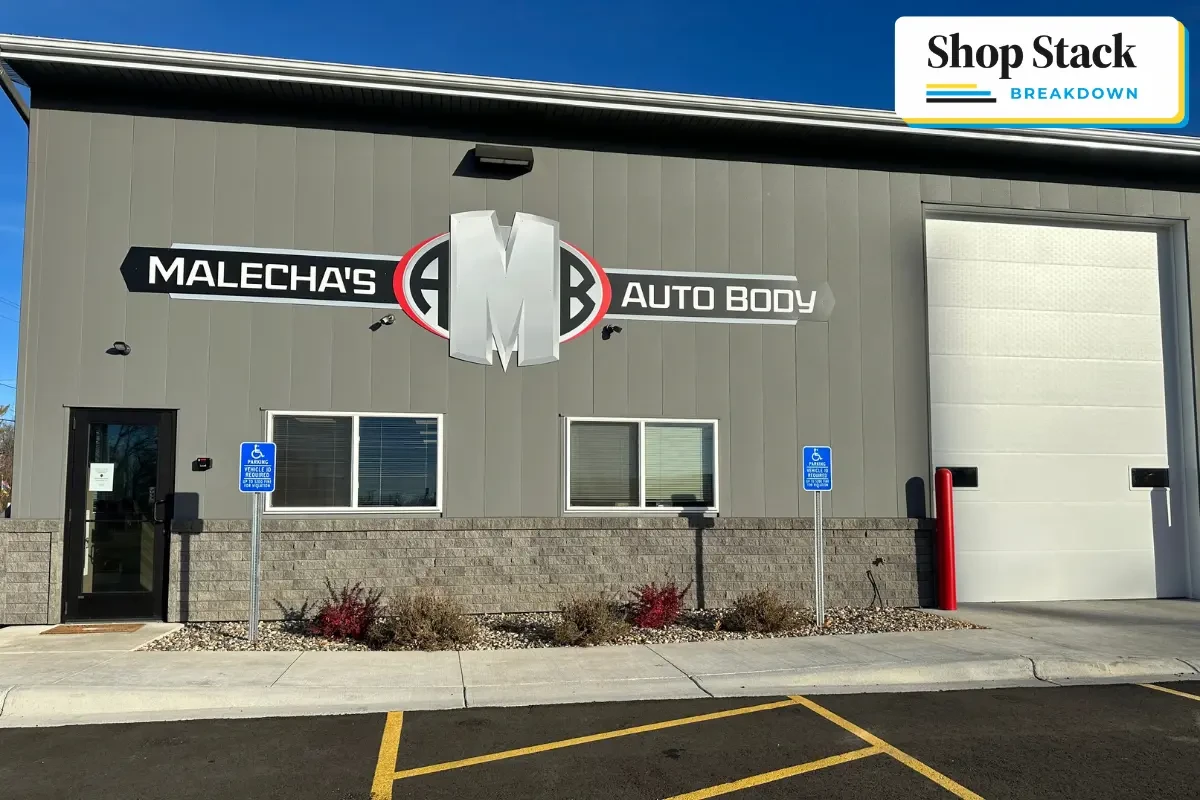
Malecha's Auto Body traces its roots to a teenage side project. William Malecha said that eventually evolved into a two-location, independent collision repair business in Faribault and Waseca, Minn.
"I started working out of my parents' garage back when I was 17 or 18 years old, and kind of just grew from there," said Malecha, owner of Malecha's Auto Body LLC.
He's been in the collision repair industry since 1996 and started his own business in 1998. The shop grew from that garage into a larger building and eventually into a new main facility in Faribault, Minn., that opened in 2023, a roughly 11,000-square-foot flagship location. In November 2022, the business acquired a second location about 30 miles away in Waseca, Minn., a shop that had previously operated as Dave's Body Shop.
Malecha's Auto Body is an independent shop with two locations and 13 employees, and holds certifications with 10 automotive brands, including Acura, Fiat and Ford/Lincoln. Malecha said the shop built its certification list around the vehicles it actually sees rather than pursuing every brand available.
"We mainly chose the brands that we're certified with just based off what we're seeing for vehicles coming through the shop," Malecha said. "We're in smaller towns, so having like Audi and Land Rover and the high-end vehicles just isn't ... we don't see enough of them to justify it." He said the shop runs few DRPs as a result. "We hardly have any DRPs, we're very independent, and all your certifications have just been, to me, it's been the direction to go, and we stay very busy all the time," he said.
Managing 10 certifications across two locations hasn't been difficult, Malecha said, because manufacturer requirements largely overlap and the shop's internal quality control already exceeds what OEMs require. "Most of the manufacturers all pretty much have about the same requirements, and in most of the documentation side of it, it's like our procedures, our quality control is actually above and beyond what even the manufacturers expect us to do," he said. "When our cars come in, the protection we're doing on the vehicles is already done, the checklists are done through each phase of the repair."
THE STACK
Estimating and management
- Estimating: CCC
- Shop management: CCC
- Parts ordering: CCC, CollisionLink, PartsBridge
- Accounting: QuickBooks
- DRP/insurer portals: Mitchell Connect
Malecha runs estimating, shop management, scheduling, customer communication, and photo documentation almost entirely through CCC, a setup he attributes to the training he received directly from the vendor.
"I think a lot of it has to do with the training I've received from CCC," Malecha said. "If you ask for the help and really pay attention to the training, it's so nice, because I can manage both my shops sitting at my home."
He said technicians log documentation through CCC's mobile app as a vehicle moves between departments. "My technicians have the apps on their phone, so they're putting all the documentation in the files as the repair is in process," he said. "When my body techs get done with something, they move it to the paint department, and I can see that. I know where everything's going and how it's happening. To me it's convenient because I'm not jumping back and forth between different platforms."
For parts, Malecha said PartsBridge is used mainly for Toyota price matching on aftermarket parts, while he's leaning more on CCC for other manufacturers. "But not all dealers are set up with CCC, so a lot of it is based on what our dealers that we're purchasing from are set up with. I wish I could just do it all through CCC."
Mitchell Connect is used only for the shop's Progressive DRP business at the Waseca location, with estimating still handled in CCC. "We go into Mitchell Connect just to retrieve our assignments, customer information, claim numbers, and then everything, getting all our estimates, are getting done in CCC."
Communications and workflow
- Customer communication: CCC
- Internal team communication: CCC
- Photo and documentation: CCC
- Scheduling/capacity planning: CCC
- Digital vehicle check-in: CCC
Customer updates go out through CCC's text and email tools, triggered as a vehicle moves between repair stages, based on preferences collected at check-in. "If the people choose to want to know where their vehicle's at, I can send them text messages or emails once I move the vehicle through the repair process," Malecha said. "Some people just want to know when their car is done ... but some people like to know ... my car is getting painted today. So that's one of the questions we ask when we're checking our customers in. If that's what they want, we have it set so they get the updates through CCC, and it makes it really slick."
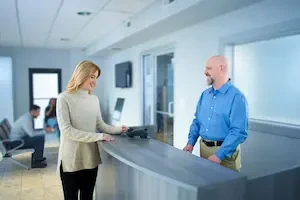
For intake, the shop uses self-service kiosks, an option Malecha said gets heavy use early in the week. "We have a couple, basically kiosks, and customers can check themselves in if they like. Sometimes Monday mornings people love it, because we're getting numerous vehicles dropped off," he said.
Estimators also pull tablets from the kiosks for in-field documentation. "We grab the tablets off the kiosk, and that's what we use when we're going out to do an estimate with a customer. We can manage all the photos right there, and everything is loaded back in, so when I come back to actually sit down behind my computer to write the estimate, I've got all the photos ... that has come right from the mobile devices," he said.
Repair and production technology
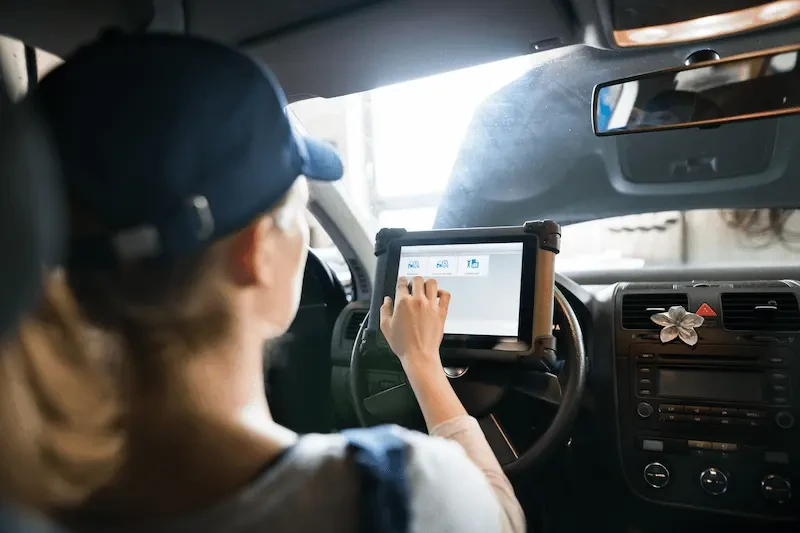
- Scanning and diagnostics: Autel, asTech, OEM
- ADAS calibrations: In-house (Autel)
- Measuring system: Chief
- Paint mixing and color matching: PPG Envirobase
For scanning, Malecha said OEM tools are his default for GM, Ford and FCA vehicles, with Autel and asTech covering other diagnostics work. "If I have the OEM scan tools, that is my go-to. So GM, Ford and FCA, I have all OEM scan tools. Any other vehicles are scanned with OEM equipment," he said.
He said the choice between Autel and asTech mostly comes down to speed for a given job, and asTech's remote capability lets an outside technician complete certain OEM scans. "It's not really choosing so much which one to use, it's more just from my experience of using them. I know which ones are a little faster for different situations," Malecha said. "With asTech, we have the remote. Let's say I have a Honda in and I need a remote OEM scan, asTech can remote in and do an actual OEM scan for me."
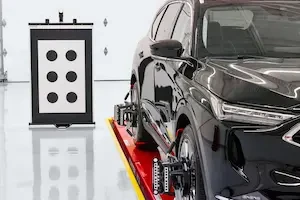
Autel, meanwhile, is the tool tied to the shop's in-house calibration work. The shop began performing ADAS calibrations in-house about six month ago, after building a dedicated calibration and detail center next to its main facility. "We built a new facility right next to our main facility. We purchased a property, a house that was right next to us, tore the house down, and built a calibration center as our calibration center and detail center," Malecha said.
He said the move was driven by concerns over how mobile calibration vendors were performing the work. "A lot of people have used the mobile calibration techs that come out, and the mobile techs, they're not doing calibrations correctly. They're not doing them to OEM standards," he said. "The first thing in any calibration, you need a wheel alignment check first, and it must be done on a level surface in a controlled environment. Well, a lot of these mobile guys are coming in and they're doing the calibrations in a parking lot."
He said the liability of a missed calibration outweighs any convenience of outsourcing it. "People don't realize if a front radar on a car is off one degree, how big of an effect that can have. It changes stopping distances and everything," Malecha said. "I don't want to have the liability of using an outside vendor and them not doing it correctly. When I know when we work on them, we're doing them the way they're supposed to be done. We've got a quality repair."
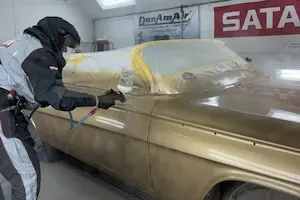
Malecha's Auto Body sprays PPG Envirobase waterborne paint out of two heated downdraft booths, which the shop has serviced quarterly. "We have two full GFS heated downdraft booths with a mix room in between. Our booths are only two years old," Malecha said. "Every vehicle, when we're done painting it, is baked, the finish is baked just like it is from the factory."
He said the booths get close attention. "Our booths are probably one of our most important pieces of equipment in the shop, and we take care of them like they're the most important," he said. "We actually have a company that comes in and services our booths every three months to make sure they're spotless and we're getting perfect repairs."
What technology could you not live without?
Malecha pointed to his estimating and shop management platform as the piece of technology the business could not run without. "Without having our estimating and management system, it would be a nightmare. I think that's one of the most valuable pieces of equipment in the shop, is the management system," he said. "You're always aware of how everything's happening."
He contrasted that with how jobs were tracked when he started in the industry. "I remember when I started, everything, you're walking around with a notebook, writing down your parts list, writing down what vehicles are where they're at," Malecha said. "Now it's just clicks of buttons, and you know everything that's going on."
Before bringing in new equipment, Malecha said he relies on shop owner groups on Facebook and in-person conversations with vendors at SEMA. "I rely a lot on the groups I'm on, collision repair groups and shop owner groups on Facebook. We get in conversations all the time ... what do you think about this piece of equipment," he said.
Malecha said the shop typically holds off on major purchases until after he and his wife attend SEMA. "I spend pretty much two, three days out there just on the auto body equipment floor, just talking to the reps, and being able to use the equipment and really see what it does," Malecha said. "It's so nice because there's not a lot of vendors that will load up equipment and bring it to you to try, because so much of it's so large."
Vehicle trends coming through the door factor into those decisions, too, he said, pointing to the shop's purchase of battery lift tables to accommodate EVs. "We had to buy battery lift tables because of the EV vehicles. We just kind of based it a lot on what we're seeing for vehicles coming through the door," he said.
Want to see your shop's setup featured in Shop Stack Breakdown? Every edition profiles a collision repair shop and the technology behind its operation. Fill out our intake form and we will be in touch.