
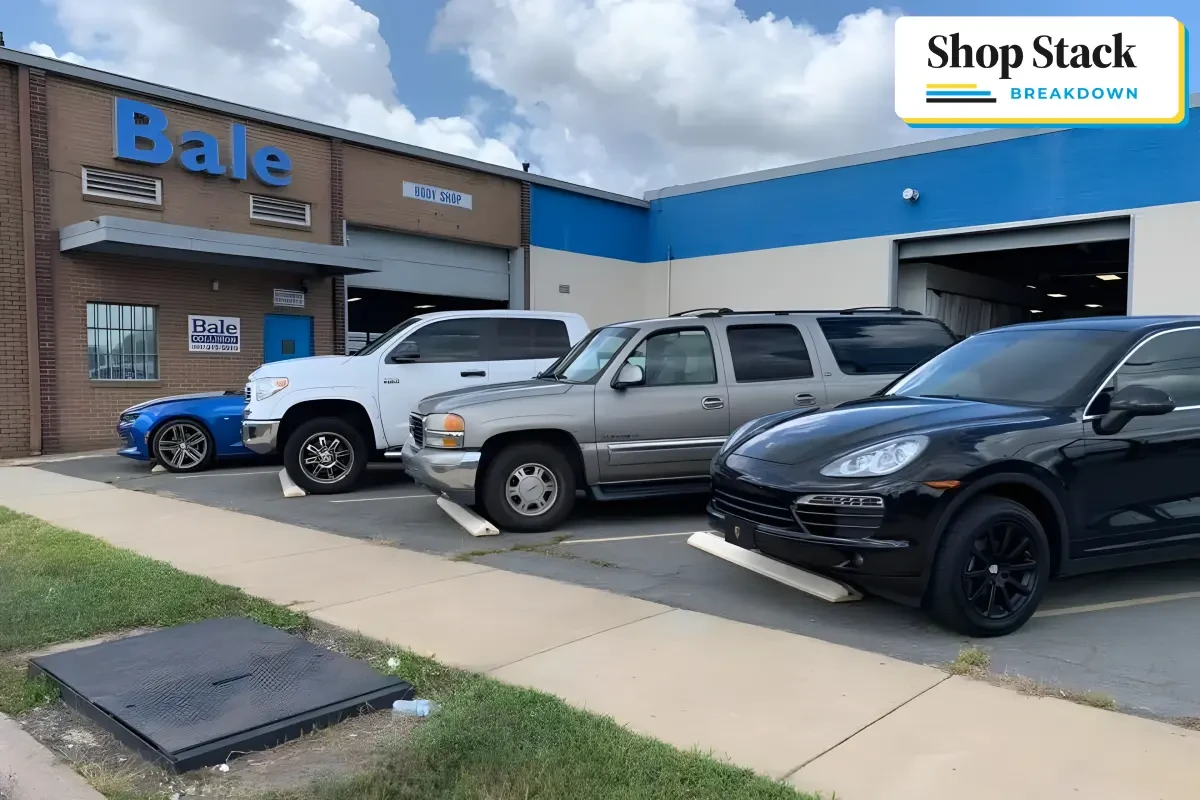
Bale Collision Center has been part of the automotive landscape in Little Rock, Ark. since 1958, operating under the broader Bale Automotive Group that dates to 1912. The two-location, 25-person dealership shop holds a General Motors certification and runs a mix of DRP, customer pay, and organic insurance work across its locations — one in downtown Little Rock, one at the dealership campus.
David Cates, who serves as body shop manager, joined the collision side of the business in December 2025, bringing a background in management but not yet in collision repair. Jason Spiller, Bale Collision's collision director, has spent 12 years in the industry and also runs a separate company, Tech Xpress, that Bale Automotive co-owns and uses for ADAS calibrations, safety inspections, and mechanical work.
For Cates and Spiller, the technology stack reflects a deliberate preference for consolidation and control: keeping systems few, keeping vendors accountable, and keeping as many operations as possible under the ownership umbrella.
THE STACK
Estimating and Management
- Estimating: CCC
- Shop Management: CCC
- Parts Ordering: CCC, CollisionLink, PartsTrader
- Accounting/Financial: DealerOps and Dealertrack
- DRP/Insurer Portals: Entegral
Bale Collision runs CCC for both estimating and shop management. For Spiller, who has worked across multiple platforms, coming back to Bale and finding one unified system was a relief.
"When I came back to Bale, that's all they were using was CCC for their whole operation for collision, and for me it was really nice," he said. "You can get bogged down in a business that can be very admin heavy. You can't get bogged down with having to go into too many systems."
Parts ordering draws on CCC, CollisionLink, and PartsTrader. According to Spiller, the split across platforms comes down to carrier requirements and parts pricing structures, with different insurers and manufacturers favoring different procurement channels.
Communications and Workflow
- Customer Communication: Body Shop Booster, CCC
- Internal Communication: Carbeat and email
- Photo and Documentation: CCC
- Scheduling/Capacity Planning: Body Shop Booster, CCC
- Digital Vehicle Check-In: No
Customer-facing communication runs through both Body Shop Booster and CCC, with the two platforms serving different functions. Customers are scheduled in Body Shop Booster, which then rolls the appointment into CCC's scheduler, but the sync is one-way. Updates entered in one system have to be manually entered in the other.
"You can update the customer in Booster, but it doesn't update in CCC," Cates said. "You have to manually put that in there, so they don't necessarily talk to each other as far as updating."
Body Shop Booster's value, Spiller said, is in its flexibility for outreach and follow-up. The platform allows the shop to set up automated messages and send links easily, in a format that tends to land better with younger customers. Spiller noted he recently received an automated follow-up from a vehicle he had in for repairs a year ago.
"It's just a little bit more flexible on how you use it to gain opportunities and follow up with customers," he said.
Internal team communication and production tracking runs through Carbeat alongside email.
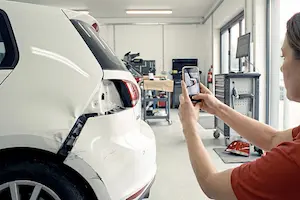
Bale Collision does not currently have a formal digital vehicle check-in process beyond what the CCC mobile app supports. Staff use the app to photograph vehicles and push documentation directly into CCC, but the shop has not added a dedicated tablet-based check-in workflow. For Cates, that's a deliberate choice rooted in the shop's customer service philosophy.
"We don't want to get into too many systems that takes more time away from that personal touch with the customer," he said.
Spiller framed it similarly. Bale Automotive has operated since 1912 on handshake communication, and while digital tools have their place in the shop's workflow, they're used selectively.
Repair and Production Technology
- Scanning and Diagnostics: VSSTA
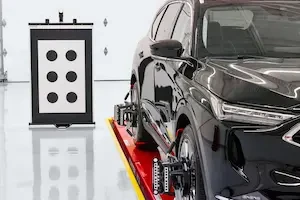
- ADAS Calibrations: Sublet (Tech Xpress)
- Measuring: Car-O-Liner
VSSTA handles scanning at Bale Collision across three stages of each repair: a pre-scan at check-in, an in-process scan after repairs are completed to confirm codes are cleared, and a post-scan as the final step before delivery.
Cates described how the three-scan workflow functions as a liability record. If a fault code was present when the vehicle arrived and remains after repair, the pre-scan documents that it predated the collision work.
"If there's something wrong with the PCM or something like that that's not accident related, we've got something we can stand on saying that the code was in there whenever it came in," he said.
ADAS calibrations are sublet to Tech Xpress, the calibration and safety inspection company that Spiller runs in parallel with his role at Bale Collision. Bale Automotive holds a partial ownership stake in Tech Xpress, which also performs work for other shops. Spiller said the arrangement reflects a broader principle: rather than fully subletting a function the shop can't control, take an ownership position in the vendor.
"I believe that trying to have as much control on all operations that some shops may sublet out is very important," he said. "With the liability that I believe is coming with more advanced vehicles, you better make sure you know what's being done."
What collision repair technology could you not live without?
Cates pointed to the paint booth as the shop's most essential piece of equipment — the one thing that makes professional collision repair output possible.
On the technology horizon, Bale Collision has been evaluating a new piece of equipment for the calibration side, something Spiller described as not quite a robot, but automation that could significantly increase throughput without reducing headcount.
How Bale Collision vets new technology
For Cates and Spiller, the evaluation process for new tools runs primarily through peer networks. The shop participates in both national and regional 20 groups, where members can ask whether others have tried a tool, what the experience has been, and whether the return on investment justified the cost.
"We kind of talk amongst ourselves. If somebody's tried it, we ask them how it worked and if it's worth the money," Cates said.
The broader goal driving technology decisions at Bale Collision is cycle time reduction. Shorter cycle times directly affect DRP referral volume, and combined with strong CSI scores, they form the foundation of the shop's insurer relationships.
Want to see your shop's setup featured in Shop Stack Breakdown? Every edition profiles a collision repair shop and the technology behind its operation. Fill out our intake form and we will be in touch.



Lisa McArdle