


Use of artificial intelligence within collision repair shops isn’t limited to just the office.
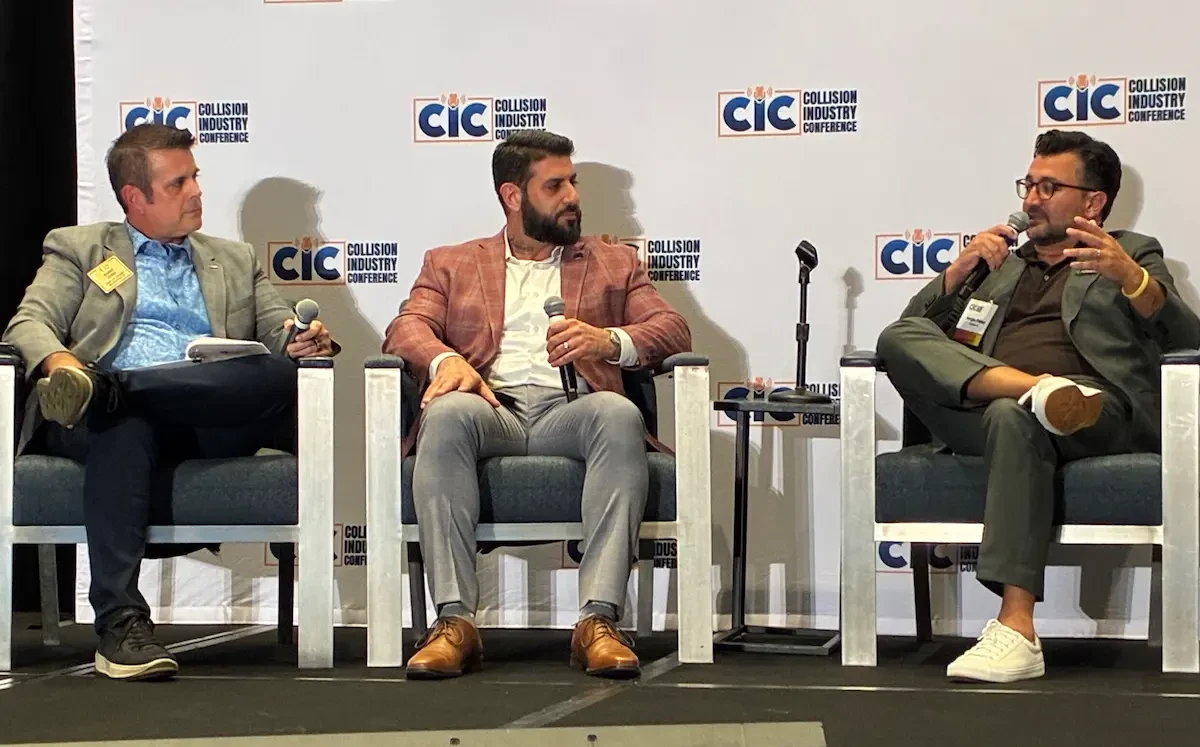
During a discussion at this summer’s Collision Industry Conference (CIC), Nader Akbari of Central Florida Paint and Body said his company uses the AI tool Carmic to help technicians pull information they need from the OEM procedures. Akbari said he likes it because the process still relies on the expertise of the repair planner — who really understands the automaker service information — to compile the needed information relative to the repair.
“But then it really saves time for the technician to just ask the AI,” Akbari said. “The AI is only looking at the documentation that the repair planner has put in there, and the repair planner has taken the time to put in the accurate information for that specific repair. AI can be a tool to identify one-time-use parts and things like that. Torque specs, something super important that takes a lot of time to find, they can just ask it. If they need a visual, they can ask it, ‘How do you remove this bumper?’”

Nader Akbari said the right AI can save technicians time pulling important information from the OEM repair information already uploaded for a particular job.
Sergio Palma, founder of Carmic, said the system can help technicians find things they need to know that are more unique to the specific job they are working on.
“Once you’ve loaded up the OEM procedures, what’s in those OEM procedures? Maybe safety considerations and other materials that you might not think of that are special to that vehicle,” Palma said. “You can ask an AI, prompt it: Can you find me anything that is pertinent to repair this specific repair line item? And it can come back with a list of torque specs, materials, adhesives, any safety procedures, even maybe required photos you’ll need to maximize your reimbursement documentation. That all can be done with the right AI prompt. The intelligence is there as long as you feed it the right amount of information, which is in your OEM docs to begin with. So, you’re probably already pulling these, but you’ve got a goldmine of information that can level up your safety, your liability protection and, the key part, your profitability.”
Verifying that repair plans are followed
Akbari said he also uses Carmic to help track technician's work.
“It’s one thing to write a really good repair plan. It’s another thing to make sure that all of those processes get followed,” Akbari said “So, one thing that AI has really helped with us is after we create that repair plan and ingest it into the software, and as we assign the labor, it will actually create a checklist for each technician. That technician can check off all the items that are assigned to them, and include a photograph of the assignment being done. I’ve always had that concern that we take hours to write a great repair plan, but then is all of this stuff actually happening? That’s where AI has been critical for me.”
Applying off-the-shelf AI and equipment upkeep
Palma said a shop bringing together the OEM procedures for the repair plan for a job and dump that information into even an off-the-shelf AI — Claude, ChatGPT or Gemini — and use it to glean helpful information.
“Throw them together and ask, ‘What am I missing here on my repair lines,’” Palma said. “‘Call out any safety procedures or inspections that I should be doing. Boom, it can do that.”
Akbari said he’d also like to use AI to help with important but often overlooked tasks such as maintenance of shop equipment.
“If you give it the information on what equipment you have, and basically teach it what the schedule is for maintenance, it can kind of create and streamline that process for you,” Akbari said.





John Yoswick