

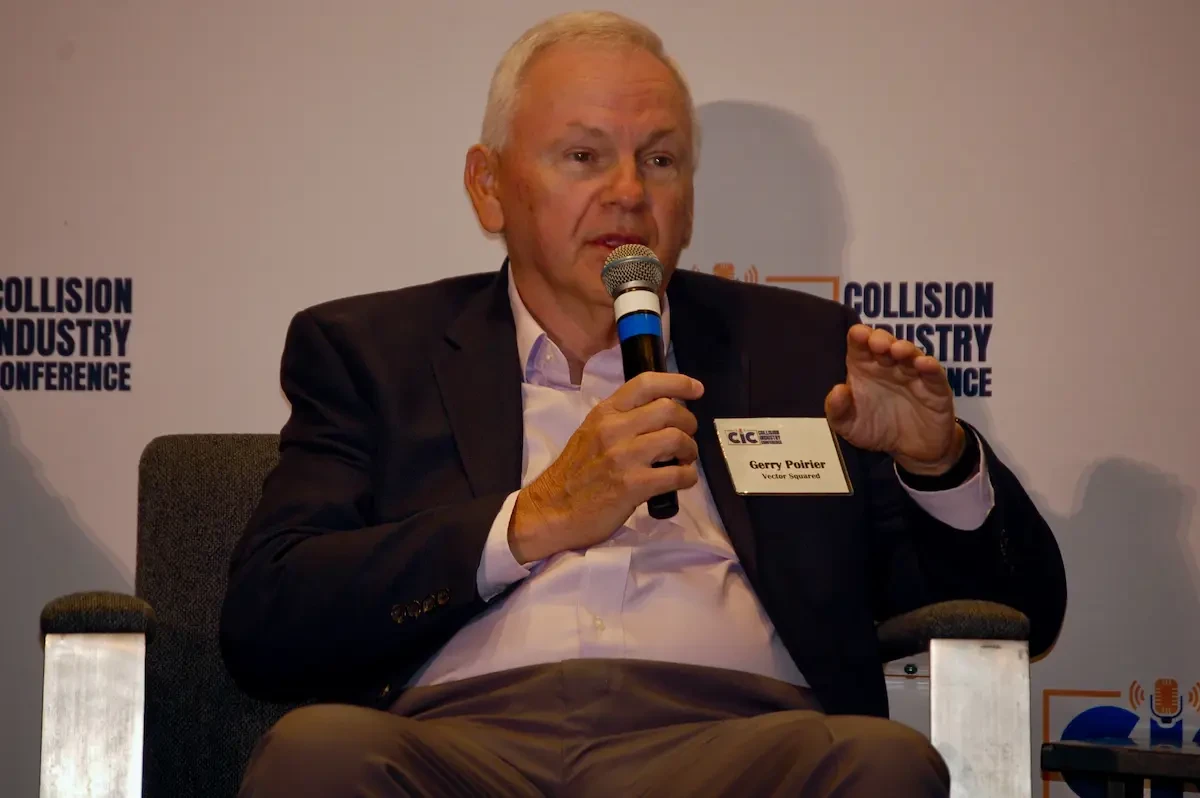
Collision Industry Conference (CIC) panelists discussing the post-crash vehicle safety inspections required by some automakers all agreed those procedures have become a serious point of contention between shops and insurers. But they also offered some suggestions for easing some of that friction.
Gerry Poirier, a former insurance company claims executive who is now a consultant with Vector Squared, said the issue often comes down to the insurance contract language. That language obligates insurers to repair or replace the policyholder’s vehicle, but doesn’t say anything about such “inspections.”
Porier said he thinks some of the debate could be reduced if there was a way for shops certified by an automaker to get data about findings from safety inspections — how often steering columns are collapsed, for example — back to the OEM.
“I think the insurers can buy into that because there’s actually data behind the request, that ‘We’ve actually seen this in these cases,’” Poirier said. “When is it damaged, when is it not damaged. By providing this feedback to the OEMs, it could limit the amount of times that [the inspections] have to be done rather than inspecting everything across the board. I think insurers would have an easier time of understanding.”
Other calls for more info from shops, OEMs
Nader Akbari of Central Florida Paint and Body agreed that more data on the types and number of issues the inspections uncover could help, but to be effective, that will require that more shops regularly perform the inspections.
“We’ve got tons of examples, photos, documentation [of such issues found] at our shop,” Akbari said.

He also sees a need for more education about the inspections for shops and insurers. “Even little things like making sure that the dealership service departments are aware of this,” Akbari said. “A lot of times, a carrier that might not understand the need for it or doesn’t want to look through the documentation that we provide will pick up the phone and call the dealer service lane, and the service guys are just unaware of the process because it’s not in the scope of daily work that they come across. So, I think educating everybody is key.”
Industry trainer Mike Anderson of Collision Advice agreed, noting that Nissan created a required training module for dealership service departments on the topic. He also concurred with other panelists who said the automakers need to offer more clarity on when specific inspections need to be done.
“I think there’s also a huge opportunity for companies with computerized measuring systems to incorporate some technology to measure steering columns or steering gear assemblies as opposed to [shops] using a frame gauge or something like that,” Anderson said.
Gerry Rosenbarker of Mohawk Collision Center in East Glenville, New York, also believes there are ways automakers could help reduce the need for some of the inspections.
“With the technology we have in these vehicles, they can drive themselves, they can communicate with each other,” Rosenbarker said. “We certainly should be able to tell if a [steering] column is collapsed without having to take it out, disassemble the dash and physically measure it. That seems to me to be an easy fix.”
He said some standardization across vehicle brands could also help reduce the time and cost involved.
“It’s not a ridiculous amount of equipment that’s required,” he said. “The vast majority of it you can get into for under a couple thousand dollars. But it gets a little more difficult and costly because we repair such a broad spectrum of models of vehicles, and there are variations on the requirements for each one.”
I-CAR working to play a role
The panel discussion’s moderator, Bud Center, director of technical products and curriculum for I-CAR, said his organization has made some effort to collect industry findings from the OEM vehicle safety inspections. Back in 2021, I-CAR posting a form shops could use to submit information on what they are seeing related to supplementary restraint systems (SRS) during OEM safety inspections. Months later, I-CAR reported having received only about two dozen submissions through that form, with more than half of those coming from one shop.

“We are still under 200 total, just 125,” Center said at this summer’s CIC, more than five years after the form was posted. “How many cars get fixed every year, and you only have 125 submissions?”
“I think that’s interesting because I would say we’ve found more than 125 problems [through safety inspections] just on vehicles we’ve repaired in our shop,” Rosenbarker said. “So, it’s a lack of people taking the initiative to send things in to [I-CAR]. And I think it’s also a lack of education on shops’ behalf. I think until a shop really sees something for themselves, sees a damaged pillar or collapsed steering column [they would have missed without the safety inspections], I don’t think they’re going to take it that seriously.”
Center said I-CAR has a number of articles and videos related to such inspections, including nearly a dozen on steering column measurement alone “because we get so many inquiries from people in the field and find that people just don't understand how to properly measure them.”
“We need to get everybody educated on what these safety inspections are and what’s required,” Center said. “I can tell you from an I-CAR perspective, we’re planning to build that type of curriculum in the very near future. So, you will see things coming out from us on post-collision safety inspections.”






John Yoswick