

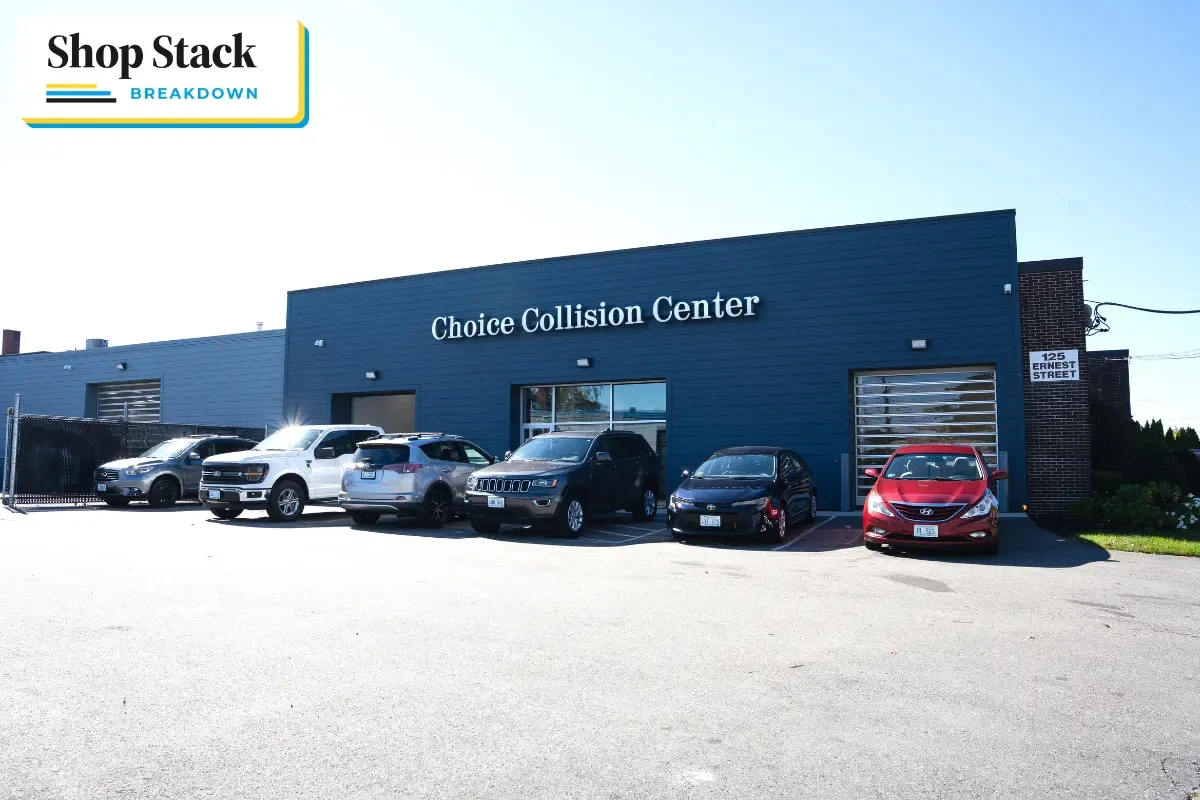
Steve Melo started Choice Collision Centers 29 years ago in Fall River, Mass., after growing up around his father's body shop and swearing he would never join the industry. A senior year in college changed that: a vacant building came up for sale with seller financing attached, and Melo bought it.
Today, the I-CAR Gold Class-certified Choice Collision Centers operates two locations — a 35,000-square-foot facility in Providence, RI and a second shop in Fall River — and holds 11 OEM certifications between them. The Providence location moved from Warren, Rhode Island, in pursuit of a bigger population base and better state-level repair regulations and has more than tripled production volume since. Production Manager Brennan Thacker, who grew up working at the shop as his stepfather Melo's business expanded, now runs day-to-day operations alongside him.
THE STACK
Estimating and Management
- Estimating: CCC One, Mitchell
- Shop Management: CCC One
- Parts Ordering: CollisionLink, Auto Parts Bridge, CCC One
- Accounting: QuickBooks Desktop
Choice Collision Centers writes estimates in Mitchell only for Progressive claims, a platform requirement from the insurer, then exports those estimates into CCC One's management portal. Every other estimate (other insurers, walk-ins, and additional work) runs through CCC One.
Melo said the all-in-one structure of CCC One was a deliberate choice after reviewing demos from other vendors. “It's nice to have, and I guess that's why CCC calls it CCC One, because it's all in one,” Melo said. “You're not jumping around different platforms, which makes it a little more efficient.”
Parts ordering runs through CollisionLink, Auto Parts Bridge, and CCC One simultaneously, with the shop price-matching across all three platforms on a given order. Melo said the system has not yet been standardized industrywide, so running the same order through multiple platforms can produce different prices for different parts within it.
"If you were ordering 10 parts, you potentially could order three parts from Parts Bridge and seven parts from CCC One," Melo said. "If you want to get the most profit, you should be using multiple platforms, because right now they haven't perfected it where all the prices are equal."
Melo also described how price-matching works on OEM versus aftermarket parts when a vehicle qualifies for an aftermarket option. The shop runs the aftermarket price through its parts portals, and the OEM manufacturer matches that price for an OEM part. The insurer pays the aftermarket-level estimate, the shop installs a factory part, and the customer receives OEM equipment.
"We, as the shop, are using an OEM part, but the insurance company is paying for an aftermarket part," Melo said. "The technician wins because they're not wrestling with an aftermarket part, and the client really wins because they're getting an OEM part."
Communications and workflow
- Customer Communication: Kenect, CCC One
- Internal Team Communication: Microsoft Teams
- Photo and Documentation: CCC One
- Scheduling/Capacity Planning: CCC One
Customer outreach runs through Kenect, which the shop uses for calls, texts, and preset replies covering vehicle drop-off, appointment scheduling, and after-hours pickup and drop-off instructions. The platform also supports multilingual texting, allowing the shop to follow up a voicemail left in Spanish with a text in Spanish.
Melo said text-based communication outperforms voicemail for reaching customers who are unlikely to answer or return a call from an unrecognized number. "It's 2026. I don't listen to voicemails ever," Melo said. "But you will respond to an email, you will respond to a text."
When CCC One's standard production board fell short during a high-volume winter, Thacker built a custom replacement. He exports a pre-formatted Excel report from CCC One each morning and afternoon and uploads it to Lovable, an AI development platform, which generates a production board with added notes and phase-tracking detail for each job. Thacker said he is exploring CCC Secure Share as a way to automate that data transfer rather than manually uploading reports.
"It kind of mirrors the CCC production board, but it just has a little more information, and it's a little more fluid," Thacker said. "It has notes on the front of the card, so I always know where the job is and what's going on with it. It tells me if a job's stuck in a certain phase."
Repair and production technology
- Scanning and Diagnostics: OEM scan tools, asTech
- ADAS Calibrations: In-house (Hunter Ultimate ADAS), transitioned from sublet roughly four years ago
- Measuring System: Car-O-Liner
- Paint Mixing and Color Matching: BASF
- Spray Booths: Three Global Finishing Solutions side-loading downdraft booths
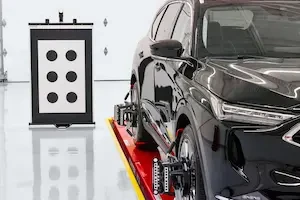
Choice Collision Centers brought ADAS calibration in-house about four years ago and now performs it on a Hunter Ultimate ADAS system. Melo compared the move to the shop's earlier decision to stop subletting alignments after recurring delays with outside vendors.
The more you can control, the more efficient you are, Melo said. "Every capable collision center should be doing their own ADAS, because there's a lot of money that they're giving away when they're not doing it themselves."
The shop added in-house windshield calibration work more recently, expanding on glass work it already performed for quarter glass and back glass. The change followed a winter in which the shop's longtime glass vendor, hit with a backlog from a severe regional storm, could no longer turn around quarter glass, back glass, and liftgate transfer work on schedule.
"It's making us more efficient; it's also making us more profitable," Melo said.
The shop's three spray booths are side-loading models that allow technicians to fully mask and prep a vehicle on rolling skates outside the booth before it goes in to paint, rather than completing final masking once the vehicle is already inside. Melo estimated the setup saves 15 to 20 minutes per job compared to traditional booths.
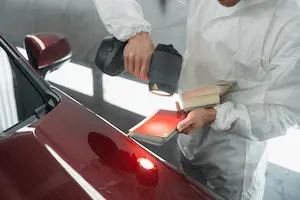
Choice Collision Centers has used BASF's Glasurit paint line throughout its history. The shop also recently brought on 3M RepairStack, an automated material management system installed roughly six months ago that tracks consumables such as body filler through scan-out cabinets and triggers weekly restocking.
The shop uses UV primer rather than urethane primer for most repairs, citing curing speed as the deciding factor. Melo said UV primer cures fully in about three minutes under direct UV or sunlight exposure, compared to a 30-day cure window for urethane primer at a minimum of 68 degrees, a temperature New England does not reliably offer outdoors.
What technology could you not live without?
Both Melo and Thacker pointed to certification-driven equipment as central to how the shop evaluates new purchases. Melo described OEM programs such as General Motors' Cadillac certification as requiring specific specialty tools — in that case, an additional rivet tool beyond what the shop already owned. Thacker added that planning the buildout of the shop's newly converted production space involved working backward from certification equipment requirements, including a two-post lift rated to handle the weight of EV battery packs in vehicles such as the Rivian or Tesla.
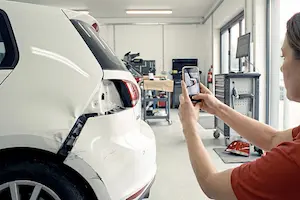
On the technology horizon, Thacker said the shop is evaluating Record360, a vehicle inspection and documentation platform that captures video of a vehicle at intake and flags visible damage on a model overlay. He said the appeal is being able to show a customer exactly what condition their vehicle was in when it arrived, reducing disputes over pre-existing damage at delivery.
Melo said the shop is not planning major new equipment purchases in the near term after recently converting production space but is actively pursuing additional luxury-brand OEM certifications that require manufacturer sponsorship, which are decisions he said can take months to materialize.
"It might be a no today, and it might be a yes in six months," Melo said.
Want to see your shop's setup featured in Shop Stack Breakdown? Every edition profiles a collision repair shop and the technology behind its operation. Fill out our intake form and we will be in touch.



Lisa McArdle