
The market for artificial intelligence (AI) systems embedded directly in vehicles is projected to expand nearly sixfold over the next five years, growing from $43 billion in 2025 to $238 billion by 2030, according to a Frost & Sullivan study released Dec. 16.
The report, sponsored by software-defined vehicle technology provider Sonatus, projects a 40% compound annual growth rate for in-vehicle AI adoption across Europe, North America, and Japan. The growth is being driven by automakers' investments in centralized computing platforms, over-the-air update capabilities, and adaptive intelligence systems that enable vehicles to adjust performance based on real-time driving conditions.
"AI at the edge is reshaping the fundamentals of the automotive industry, moving from isolated use cases to a central role in how vehicles are designed, operated, and monetized," said Ajit Chander Swaminathan, associate partner head of mobility Americas at Frost & Sullivan.
From cloud to edge
The study identifies a structural shift underway as AI moves from cloud-based processing in premium vehicles to mass-market, in-vehicle edge execution. Edge AI enables vehicles to process data locally in real time, improving responsiveness while reducing latency — a shift that allows safety-critical systems to operate without relying on remote servers.
Frost & Sullivan's analysis quantified the financial impact of AI-driven vehicle intelligence for automakers, estimating multi-billion-dollar gains by 2030 across several categories. Energy efficiency improvements are projected to rise from $2.84 billion in 2025 to $20.93 billion by 2030. Warranty cost reductions are expected to increase from $650 million to $11.77 billion, while battery degradation mitigation is projected to grow from $720 million to $6.10 billion over the same period.
OEM investment outlook
Not all automakers may be able to sustain the pace of investment required to capitalize on in-vehicle AI. A separate Gartner forecast released Dec. 8 predicts that by 2029, only about 5% of automakers will maintain strong AI investment growth, down from more than 95% today.
"The automotive sector is currently experiencing a period of AI euphoria, where many companies want to achieve disruptive value even before building strong AI foundations," said Pedro Pacheco, VP analyst at Gartner. "This euphoria will eventually turn into disappointment as these organizations are not able to achieve the ambitious goals they set for AI."
Repair complexity on the rise
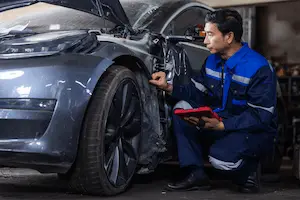
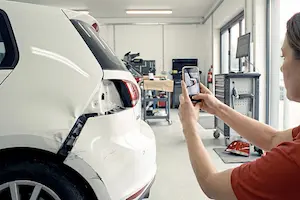
Separately, industry analysts are tracking how the proliferation of AI and ADAS technology is affecting collision repair operations.
S&P Global Mobility, in an August 2025 analysis, found that the deeper integration of these technologies "will reshape the service industry from a repair and calibration standpoint." The firm noted that sophisticated AI-enabled systems "will require a much higher level of precision and technology integration into workshop collision repair processes, increasing repair costs in the event of an impact."
S&P Global projects the number of cameras in U.S. vehicles will grow at a 4.4% compound annual growth rate, from 50 million units in 2024 to over 65 million by 2035, while radar sensors are expected to increase from 39 million to approximately 50 million units over the same period. "Workshops will have to invest in equipment, tooling and training to handle ADAS-related work, particularly calibration, and integrate these into their workflows to remain competitive," the firm stated.
Calibration workload expands
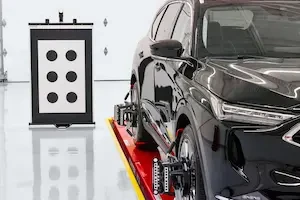
The calibration workload is already expanding rapidly. CCC Intelligent Solutions reported in its Q4 2025 Crash Course that calibrations now appear on 35.6% of DRP estimates, up from 26.9% in the same period last year — a jump of nearly nine percentage points in 12 months.
"The proliferation of ADAS has made diagnostic scans and calibrations a routine part of the repair process," CCC stated. "Calibrations are not only costly but also add significant time to the repair cycle."
CCC's data showed that repairs involving multiple calibrations averaged more than 17 days keys-to-keys, compared to 13 days for repairs with no calibrations — a gap that underscores the operational impact as ADAS-equipped vehicles become more prevalent in the repair stream.
Sonatus, which sponsored the Frost & Sullivan research, says its AI toolchain and in-vehicle orchestration technology is embedded in more than 6 million production vehicles. The company will showcase its software-defined vehicle technologies at the Consumer Electronics Show in Las Vegas, Jan. 6–9.