


Can you opt out of AI? Maybe you already have, or decided to, or think so.
It’s not completely possible, as collision work, like most other kinds, includes a slew of invisible interactions with artificial intelligence, if only with outside companies, people and actions: contacting insurers, using a smart phone or paying bills.
But not only that, since AI is already here. Owners and operators hear the phrasings about its inevitability — often meant to nudge you toward further acquiescence, often from a vendor — but the truth is some go slow with tech adoption all the time. There’s even a term for it.
Seeing, Hitting the Curve
“The laggards are 16% of any industry … 16% of our industry,” Ryan Taylor told Autobody News.
The word and number stem from an idea emergent in the 1960s on “diffusion of innovations” that gathered real steam as recent technology — like Steve Jobs and Apple — came to the fore. A curve graphing it charts 16% each for “innovators”/”early adopters” and “laggards,” and 34% apiece to “early” and “late” majorities.
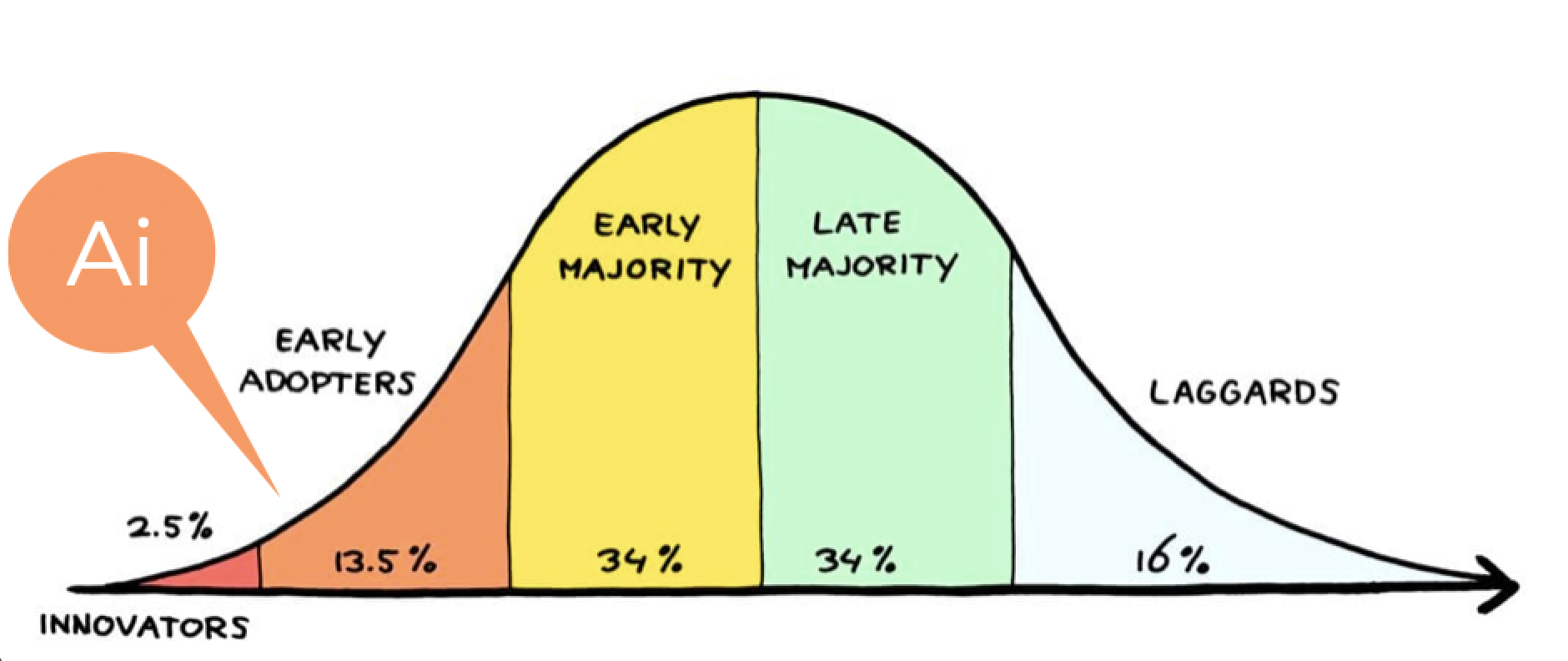 AI in collision repair is still in the "early adopters" stage of acceptance. Image via BodyShop Booster.
Incorporating innovation follows five steps: knowledge, persuasion, decision, implementation, confirmation — completing the path if innovation is accepted rather than rejected at its “decision” stage, according to the theory.
“They’re kind of what we call ‘holdouts’,” said Taylor, who runs AI-based software suite BodyShop Booster. He likened laggards to collision center operators happy with their current paint gun.
You could also just call them “happy,” or at least satisfied.
Small Ball and the Art of Bunting
Ignorance might be bliss, but it’d still be ignorance. We can be satisfied for unhelpful reasons.
Taylor said AI laggards in collision repair could be those who “just go until they run out of cash or they’re just barely surviving, or they’re going to stick to the old ways of doing restorations or some kind of work,” he said.
Not until the end of the list do reasons start to sound good or even fun. So custom guys might not need to care much about AI.
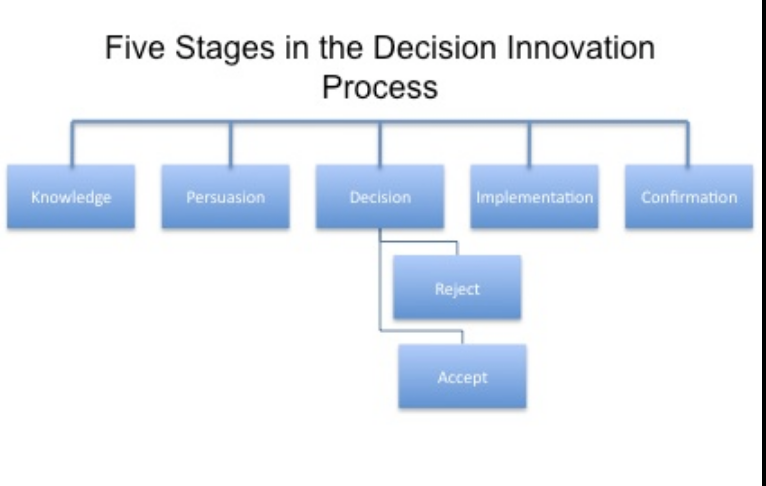 Incorporating innovation follows these five steps. Image via BodyShop Booster.
“I changed my shop to straight restoration motorcycles and customs,” Florida operator John Bia said via social media. “I’m so happy.”
Depending on if such customers want a classic exterior on a bells-and-whistles machine, it could end up being no big deal. Operators pull back like Bia to focus on custom, and because they’re nearing retirement or selling. Let new owners decide; they’ll want to choose for themselves anyway. Or an owner plans to outsource ADAS, avoiding other newer kinds of work.
Veterans and Rookies
Body shop veterans are often AI rookies. If AI is here, and it is, it will be in your shop because it’s in cars.
“It’s usually really hard for [operators] to make a living” opting out, Taylor said. Bia added, “The market is still the way it is for this type of work.”
Newer cars of course incorporate AI into onboard systems, and this will only grow. Add to that insurers being at AI for so long it hardly bears noting, except it was what got things rolling about five years ago, and they’re invested enough now to be training adjusters with — you guessed it, AI tools from start-ups like Symphony — while developing ways to fight AI fraud in the estimating protocols they backed or developed during the pandemic.
Initially, AI-based estimating products focused on that market, insurance, and the bigger fish in automotive: dealer groups, rental car companies, auctioneers, fleet management. AI-shoppers with thousands of cars that need care or at least monitoring, and could afford the hardware installs.
But costs have dropped. Early pre-estimate player Tractable can run a couple hundred bucks a month, users say. And offerings from overseas such as Ravin AI, or in collision-adjacent industries such as auctions, like Claim Genius, say they’re ready to serve body shops.
AI is touching more operational areas as well, including call centers and intake, pre-screen job interviews and marketing. This doesn’t mean they’re great at that — Autobody News knows of a marketer exploring AI-based promotion itself, whereas a second doesn’t even like it answering the phones.
And one might ask, who does? Automated systems drive us nuts, so why would we inflict it on our customers?
Perhaps there’s a way to buy-in minimally, as an initial bot-contact/immediate response? Maybe there’s value in a “sales funnel plus,” the proverbial business-builder followed by personal follow-up.
“People want personal interaction; they don’t want to spend an hour with AI,” Taylor said. “We are transparent, and encourage our shops to be transparent. Tell your customers, ‘This is AI.’”
Point being, don’t see AI as all or nothing — talk about a rookie mistake — and look at how it can help.
Fans Pay to Watch the Game
If your customers see AI as imperative, shop operators must be up to speed, with AI elements and options available and the knowhow that goes with it. If they don’t, they’ll expect you to know why that code came up and what to do about it.
You’re not certain what AI means for your life, but your customers might be even less sure, and they’ve just had a collision. They’re looking for someone knowledgeable who perhaps they even already know and trust. A LinkedIn survey this summer suggested a third of respondents are embarrassed by how little they know about AI, more than half of working professionals compare learning AI to having another job, and more than three-fourths of some surveyed said they vet brands through their personal networks.
That’s a possible profile of collision customers — and collision centers.
“I’d encourage shops to think about how right now, we’re in the early adopter stage,” Taylor said. On the graph, this means the second-earliest of the AI adoption behaviors.
Back-and-Forth Slugfest Goes to Extra Innings
Taylor connects this to a term you may have heard, the “first mover advantage” — where “early adopter” collision shops create benefits that shops who join-in later don’t get. Shops realize results sooner, including some that are unavailable to the same degree at later stages.
He noted, for example, shop relationships with dealers, who’ve already begun working with AI. They expect it in others. Or your shop has a QR code on its marketing materials and other communications, giving collision clients quick access to estimates or information about their in-process repair.
Some benefits come when you eventually do it, but the lost months are just that: lost.
“If they’re late to the game, they’ll still get” the benefits, Taylor said. But “will that lift be there in time?’
The flipside is the risk — the innovation diffusion chart is a classic rendering of an even older concept, that of risk-reward — of costs, choosing an untested product, committing to one AI product that won’t play well with the next one.
The QR code is a good example. It emerged more than a decade ago and was a “next big thing” of the moment for businesses marketing themselves. But consumers didn’t get the memo, or the technology: they were literally confused. Businesses in thrall to it weren’t any better — for instance, putting QR codes on highway billboards, where they couldn’t be scanned.
Same with virtual reality and augmented reality, both supposed to be monster hits for consumer entertainment, but the truth being not so much. And let’s not even get into AI-augmented reality, which is said to be coming… someday.
As they developed, QR codes and VR/AR found application. The latter, for instance, has a niche with business for training and trade show demos, among other areas. The former is now not uncommon electronically, and on hard-copy materials, such as the flier one body shop uses to send people to its AI estimating, in 90 seconds.
Taylor said QR codes were restrained by camera quality and requiring a special app to use. “What changed was the camera’s ability and Covid,” as tech advances and businesses were being forced to find new ways to connect.
Making the Playoffs
But that’s the risk-reward point. You can get in early and see gains, but you’ll also be “first-mover” on the headaches.
“Some shops will feel this way,” Taylor said. “I can wait, I can take my time, weigh efficiencies and benefits, potential costs.”
This is of course good general advice for any business choice, but timing affects it. Taylor cited a “massively increased administration burden” today, compared with 30 years ago. Artificial intelligence can help, he said. Yes, there’s an AI app for that.
Then remember it’s a long season: play the long game. If innovation in all industries follows this general path, and because business decisions are made amid multiple overlapping — sometimes competing — priorities, it’s not something you have to do tomorrow, or all-in.
You’re a custom shop, or someone who doesn’t need or want 15% CAGR; a guy who loves working on cars, and wants to keep talking with real people — those could become differentiators. You’ll be the shop that does excellent work with certain unseen AI bits, and that’ll be more than fine.
After all, it might not matter what the industry is doing, since the only shops you compete with are the ones in your market — and in a significant sense, only the one you own.
But thinking AI estimatics are hooey because how can one possibly know what’s needed before a teardown could be as all-or-nothing as believing artificial intelligence will make you a millionaire.
But is it part of a package of consistent improvement? Is there a sales funnel to fill a little faster? Can a text bot taking calls over the weekend get you a couple more jobs a month, even if someone has to follow up for a half-hour with a few inquiries on Saturday morning?
There are plays at both ends of the adoption spectrum and collision repair seems to be taking AI with a measured pace. Just as you have the talent, you have the coach, and he might be telling you to “rest that arm” so to speak.
Adoption is always slow. The real headline is adoption is slow, even as options grow. If more operations applications are sprouting from AI’s mad speed skills, and you’re taking a measured approach, without cheerleading for tech bros quarterbacking an unknown-by-anyone future and without deep-sixing it all out of hand, it’s all opportunity for you.
It’s a buyer’s market, and you’re paying with cash.





Paul Hughes