


As collision repair businesses grow beyond a single location, the biggest threat can be internal inconsistency. What works in one shop can quietly break another, creating bottlenecks, uneven customer experiences, and lost profit that compound with every additional location.
In a recent episode of The Collision Vision, Sebastian Torres of CARSTAR Torcam Group, part of Driven Brands, shared how his organization confronted those growing pains while expanding to multiple sites. By centralizing key functions, rethinking estimating workflows, and deploying technology strategically, the group transformed operational chaos into a scalable system.
Tour Cam Group’s experience offers key lessons that collision repairers of any size can apply to strengthen operations and profitability. Here are the highlights:
Standardization may have to start centrally
Early expansion revealed a familiar problem: each shop operated differently, with inconsistent scheduling, workflows, and customer experiences.
“When we were running the third [shop], it was just separate silos. If you walked into one of my stores when we had the three of them, you wouldn't see a similarity between any of them,” Torres said.
In other words, running multiple locations as independent silos is difficult when it comes to sustainable processes and procedures. Growth may force structure, whether you plan for it or not.
So rather than forcing uniformity store by store, Torres built centralized, shared services to support the shops:
- A review desk to audit estimates before final billing
- Centralized accounts receivable and payable
- Group-level HR and health and safety support
This allowed shop managers and technicians to focus on repairs, not admin.
Key Takeaway: If you’re expanding with more locations, it’s easy for one shop to fall behind when you’re focusing on others. But standardization can work best when support functions are centralized, not pushed downstream to already overloaded shop teams.
The goal is to free production teams to focus on repairing vehicles while ensuring critical business functions are handled consistently and correctly.
AI tools work when treated as tools, not replacements
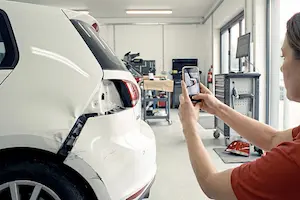
Torres piloted Solera’s mobile inspection app and Visual Intelligence (VI) estimating tool in just one shop before rolling it out more broadly.
“As soon as you realize that this is a tool and you still need the human intervention, this is when this tool becomes very, very powerful,” Torres said. “Once we got this tool, I said, ‘what if we use it as a scheduling tool and we started running it? ‘So that's where it got really, really cool.”
The technology didn’t replace estimators; it compressed time:
- Preliminary estimates dropped from 60-90 minutes to 10-15 minutes
- Estimators shifted from writing rough estimates to “grooming” higher-confidence ones
- Non-drivable vehicles could be scheduled faster and more accurately. Instead of doing one car in an hour and a half, they could now do four or five.
Key Takeaway: AI doesn’t eliminate estimator roles; it speeds up processes and workflows so humans can focus on accuracy and documentation.
Shops considering AI or automation should evaluate whether the tool reduces time spent on repetitive work, such as preliminary estimating or data entry, while preserving human judgment for accuracy, negotiation, and decision-making.
Faster front-end estimates improve back-end performance
Torres found that better estimates upfront led to tangible downstream benefits, including improved touch time and throughput, and reduced rental length.
“It's no secret that your profitability is at the estimate,” he said. “So if you have an accurate estimate and that car goes through the shop accurately and your length of rental is down and your touch time is up, then your throughput is going to be a little bit higher. So, with the same amount of people, you're going to be able to put through a little bit more cars with more profitable estimates.”
Key Takeaway: Front-end accuracy is still where profitability is won or lost because it affects nearly every downstream metric, from parts ordering to cycle time and rental costs.
Shops that want to improve throughput should examine intake and estimating processes first, and not just production efficiency.
Documentation reduces friction with insurers
With guided photo capture and stronger estimate documentation, Torres found that conversations with insurers became less adversarial and more straightforward.
“Our relationships with our insurers are amazing right now,” he said. “It's not this notion of the body shops versus insurance ... we're all on the same team, at the other end of that screen is another human that just needs to make sure they're doing their job correctly.”
Torres emphasized accountability: if it wasn’t documented, the group didn’t expect to be paid for it.
Key Takeaway: Strong documentation doesn’t just protect revenue; it can improve insurer relationships and reduce rework. When repair operations are supported by proper documentation, approvals tend to move faster and disputes can decrease.
Shops that struggle with payment delays or denials should evaluate documentation practices before assuming other problems are to blame.
ROI can show up quickly when you invest in technology
After implementing the new AI technology, Torres saw:
- A 2% gross profit increase in the first month
- Scaling to 6-7% GP improvement within six to seven months
What started as a two-tablet, one-store pilot has expanded to 55 tablets, with plans for every employee across CARSTAR Torcam to use one.
“When you talk about that, investment fees, it definitely does become more comfortable when you see that there are good results at the end of it,” said Torres.
Key Takeaway: Investing in technology doesn’t have to be a long-term gamble if the investment is made strategically and measured carefully.
For instance, starting with a small pilot allows shops to track real performance changes before committing a larger investment. When ROI is visible and measurable, it enables more technology adoption.
Culture enabled adoption more than technology
Despite major process changes, Torres reported little internal resistance. He credited transparency, explaining the “why,” and involving team members early.
“We work as a team. There is no ‘my way or the highway.’ I make sure everybody's involved in the processes,” said Torres.
Key Takeaway: Process adoption is a leadership issue, not a software issue.






Lisa McArdle