

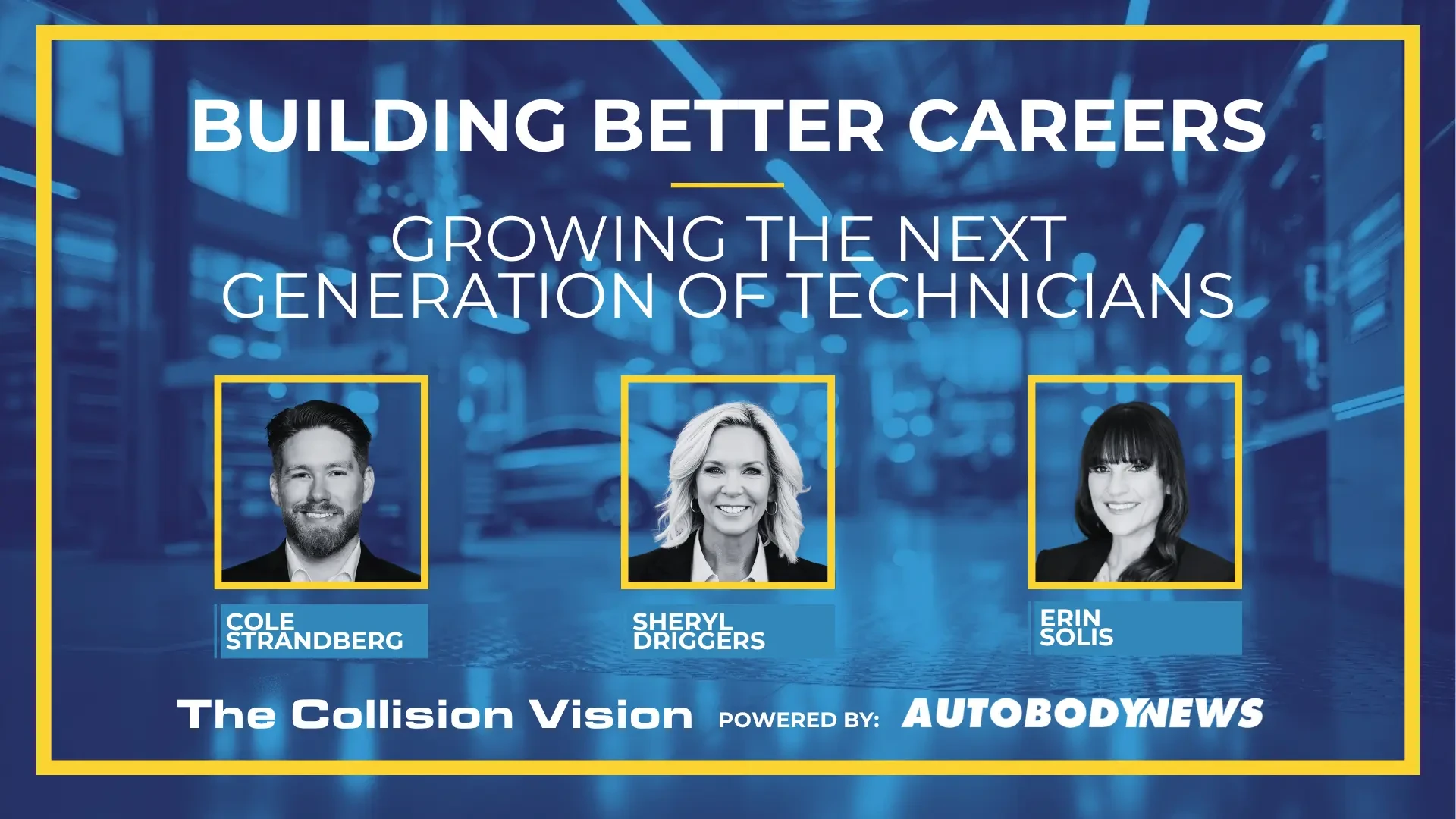
On a recent episode of The Collision Vision, host Cole Strandberg asked whether the collision repair industry is doing enough to make the trade a career people actually aspire to. The question followed audience reaction to an earlier episode with Juan Carlos Gasga Perez, owner of Premier Auto Body in Holly Springs, N.C., and the technician behind the social media account Auto Body Strong. Strandberg said their own Instagram reels featuring Gasga Perez drew an unusually strong response.
He was joined by regular panelists Erin Solis and Sheryl Driggers to discuss what shops can take from that response, from training and mentorship to recruiting and retention.
Respect for the craft and authenticity drive the response to Auto Body Strong
Driggers said Gasga Perez's content resonates because it gives technicians "something that our industry has not been doing a very good job at ... respect for the craft. He shows how technical and sophisticated and skilled this profession really is."
Solis pointed to positivity as another factor, including how he handles online criticism. "The people that are negative and the keyboard warriors, ... he just doesn't even flinch. He's like, 'I'm here to do good and here's all the good I can do...'"
Driggers added that Gasga Perez's content stands out because it speaks to a different audience than most industry material: "Number one is authenticity ... I think that's one of the things that resonates with so many people."
She said a lot of industry content "is geared towards shop owners and shop operators, and he is communicating directly to technicians ... so they are seen and respected and included in the conversation."
Key takeaway: Panelists attributed the content's reach to three factors: treating the trade's technical skill with respect, staying positive in the face of online criticism, and speaking directly to technicians rather than shop owners.
Not every repair video online can be trusted
Strandberg raised a separate concern: that social media can spread bad information as easily as good and asked how technicians can "distinguish great educational content online from some bad information and the shortcuts" the industry fights against.
Solis offered a specific example, describing how easy it is to find videos of improper repairs mixed in with legitimate ones: "How cool would it be for [Gasga Perez] to grab some of those videos where you just see the guy pull in a quarter panel with a comealong on the oak tree in the backyard ... and then talk about all of the ways that that's wrong and why real life repairs don't actually work that way."
She added that even good content from a credible source like Gasga Perez isn't a substitute for structured learning. "You have to have all of the rest of the formal training that goes along with it,” she said. “And I think a hell of a lot of that happens ... in the shop in the actual setting with a mentor and somebody guiding you through how to do all of that."
Key takeaway: Panelists distinguished between content that models good repairs and content that actually teaches shortcuts or bad technique, and said technicians still need a mentor to tell the difference.
Social media builds curiosity, but formal training still fills in the rest
Strandberg framed social media as one piece of a broader mix that includes formal training, mentorship, and OEM education, calling it "peer-to-peer education at scale."
Solis described the appeal of short-form content itself as "absorbing a lot of content in a shorter period." Driggers cautioned that curiosity alone isn't enough: "I think social media, what Juan is doing is creating that curiosity ... But it still has to be backed with that formal training ... the OEM repair procedures, the OEM training that gives us the verification of this is how the vehicle has to be repaired."
Solis agreed a short clip can't show the full scope of a repair. She said the videos are useful for showing what's possible, but that a repair involves more than what's shown, including checking the backside of panels and interior panels for damage not visible in a short clip.
She added, "There is still a lot more content ... and training and OEMs and everything else that is going to have to come along with that to fully understand the whole entire scope of the repair, and not just the small section that's shown in those videos."
Key takeaway: Both panelists framed social media as a tool for sparking interest, not a substitute for OEM procedures, formal training or mentorship.
Clear apprenticeship paths keep technicians from feeling stuck
Driggers said giving new technicians visibility into their career trajectory is critical to retention. "We have to set proper expectations, but we also have to set a really clear career path and the steps that they need to take to get there."
Solis described a shop she works with that built a structured apprenticeship program around a veteran technician's vision for bringing in the next generation, with defined steps. "You are the first year, this is what you're going to be doing. These are the boxes you're going to check."
She said the result is that "these students come in and they can clearly see where their future is going to be within this company and within this industry in a year, three years, five years down the road."
Key takeaway: A documented, step-by-step apprenticeship path, paired with realistic pay expectations, was cited as more effective at retaining entry-level technicians than growth opportunities left informal.
Benefits and financial planning signal investment in technicians
Driggers referenced a 2015 employee survey in which technicians said, "If you want us to invest in your success, you need to invest in us," which led her team to add a 401(k) plan.
Solis said the shift extends to benefits that weren't standard earlier in her career. "When I first started in the industry ... you want health insurance? We can't do that. We didn't have health insurance for everyone ... It just wasn't something that was a thing back then. And it is now, and it's very common now." She described shops she works with that now bring in outside financial planners to meet one-on-one with technicians about retirement: "We have to invest in their future."
Solis added that this investment has to be ongoing rather than a one-time gesture: "You have to continue doing the employee surveys. You need to know what your employees think about being there and what they need ... and what would make their job better and their life better, and you have to take action on that kind of stuff."
Key takeaway: Solis linked technician retention to concrete, ongoing investment, not just pay, including retirement plans, financial planning access and acting on employee feedback, building on Driggers's point about the shop's 401(k) plan.
The best operators are intentional and transparent
Asked what separates top-performing shops from those struggling to retain staff, Driggers said, "I think the best operators are being intentional. They're not just leaving it up to chance." She said those operators are "super intentional to create training paths to create career paths for their team members and then make sure that they're connecting on a consistent basis."
Solis pointed to transparency with the full team, not just managers, as a related factor. "I'm going to add on to that being transparent," she said, explaining that openness "helps give the employees, all of the employees, the buy-in to the business ... this is we are actually responsible for these things that happen and this is how we can make the business better." She warned that when employees feel information is being withheld, "if they don't trust you, they are going to leave for just an extra dollar."
Key takeaway: Intentional career planning paired with company-wide transparency, not just management-level communication, was framed as a differentiator for shops with stronger retention.
Shops are using social media to recruit, not just market
Driggers described a shop in Georgia that she said does "one of the best jobs I've ever seen on social media," recounting that an experienced technician relocating to the area chose that shop over a competitor because "he felt like he already knew everyone because of their social media" before he ever walked in.
Solis said posts that show personality, like a shop dog that rides a skateboard, help the public see "another side of the industry that I think a lot of people don't ... get to see or really even understand," adding that "there's a lot you can do with social media besides just showing us fixing a car, pulling on some metal ... there's a whole other side of it as well, and that's being personable."
Key takeaway: Panelists described shop-level social media as functioning as a recruiting tool and a customer-trust builder, not only external marketing.
Build the plan, then talk to every technician about it
Asked for one action a shop owner could take immediately, Solis said, "If they don't have a plan built out for how an apprentice can come in and where they're going to be and what tools they're going to need in five, 10 years ... they need to start building that now if they haven't built it already. You've got to build a program around growing these technicians from within and from a young age."
Driggers added that owners should have individual conversations with every single person on your team. "Really listen to what they have to say, and then take that and create that action plan where you have that plan in place for your entire team.



Lisa McArdle