


When a customer's insurer wouldn't budge on a repair estimate for his truck, Jared Osten, general manager of Center Collision in Tacoma, Washington, pointed him toward an option that didn't exist a few years ago: a right-to-appraisal clause the state now requires in every auto policy that includes physical damage coverage. The process closed a gap of about $10,000 between the insurer's position and the final appraised repair cost.
A discrepancy insurance wouldn't close
The customer and his insurer were far apart on what the repair should cost, and the carrier held its position even after the shop submitted documentation and the customer contacted the insurer directly, Osten said. The customer wanted his vehicle fixed according to the shop's repair plan.
"It creates a check and balance for both parties by somebody who's not profiting off of the repair, whether by saving money or charging for repairs," Osten said.
A new law gave the shop another option
Once negotiations stalled, Osten advised the customer to check when his policy had last renewed. Under Washington Senate Bill 5721, auto insurance policies with first-party physical damage coverage issued or renewed on or after Jan. 1, 2026, must include a right-to-appraisal clause. If a shop and an insurer can't agree on repair costs or a vehicle's value, the customer and insurer each hire an independent appraiser; if the two appraisers disagree, a neutral umpire settles the difference.
The process took heavier documentation on the shop's end than a standard repair, Osten said, and took roughly a month to resolve, an outcome he and office manager Monique Walls contrasted with the six months to a year a lawsuit against an insurer could take.
An outcome that also humbled the shop
The customer got his truck repaired without hiring an attorney or paying out of pocket beyond the appraisal cost. Jared recalled the customer's reaction: "I got my truck paid for it, and both insurance and you were wrong, because it cost $3,000 more than what you originally said it was going to take, Jared."
"So I was fine with being wrong in that situation," Osten said.
Explaining why a car gets totaled
Title Manager Darin Dewey, who handles total loss files at Center Collision, said much of his job is calling customers to explain the damage and what happens next, and that the most common point of confusion is why an insurer chooses to total a vehicle at all.
"The biggest thing I explain to people or help them understand is just why the insurance company might come to the conclusion of a total loss, because people just don't necessarily understand," Dewey said.
He walked through the math using a hypothetical example: an insurer's repair estimate might come in at $6,000, but the insurer offers $10,000 to total the vehicle instead. Customers often ask why the insurer wouldn't just pay for the $6,000 repair. "If they pay you the $10,000, they sell your [wrecked] car at the auction and make some money back, so they might actually only spend $4,000 after they make all that money back," Dewey said, "and that's why they don't just fix your car."
Dewey said customers frequently turn to AI tools to fill in the gaps, a trend a recent JD Power study also documented, with mixed results. "People end up resorting to Chat GPT, which might quote laws for Washington, DC, or things from 20 years ago, or it's just very poor advice that people can find or get," he said. His average call with a customer runs 20 minutes or more. "Having the staff that's dedicated to giving you real, thorough, in-depth answers is something that kind of sets us apart," Dewey said.
More complex cars, more confused customers
As vehicles get more expensive to repair, Dewey said, the sticker shock alone can trigger disputes. "This customer the other day had a 2019 Lexus, and they said, well, why is it so expensive?" he said. "Just for your two headlights and the pieces we need for your bumper, that's $12,000 for two headlights and a bumper. That's hard to understand."
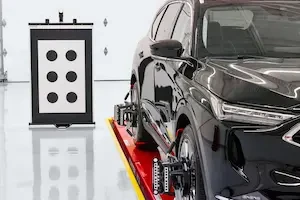
Walls said modern driver-assistance systems compound the confusion, since much of what needs to be repaired isn't visible to the customer. "Cars now have [ADAS] systems and so many sensors that people don't see, behind their bumpers, and they completely don't understand how that plays into their safety and the repairs," she said. "Your car is now compounded of so many computers and sensors, and if those aren't operating properly, you're not safe down the road, and it's a whole new world for them."
Osten added that the absence of a warning light doesn't mean a car is safe to drive after a collision. "A lot of times there's no extra lights on the dash, everything appears fine," he said. "But it doesn't mean that everything's functioning the way that it should be."
Educating customers before the dispute starts
Center Collision's staff said most of their advocacy work happens before a dispute ever escalates. Much of that starts with basic education, Osten said: explaining the difference between a shop on an insurer's preferred list and one that isn't, and what a customer gains by choosing an independent shop. Washington law also lets vehicle owners choose their own repair shop rather than one selected by their insurer, he said.
"We're not going to tell you where you need to have your car fixed and why you shouldn't go to XYZ," Walls said. "We're just going to tell you to do your own homework."
She encourages customers to check their rights directly rather than take an insurer's word for it. "I always just tell them, do your own research and look up the laws and see what rights you do have," Walls said. "Whenever we steer somebody to look up the codes in Washington, they're like, 'Oh my gosh, I did not have any idea those were my rights.'"
Walls also pointed customers to a source closer at hand: many drivers don't realize their own vehicle's owner's manual specifies what needs to be repaired or inspected after a collision, information an insurer may not volunteer. "Look at your owner's manual," she said. "It will tell you some of these things that need to be done."
Staying credible with insurers
Osten said the shop is careful not to frame its advocacy as a fight against insurers outright. "We definitely don't want to talk bad about the insurance companies. They pay all of our bills, so we don't hate them," he said. "You know, sometimes we hate their claim handling practices."
Instead, staff said they lean on documentation, not opinion, when a dispute arises: reading manufacturer repair procedures and passing that information along to whoever is responsible for the bill, customer or insurer.
Not every call ends with a repair at Center Collision, Walls said. Some customers who go elsewhere still call Dewey afterward with questions about their claim.
Lessons for shops facing a similar standoff
- Confirm eligibility before recommending appraisal. SB 5721's appraisal clause only applies to Washington auto policies issued or renewed on or after Jan. 1, 2026. Shops in other states should check whether a similar law applies; Texas passed a comparable measure in 2025.
- Explain total loss math in plain terms. Customers often don't understand why an insurer would rather total a vehicle than pay for a lower repair estimate. Walking through the salvage-value math up front can head off confusion later.
- Don't let a clean dashboard stand in for a real answer. As ADAS and sensor repairs become harder for customers to see or understand, a verbal explanation matters as much as the paperwork.
- Frame appraisal as a tool, not a first move. Center Collision turned to it only after direct negotiation with the insurer stalled, preserving the option for genuine disputes rather than every pushback.




Lisa McArdle