


Collision repair shops keep hearing the same message from every direction: adopt more technology or fall behind. Most owners do not disagree. Claim volume is tightening, vehicle complexity keeps climbing, and the tools that promise to close that gap are easier to find than ever.
Yet plenty of shops that know they should invest still do not pull the trigger. This month, Autobody News asked its Technology Council a direct question: What is the real reason that gap between knowing and buying persists, and what finally moves a shop from one side of it to the other?
The answers all pointed to the same underlying pattern: shops are not rejecting technology on price. They are stalling on trust, confidence, and bandwidth, and what breaks the stall is rarely a spreadsheet. It is a forcing event, or proof from someone they already trust, that spurs them to action.
Trust and disruption, not cost, drive the hesitation
Jonathon Best, founder and CEO of Better Collision Group and founder and CEO of BetterX, said he has watched shops spend big on equipment without hesitation, then sit on a modest software decision for a year. "The problem isn't the checkbook," he said. "It's trust and burden."
Best said he has been burned by tools that promised to fix scheduling, communication, or parts, only to become shelfware six months later, not because the software failed, but because it added work before it removed any. Every new system needs a champion, training, and a process change, he said, and that burden typically lands on whoever in the shop is already the most stretched.
In his experience, what actually moves a shop is one of two things: pain with a deadline, such as a slipping DRP scorecard or a competitor pulling visibly ahead, or proof from a peer who has already used the tool successfully.
"We don't buy from demos," he said. His takeaway for vendors is that the shops adopting fastest are not the best-funded ones. They are the ones being offered technology that does the work rather than adding to it.
Confidence in the investment matters more than its price tag
Josh McFarlin, chief operating officer at AirPro Diagnostics, said cost is rarely the core obstacle since most owners already accept that advanced technology is becoming a requirement. The bigger barrier is confidence: that the investment is the right one, that it will hold up as vehicle technology keeps changing, and that it will actually pay off.
That uncertainty is compounded by the pace of change in vehicle systems, McFarlin said, which leaves shops wary that a solution bought today will not support what comes through the door tomorrow. Add training, staffing, and ongoing software costs, and delay becomes the easier default.
The shift from knowing to buying tends to require both necessity and clarity, he said.
"Necessity comes when ADAS work becomes a significant part of their repair mix or when insurer, OEM, or customer expectations make the status quo unsustainable," McFarlin said. Clarity comes from confidence that a solution fits the shop's model, has credible support behind it, and can show measurable results.
McFarlin argued the framing needs to flip entirely: "The question has to shift from 'Can I afford this technology?' to 'Can my business afford to operate without it?'"
Urgency, not affordability, decides when a shop finally buys
Tanya Sweetland, senior vice president of collision at OEC, said finances are usually the opening question, but in a lower-volume market the conversation moves quickly to return on investment: how fast results show up, and what it will take to get there with a given team in a given market.
Once that shift happens, she said, the real hesitation is less about doubting the technology and more about whether a shop has the time and tenacity to manage the change it requires.
Part of the difficulty, Sweetland said, is that technology ROI does not behave like equipment ROI. It is not calculated in units produced. It shows up in metrics such as cycle time, comeback rate, and cost per repair, areas where many shops get thin reporting from their current suppliers. Without a clear "if I do this, I save X" story, new technology struggles to win attention against the other demands on an owner's day.
"It's less common that technology gets rejected as a bad investment," Sweetland said. "It just doesn't feel urgent enough to earn the time it takes to evaluate and implement it."
That's typically why it takes a forcing event to tip a shop into buying: losing a key technician, a new DRP or insurer requirement, a rough quarter that exposes an inefficiency in the P&L, or hitting a growth ceiling the current process cannot clear. "That's the moment ROI stops being a spreadsheet exercise and becomes an urgent business problem," she said.
Her recommendation is to get ahead of that moment by mapping out two or three likely business scenarios in advance, growth, downturn, or flat volume, and deciding now what the right investment would be for each. Doing that thinking early, she said, makes an owner far less likely to buy on impulse when a new tool shows up in a demo.
Confidence in getting paid, not the price of equipment, drives ADAS hesitation
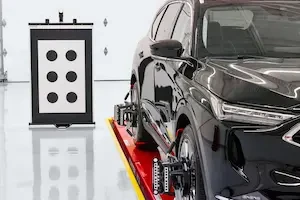
Joel Adcock, director of strategic partnerships at Revv, said "The gap isn't usually about the cost of the technology, it's about confidence.” Shops move from awareness to action, he said, when they understand the business opportunity, trust they will be reimbursed for doing the work correctly, and have a clear plan for integrating ADAS into their existing operation.
Part of the hesitation, Adcock said, comes from how shops frame the investment in the first place. Many evaluate an ADAS purchase as the cost of a calibration system rather than the entire operational opportunity it opens up, including keeping repairs in-house, reducing cycle time, controlling quality, retaining customers, and building a profit center that grows as vehicle technology advances.
A second source of hesitation is reimbursement risk, Adcock said. Shops that understand the need for calibrations still hesitate because they have heard stories about insurers pushing back on payment. The concern is not performing the work correctly, he said, it is proving that the work was necessary and done right. Without confidence in documentation, repair planning, and OEM procedure workflow, the investment feels risky. There is a liability dimension as well: a required calibration that does not get performed can carry serious consequences for both the vehicle owner and the shop.
The third factor, Adcock said, is that many shops simply have not encountered enough ADAS-intensive vehicles yet to force a change, or they underestimate how dependent today's vehicles already are on calibration. He pointed to persistent myths, such as the idea that a vehicle will calibrate itself or that the absence of fault codes means everything is fine. In reality, ADAS issues often do not generate diagnostic trouble codes, and systems can be out of specification while still appearing to work normally.
"The shops that move from awareness to action are the ones that stop viewing ADAS as an equipment purchase and start viewing it as a long-term business strategy," Adcock said.
Once a shop understands the financial opportunity, trusts it will be reimbursed appropriately, and recognizes how much the vehicle population has already changed, the investment becomes far easier to justify. He described the progression in six stages: awareness, education, confidence, process, investment, and execution.
What all the answers have in common
The definition of readiness across all the answers kept shifting away from budget. Best frames it as trust, whether a tool will reduce work or just add to it. McFarlin frames it as confidence, whether an investment will hold up as vehicles keep changing. Sweetland frames it as urgency, the point where a forcing event turns a slow-moving decision into an unavoidable one. Adcock frames it as reimbursement confidence, whether a shop trusts it can prove the work and get paid for it.
The language differs, but the message lines up: the shops that adopt well trust what they are buying, and they usually get there either through proof from someone they already respect or through a business problem that will not wait any longer.
The Autobody News Technology Council is an invite-only group of industry leaders who respond to a monthly question on the technologies shaping collision repair. If you're interested in joining the conversation, please reach out to Jess Fritsche at jess@autobodynews.com to learn more.



Lisa McArdle