



If a customer’s vehicle is being declared a total loss and they’d prefer to have it repaired, it might be worth checking the salvage bid for the vehicle, one collision repairer suggested at a recent industry meeting.
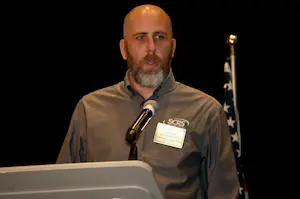
The Society of Collision Repair Specialists (SCRS) open board meeting in Illinois in late July included time for board members or attendees to raise issues or concerns about what they’re seeing in the industry. Andrew Batenhorst, board treasurer for SCRS and manager of the Pacific BMW Collision Center in Glendale, Calif., said an insurer recently determined a vehicle was a total loss despite Batenhorst believing it was repairable and the customer preferring that it be repaired. In challenging the total loss decision, the customer was able to obtain the salvage bid for the vehicle.
“The salvage quote that was obtained was easily in the 40 percent range of the actual cash value of the vehicle, probably even closer to 50 percent,” Batenhorst said. “This is a growing trend that I’m seeing in my shop quite often now, where it’s killing perfectly repairable cars because the salvage quotes are quite high.”
In looking at the salvage quote, he said, the adjuster’s damage rating for the vehicle was listed as “light,” which “definitely does not match the kind of damage the car had.” He said that “after a very difficult conversation” in which claims management at the insurer “was pushing back hard,” the customer was able to convince them to change the damage rating on the car.
“That netted a $7,000 difference in the [salvage] quote by correctly classifying it as severe damage or structural damage rather than light,” Batenhorst said. “In the end, this customer lacked the resources and the patience to try to hold the line further and get the vehicle repaired. However, I found it very interesting that there is a prevalent amount of manipulation in place with salvage quotes that I think maybe the industry is not completely aware of. I’m curious if other repairers have managed to get hold of an actual quote from a salvage vendor in this type of situation, or if they’ve ever had a client stand up and do something about it. Overall, this is something that we need to pay more attention to, and hopefully guide customers through it if they desperately want their vehicle repaired instead of being totaled.”
Multiple challenges as total losses increase
Tim Ronak of AkzoNobel said the type of situation Batenhorst encountered with that vehicle becomes even more challenging as the percentage of consumers who are “underwater” on their vehicle loan — owing more than the vehicle’s current value — continues to grow. Data from Edmunds shows that almost 30 percent of those trading in a vehicle in the second quarter of this year had “negative equity” in their vehicle, up 3 percentage points from a year earlier.
“They may not get enough money to be able to step [away from the loan] without money coming out of their pocket, and yet they still need to go and find another vehicle for transportation” Ronak said. “So, I think it’s important for us to understand the mechanisms that feed into a total loss decision, and perhaps help consumers understand how they can navigate this because many of them are ill-equipped to have these negotiation conversations because they just don’t understand our industry.”
Ronak said he also thinks given the rise in the percentage of vehicles being declared a total loss, shops may want to reevaluate the costs related to processing total losses at no charge as part of a direct repair program agreement. Data from CCC Intelligent Solutions indicates about 23.1 percent of all claims were a total loss last year, up from under 19 percent in 2022.
“I’m not going to debate DRP versus non-DRP, that’s not the point,” Ronak said. “But there’s now an even larger amount of [shop] activity being gifted on the part of repairers as part of participating in a contract.”
Damaged vehicle sold as-is
Danny Gredinberg, administrator of the Database Enhancement Gateway, was among the others to raise issues at the SCRS meeting. He said a relative of his in Northern California recently had some falling debris damage his vehicle.
“After he filed a claim, he took the car to a shop, and they wrote a repair plan,” Gredinberg said. “The insurance company wrote their version of an estimate. But what was interesting about the outcome was on that preliminary sheet, the insurer had suggested to my [relative] to work with another company to see if there could be a claims buyout process — on a vehicle that was nowhere even near a threshold or total loss.”
That company, “ClaimBuyout,” Gredinberg said, was “able to essentially navigate him to sell the car as-is with a clean title, without a repair on that car.”
“I’m sure there was a criteria that had to be met for the type of car, the damage,” he said. “But this is something I think more and more shops are going to start seeing is that navigating of that car to a claims buyout process without even going through a salvage process.”




John Yoswick