


On the latest episode of “On the Road with Mike Anderson — Serving Up Collision Advice,” powered by Autobody News, hosts Mike Anderson and Sheryl Driggers of Collision Advice took a look at recent data on everything from claims frequency to insurance premium increases, offering insights on what shops can do in response.
The episode aired live Aug. 11 and is now available for on-demand viewing on Autobody News’ YouTube channel.
Viewers can scan a QR code at the end of the broadcast to receive the full slideshow of data from the presentation.
Average Severity
Looking at average severity by state, Rhode Island was tops at the end of 2024, at $6,969. Anderson said he’s seen preliminary data for 2025 to date, and the state is still No. 1.
That is largely attributable to Rhode Island’s laws, Anderson said. The state requires OEM parts on all repairs until a vehicle reaches a certain age, and allows a right to appraisal for both insurers and claimants, among others.
Competitive Wages
Data from two sources showing average hourly wages by state — across all jobs — showed in Virginia, that figure is about $36 an hour.
“I always hear people talking about how we have a hard time hiring people in our industry,” Anderson said. “It's cause you don't pay them enough. You're not paying them enough.
“And you say, ‘Mike, I can't afford to pay them.’ I get it,” he said. “I will tell you that it is high time our industry takes a hard, long look at what we are compensating people for, whether it's somebody to wash cars, somebody that writes estimates or repair plans, somebody that fixes vehicles. I don't feel like we're competitive of enough with wages, not to mention benefits.”
To pay its employees more, a shop needs to either get a higher labor rate, get paid for more not-included operations, or a combination of the two, Anderson said.
A viewer asked how shop owners can balance employee satisfaction with keeping the business profitable.
“Most shops, you can't run lean anymore in the office. You have got to be fully staffed, so you're not putting so much on your team,” Anderson said. “I think you also have to offer, in some cases, a four-day work week.”
Driggers said shop owners need to make sure their teams have the right resources to take care of their mental well-being so they can “recharge” while working in a high-stress industry like collision repair.
Anderson added that owners need to “recognize when your people are close to burnout and find a way to step in and take something off their plate.”
Crash, Claims Frequency Both Decline
New data from CRASH Network shows both crash and claims frequencies are on a decline.
There will probably be about 29 million claims in 2025 across the U.S., down from 31.6 million in 2019.
Broken down by state, the change in crash frequency is also down almost across the board.
ADAS is a major factor in reducing the number of crashes. “ADAS works,” Anderson said.
Stats show automatic emergency braking has decreased front-to-rear crashes by 50%; blind spot monitoring has decreased lane-change crashes by 27%.
“I feel that most [repairers] are still not doing ADAS correctly,” Anderson said. “You're going to be open to a ton of liability. I just got to throw that out there.”
But claims frequencies are not only down because drivers are having fewer crashes in the first place.
Among the other factors driving down claims:
• Consumers avoiding a possible rate increase by not filing a claim
• 27% of insurance customers increased their deductibles last year in exchange for a lower premium
• Vehicle thefts declined 16.7% between 2023 and 2024
• 30% of all claims ends in total loss, due to an aging car parc (average age: 14.7 years old), decreasing used car values, and more insurers lowering the repair threshold to as little as 35% to 50% of the car’s value.
On the last point, Anderson said some insurance companies send almost 40% of their total loss vehicles overseas, particularly luxury vehicles, where at auctions, “they're getting bids for as much as a vehicle is worth if it wasn't in an accident.”
“All I can tell you is, it's really important that you're involved with your state legislature in regards to total loss legislation,” he said.
Anderson said this is not the “new norm,” but rather “the old norm that we were before COVID and everybody forgot what it was.”
Shop owners hired more employees to handle all the pent-up demand coming out of the pandemic, but conditions are returning.
“If you're a body shop and you're sitting around waiting for it to go back to like it was a year ago, you're gonna be waiting forever,” Anderson said. “I'm not trying to be a negative person. I'm being a realist. If there was ever a time to examine your expenses or look at your overhead, now is the time to do it, and you need to right-size your organization…for the business climate we have today.”
Insurance Trends
While some customers are raising their deductibles for a lower premium, others are buying less insurance than they know they need, or not buying it at all.
Overall, more customers than ever are interested in paying out of pocket for repairs — about 40%, according to one source.
“If your customer pay is less than 20% of total [repair order] count, you’re scaring customers away,” Anderson said.
Customers are also willing to shop around for the best price on mechanical and collision repair work.
Driggers said the key is to educate customers on why the cheapest repair estimate is not the best option.
“We absolutely have to focus on listening actively to our customers, building that trust, and educating our customers on why we have certain things on our estimates and repair plans that might not be on someone else's,” she said. The owner’s manual is a good tool to illustrate that, for instance, safety inspections are required by the automaker.
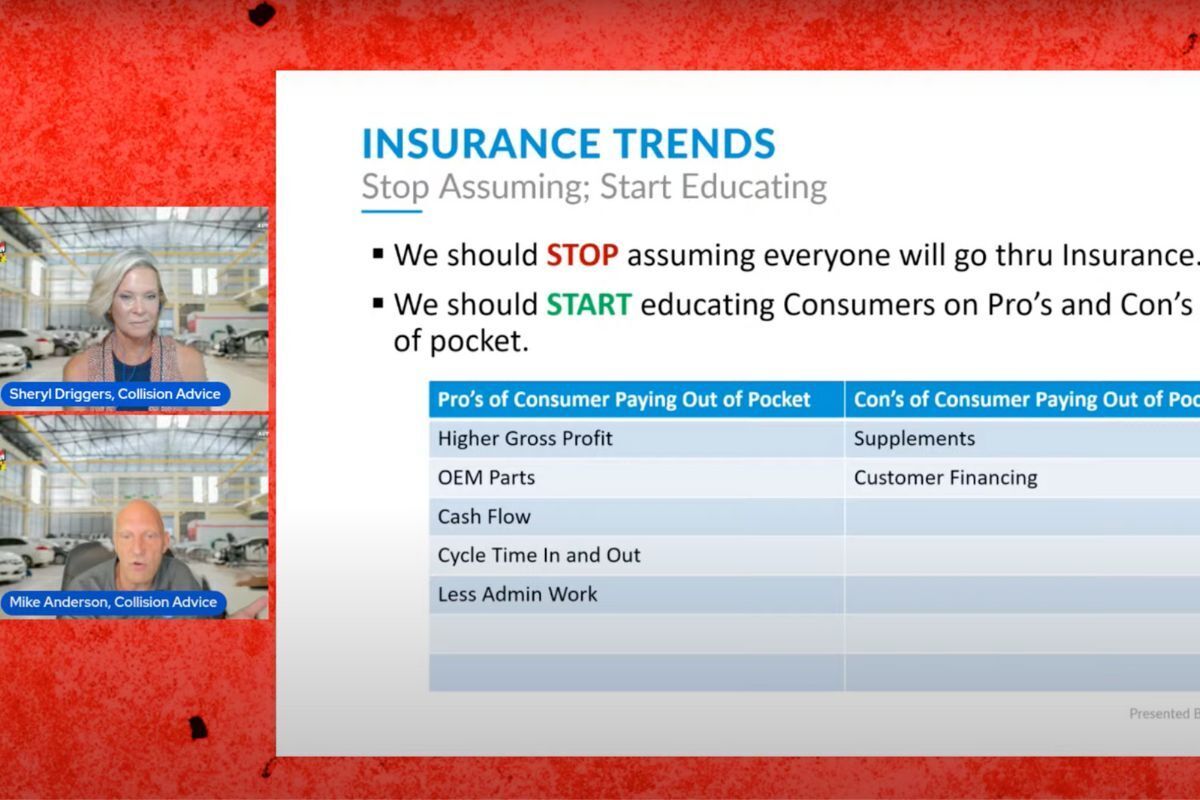
The shop should help the customer consider the pros and cons of paying out of pocket versus filing a claim, looking at how a premium increase over the next several years could be more expensive than paying for the repair directly.
One viewer asked about the maximum repair cost a customer might be willing to pay out of pocket.
While it depends on the local market, Anderson guessed the average would be about $4,000.
Anderson discussed offering third-party financing options, which usually include a period of time in which the repair can be paid off before interest starts accruing.
“I absolutely believe shops need to offer that today with customer pays growing,” he said.
Customer pays are also better for body shops, Anderson said. They mean a higher profit, OEM parts and a quicker cycle time with less admin work.
On the down side, the initial estimate has to be right, and the shop may have to offer third-party financing or pay credit card fees.
“But to me, the pros absolutely outweigh the cons,” Anderson said.
Litigation Driving Insurance Increases
Data from Samba Safety shows auto insurance is the No. 1 driver of inflation — it has risen 45.8% since December 2021.
Litigation and, specifically, “nuclear verdicts” — when a jury awards more than $10 million in damages for a bodily injury claim — are greatly influencing insurance increases.
Anderson said several states are looking at tort reform to cap the amount that can be sued for in the case of bodily injury.
“I absolutely believe that insurance companies are spinning a story to legislators, that insurance premiums are increasing because body shops charge too much,” Anderson said. “The reality is insurance premiums have gone up because of bodily injury lawsuits, and that has nothing to do with us as collision repairers.”
Anderson predicted as insurance companies pay out natural catastrophe claims from wildfires and flooding, some will not have enough money in escrow to cover it all. States will pass laws requiring them to hold more in escrow, which will reduce the amount they can invest.
In turn, those insurance companies will then put more pressure on cycle times, especially for shops in their DRP.
“If you’re a DRP shop, you better buckle up, because I absolutely believe you're going to see insurance pressures on cycle time, which does not always contribute to a safe and proper repair,” Anderson said.
Insurer Relations
The latest Length of Rental (LOR) data from Enterprise showed in Q2 2025, the overall average LOR for collision-related rentals was 15.1 days.
“Let me just say to any insurance companies listening: everybody always says, ‘It takes longer to fix a car.’ No, it doesn't take longer to fix a car,” Anderson said. “It takes longer to negotiate an agreed price with an insurance company. That's what takes longer.
“When you look at length of rental and how long it takes to fix a car, it is not because shops take longer. It's not because parts are on back order. Yeah, you have the occasional parts on back order. It's 'cause insurance companies make a shop go back and forth five times,
trying to settle the claim. And that's one of the negatives of doing these virtual inspections.”
Anderson said insurance companies’ combined ratios — the amount they paid out to settle claims versus the amount they brought in through premiums — are the lowest they’ve been since 2013.
“I'm not saying this just gives shops a license to go charge wherever they want, but at the end of the day, [insurance companies] are making money. They're not going broke,” Anderson said.
Insurance companies will continue to deny payment for line items they paid for previously, because shops are slowing down and need the work, he said.
“I don't like it. It's not right, but it's what they're doing,” Anderson said.
He suggested for every item denied, find a new line item to request to offset that change request.
“We’ve just got to start digging into the P-pages more and figuring out some things that aren't included,” Anderson said.
Auto Glass
Four states currently have laws forbidding insurers from raising premiums due to multiple auto glass claims , and other states require a $0 deductible on windshield replacements, for safety reasons.
“I think that collision repairers need to be watching legislation specific to windshield laws,” Anderson said. “I would bring my glass work in-house, 100%.”
Anderson called out Kaizen Glass Solutions for its auto glass repair training.
Marketing More Important Than Ever
Anderson said the old stat that drivers need collision repair every seven years is outdated — it’s closer to every 18 years, according to two sources.
That makes collision shop marketing even more important so consumers don’t forget a shop’s name when they need it.
“So many shops don't do any marketing until they're slow,” Driggers said. “We have to be in the community, building relationships at the dealerships, supporting our previous customers, supporting our nonprofits within our community, and making sure our name is top of mind.”
Good News
In April, a then-record 20% of new car loans had an 84-month (seven-year) term. That’s good news for collision shops, Anderson said, because drivers are required to carry full coverage as long as they have a lien.
In July, new car sales increased 4% year-over-year. In addition to being fully insured, those vehicles are less likely to be totaled if in an accident. However, they are less likely to get into an accident due to ADAS.
New vehicles are also more likely to be “connected,” as more OEMs introduce apps like GM’s Collision Assistance to immediately put owners in touch with local certified repair shops after a crash. Honda, Nissan, Volvo and BMW are also among the OEMs developing or currently offering similar apps.
Chinese EVs Could Bring Opportunities
Anderson said Chinese EVs could come to the U.S., where they will need service.
BYD has an affordable EV that can charge enough in five minutes to cover 250 miles. Even with tariffs, it would cost about $16,500.
Anderson said if those vehicles are sold in the U.S., it will probably be through a direct-to-customer model, similar to existing EV makers, like Tesla, Rivian and Lucid.
“I think the ‘gold rush’ for ADAS is over,” Anderson said. “The next big gold rush is OEMs that sell direct needing service centers.”
The services EVs need most are related to tires, brakes and suspension. Shops pursuing EV collision repair certifications should also consider being able to offer mechanical services, Anderson advised.
Customer Experience
In 2024, 43% of crashes happened outside of normal business hours. Anderson said that number is probably closer to 50% this year.
“That means consumers need to have the ability to connect with you outside of normal business hours, to request an estimate or schedule an appointment,” he said.
Another source showed most states see the most crashes on Fridays.
He hypothesized the number of people doing “gig work” — driving for companies like Uber and DoorDash — or driving their kids to travel sports are contributing to those trends.
Interestingly, Anderson said, the number of low-speed collisions have increased. “Twenty-two percent of accidents today are 30 miles an hour or less,” he said. “That drives customer-pay work, so we need to keep that in mind, that not everybody's going through insurance.”
According to a Lexus dealership service center customer survey, 65% expected the service center to follow up after repairs.
Driggers said when she owned shops, her company did that within 24 hours after delivering a repaired vehicle, through text or phone call, depending on the customer’s preferred method. She said the response was always positive.
“We want to make sure that you are more than satisfied with the repair and the experience,” she said.
Summary
Crash frequency is down.
Claims frequency is down.
Market your shop: “Triple what you’re spending,” Anderson said.
Work on your customer experience and sales process.
Spend more time educating customers.
“I think you're gonna see a lot of shops go out of business in the next 18 months to two years,” Anderson said. “I think a lot of shops got their employee tax retention credits, their PPP loans, they got fat on the hog, they overextended themselves, and they're going to fall behind on their bills. So at the end of the day, sometime the market will right-size itself, and then we'll be back to square one.”
Next Episode
The next episode of “On the Road with Mike Anderson — Serving Up Collision Advice” is scheduled for 4 p.m. ET/1 p.m. PT Sept. 8. The discussion featuring shop owners will be seat belt inspections: when and why they should be done.



Abby Andrews