


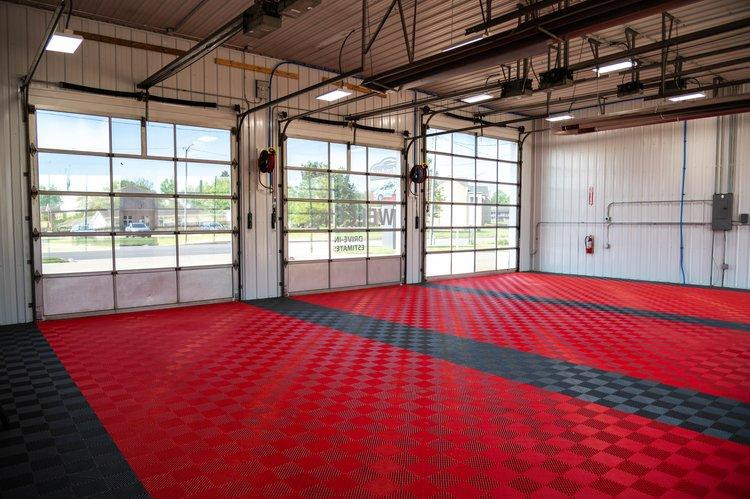
Smaller body shops are toe-dipping into adaptive reuse, or renovating and retrofitting empty buildings, to add sites, often in prime locations, and sometimes faster. It’s another way to grow in your market.
Set “adaptive reuse” between greenfield — ground-up construction on fresh dirt for its first use, often among a wider area growth — and brownfield: demolishing abandoned eyesores, requiring extensive reconstruction and remediation to be safe, let alone possible.
Adaptive reuse happens all the time as businesses fail, including big ones with hundreds of locations. Think Kmart, Toys “R” Us, Big Lots, and other big boxes. Consolidator and larger MSOs seek bigger buildings in retail corridors that can still work for a scaled, volume business, just not the failed one.
Others going under, like restaurants and offices in industrial parks during Covid or drugstores and sporting goods stores, are more right-sized for indie shops or the small MSO.
Or they’re already car focused. This is common, such as when a car dealer, mechanical repair facility, or even another body shop exits. When the reuse is minor, it can mean the renovations will be, too.
And it doesn’t have to be about bankruptcy. Sometimes businesses just move, such as restaurant chains saving on a smaller footprint, or again from the downstream effects of Covid, or big retailers changing strategies (anyone remember Target Express?)
Large operators: Anything goes
Tesla North Hollywood features a showroom, service, and collision. It was a closed Kmart of 117,000 square feet on 10 acres. Crash Champions turned a warehouse in California into a 70,000-square-foot collision center, along with an on-site Enterprise car rental desk.
Broker-developer Jason Miller of Grand Sakwa Properties in Michigan said the biggest MSO, Caliber Collision, is naturally enough one of the largest adaptive reusers of real estate, going for space in former grocery stores, big-box retailers, and multi-tenant shopping centers.
Such sites have lots of space, see high traffic in densely populated areas, are accessible, and, in buildings, have “high ceilings and open floor plans with no interior, load-bearing walls, drive-in docks, and ample parking,” Miller said.
Caliber also redid a Saturn dealer in Tennessee; Gerber, a former movie theater in the same state. A Maryland developer turned a Michaels crafts store into a business center; Caliber took 16,600 square feet.
A 60,000-square-foot bakery on six acres in Arkansas first became an auto dealership, then a Caliber. Other types of buildings turned to collision repair include home improvement stores, a paper and packaging plant, and a cannabis shop.
This “highest and best use” of real estate is select, small, and a significant staple of growth.
Innovative indies take the leap
Over the past few years, larger independents have learned from their still-larger competitors.
“Adaptive reuse is increasingly popular for consolidators, regional MSOs, and independents,” Miller said.
His research, and local and trade news reports, show innovative independents doing adaptive reuse:
- McGovern Collision Center in Massachusetts redeveloped the site of a former flea market into a 75,000-square-foot showpiece with 40 bays.
- One Twenty-Two Collision in Georgia occupied a former Bealls department store with a 20,000-square-foot collision repair and an additional 10,000 for car storage, a news report said.
- Classic Car Motoring in Alabama reworked a 140,000-square-foot Sam’s Club into a collision repair facility, custom shop, “vault” for vehicle storage, and five-acre event space with catering kitchen for car shows.
Those are from the past two or three years. Further back, a dealership and collision shop in Michigan turned a movie theater to its own highest and best use, as Gerber did.
These projects might still feel beyond the reach of most shops. Rather, they’re an example of thinking outside the box — or inside the big box retailer — for ways collision centers can find their own highest and best use.
And other operators are now on board.
Little guys catching the wave
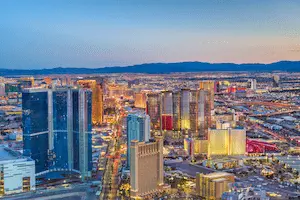
Brightpoint Auto Body Repair, on Dec. 10, bowed a new site for its Las Vegas brand, Frank’s Auto Body, with an adaptive reuse of former mechanical repair, then collision businesses. Brightpoint President Paul Williams told Autobody News late last year it was coming; a year to open is relatively speedy compared to an arduous brownfield or beautiful but way longer timeframe for greenfield.
“It’s a bolt-on,” Williams said last year. The 16,000-square-foot shop is air-conditioned (a job-selling point for Vegas) and was available where “not many single shops are for sale here, in areas where we want to be.”
That’s the prime location part, which can get a shop into a space where it wouldn’t have seemed possible.
Autocraft Bodywerks in Texas had one site for its first 30 years. Over the past decade, owner Chris Raeder has added three more, including two through adaptive reuse. The first possibly leaned toward brownfield, because the building was abandoned, said Robbie Mulderrig, one of Chris’s sons, who manages one of the MSO’s four locations.
The second was straight-up improvise, adapt, overcome: a building born as an airplane hangar, then converted to truck repair. The deal got them 30,000 square feet, including a third for painting right next to an Amazon distribution center. It was a location they wanted so they could repair and repaint Rivians for the retailer.
Premier Truck Group, with a dozen collision centers and 45 dealerships, did adaptive reuse at one of its own dealership’s service departments. The dealer was building a new location; collision didn’t have a presence.
In Oregon, a paint and body center touches all the bases: collocating with a mechanical repair shop at a former car dealership through adaptive reuse.
Can’t say whether or how
Differing opinions on “highest and best use” are why we hold horse races.
Who’d have thought Netflix would turn a department store into an immersive retail-entertainment experience? But it just did, in Philly. A second and third are planned for Dallas and Las Vegas.
Miller said development gets harder as costs rise, but there’s still demand. Retrofit, or adaptive reuse, is one avenue out of that roadblock, and he hears regularly from collision repair owners checking what’s possible.
A smaller MSO contacted him last year when 99 Cents Only Stores were closing. “He had collision shops and wanted a combo he was calling ‘Hot Wheels’ — a body shop and detailing combined.”
But.
“Body shops have a problem: Cities don’t want them,” Miller said. But we’re not alone. They dislike carwashes too, for being noisy. “They’d rather have a Trader Joe’s.”
Of all businesses that undergo adaptive reuse, perhaps 10% are related to the automotive industry.
When those 60 Sam’s Clubs closed, seven went to motoring, including an auto mall, an Airstream dealership, an auto parts warehouse, that Alabama collision-custom-car show event space, and a Tesla dealership next to self-storage.
The ugly, the bad, the good
And it doesn’t always work.
Miller said Gerber was working on a former CVS in Illinois, and it didn’t happen.
New Jersey’s Branning Collision Centers, in 2023, bought a 5,000-square-foot restaurant, according to a local news item and Miller’s follow-up. It has a handful of locations, qualifies as a small MSO, and, so far, doesn’t seem to have remade the restaurant. The status was unclear, and a request for comment didn’t produce a response.
Miller said he’s seen restaurants retrofitted, but a space with prior automotive use, like Brightpoint in Vegas, is a better option. “It’s zoned for that sort of use, 10,000 square feet or more, with the infrastructure.”
Other sites are tougher: The community might be opposed, zoning might need to be changed, special and/or conditional use permits may be required … tasks can seem endless. And while big operators like Caliber can anchor the corner of a shopping site, for the most part, Miller said, Marshalls and TJ Maxx don’t want to be near collision.
Parking is usually a top concern for them. Body shops that pass muster have heft — nationally, locally, or both — or agree to certain conditions, such as fenced off areas, or taking a spot farthest from where people are.
Miller says actual dollars usually favor adaptive reuse but some become money pits, and the more a site requires, such as demolishing part of the building or adding roll-up doors, the more you might as well build one.
So why do it?
“If you want to be there,” Miller said, like Autocraft Bodywerks cozying next to Amazon. A lack of land within an established community could drive you to look at adaptive reuse. So drive around your area and look: Where has someone just boarded up the windows? What are the relevant national and local trends? Can you find the building that will be a blank slate where you can paint your masterwork?
Do the rest of the research: demographic data from business or government, whether your shop is stuffed to capacity, and so on. Maybe a legacy body shop no one wants to buy could become a drop-off or concierge service for you. Maybe some old oil change operator will turn into something for you.
Give it your highest and best shot.

Paul Hughes