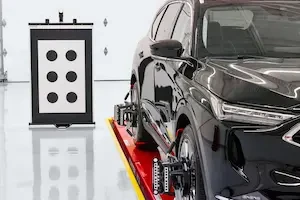

The collision repair industry has largely embraced ADAS calibration as an in-house service, but most shops haven’t figured out how to do it profitably, according to a new benchmark report from Revv.
The ADAS calibration software provider surveyed 300 collision and mechanical repair shops across North America in October 2025 and found that while 86% now handle at least some calibrations themselves, only about one in five report having a fully optimized process. That gap between adoption and optimization represents both unrealized revenue and unnecessary friction, the report suggests.
The average shop in the study brings in roughly $21,500 per month from ADAS work, with net margins around 9%. But getting there requires substantial investment: Shops reported spending a median of about $55,000 on calibration equipment upfront, with ongoing tool and equipment costs running close to $19,000 annually.
What separates the optimized shops
According to Revv co-founder and CEO Adi Bathla, the 21% of shops that have reached full optimization share a common trait: They’ve embedded ADAS into their overall operations rather than treating it as a standalone service.
“Fully optimized shops are not just identifying what needs to be done to the vehicle when it comes in for repair,” Bathla told Autobody News. “It’s a focus on operational efficiency as well — how you’re capturing proof of repair, invoicing, capturing insurance information, building the story of the repair.”
Bathla described an ADAS maturity curve that most shops progress through. It starts with recognizing that vehicles have become more complicated, then moves to identifying low-hanging fruit like procedures that don’t require major equipment investments. Shops then graduate to bringing expertise in-house and expanding service capacity. The final stage is operationalizing ADAS so that billing, documentation, and claims processes run systematically rather than being handled case by case.
“You want to operationalize for every single repair, day, week, month. Make it an engine,” Bathla said. He emphasized that shops should let technology handle the administrative burden. “You don’t want your techs doing all this admin work — billing, invoicing, proof of repair. That’s a lot of time you don’t get paid for.”
The calibration gap raises safety concerns
Bathla said the survey results revealed a calibration gap that surprised even him. Based on Revv’s data, roughly 61% of vehicles arriving for collision repair require some form of ADAS calibration, he said. . Yet according to CCC Intelligent Solutions’ most recent Crash Course report, calibrations appear on only about 36% of DRP estimates.
“Since DRP shops tend to be more operationally mature than the industry at large, the gap is likely even wider across the entire repair landscape,” Bathla said. “This raises concern from both a safety and liability standpoint, especially as vehicles grow more complex and driver safety increasingly depends on these systems working exactly as designed.”
The report found that before shops adopted systematic identification tools, more than one in five vehicles requiring calibration left the shop without it, creating callback risk, liability exposure, and lost revenue.
Bathla noted that since Revv launched, the average number of calibrations required per repair has more than doubled, a signal of how quickly vehicle complexity is increasing.
Education is the biggest barrier
When asked what single factor most holds shops back from closing the adoption-optimization gap, Bathla pointed to education.
“Realizing that the car parc has become extremely complicated is the first barrier to actually being top of mind for shops to operationalize,” he said.
The survey supports this. When asked what would help them bring more calibrations in-house, 59% of shops pointed to better technician training, making it the most frequently cited need. But the challenge isn’t simply a lack of training hours. Shops reported their technicians put in an average of 41 hours of ADAS-specific training annually. The problem is that procedures change faster than training can keep up. More than a quarter of calibration jobs involve OEM requirements that have changed since the shop last performed similar work.
Qualitative feedback in the report revealed technicians want real-world application over theory, real-time support when problems arise, and more intuitive tools that reduce the training burden by building guidance directly into the workflow.
Insurance pushback: evolving, not disappearing
The survey found that more than three-quarters of shops run into insurance resistance on ADAS claims at least some of the time. When asked about operational challenges, 19% of respondents pointed to reimbursement processes as a leading obstacle, while 15% cited documentation requirements specifically.
Bathla said the insurance dynamic is shifting but not necessarily improving.
“What we’re seeing with the insurance approval process is it’s actually evolving, not getting better or worse,” he said. “As ADAS has become more popular and systemic in repair workflows, insurance companies are gaining a better understanding of ADAS and the documentation associated with those repairs.”
But that familiarity cuts both ways. “Insurers are also more cautious about ADAS repairs. They’re increasingly focused on documentation and justification, so shops have to ensure they share clear, OEM-backed evidence detailing which calibrations were required and why.”
The report identified several tactics that shops use successfully to win reimbursement: itemizing charges in detail (cited by 52%), providing pre- and post-scan results (46%), sharing OEM procedure documentation (46%), and walking adjusters through the vehicle’s specific requirements (43%).
“The back and forth with insurance companies won’t go away on its own,” Bathla said, “but it does improve when shops can provide detailed documentation and evidence.”
Shops expect 30% growth, plan to bring more work in-house
Despite the operational challenges, shops are optimistic about ADAS as a revenue opportunity. Survey respondents expect their calibration workload to grow by nearly a third over the next two years, driven by the rising share of ADAS-equipped vehicles entering repair bays — currently about 44% of the vehicles they service, according to the report.
Shops are also planning to shift more work in-house, moving from 57% of calibrations performed internally today to roughly two-thirds within two years.
Bathla said hitting that target will require removing practical barriers. “That means adopting tools that deliver fast ROI, provide always-on training support for technicians, integrate seamlessly into existing workflows, and simplify access to OEM documentation,” he said. “The shops that overcome these implementation hurdles early will gain a competitive advantage.”
He acknowledged that physical constraints like dedicated calibration space will force some shops to continue working with specialists. “Shop and specialist collaboration will only go up and to the right,” he said. “At the end of the day, all of it has to come back to the shop and be shared with the insurers, so you want to use tech to optimize not just shop operations, but your operations with the specialists you do business with.”