



With total losses accounting for 22.6% of all claims in the first four months of this year — up from 20.2% in 2023, according to CCC Intelligent Solutions — it’s perhaps not surprising that Collision Industry Conference (CIC) leaders chose to center many of the presentations at this summer’s quarterly meeting in Philadelphia on total losses.
During several panel discussions, collision repair representatives said they are seeing insurers declare vehicles as total losses “below the repairable threshold.” Aaron Schulenburg of the Society of Collision Repair Specialists (SCRS) said he hears from shops who are seeing vehicles being totaled even when damage does not exceed 50% of the actual cash value (ACV).
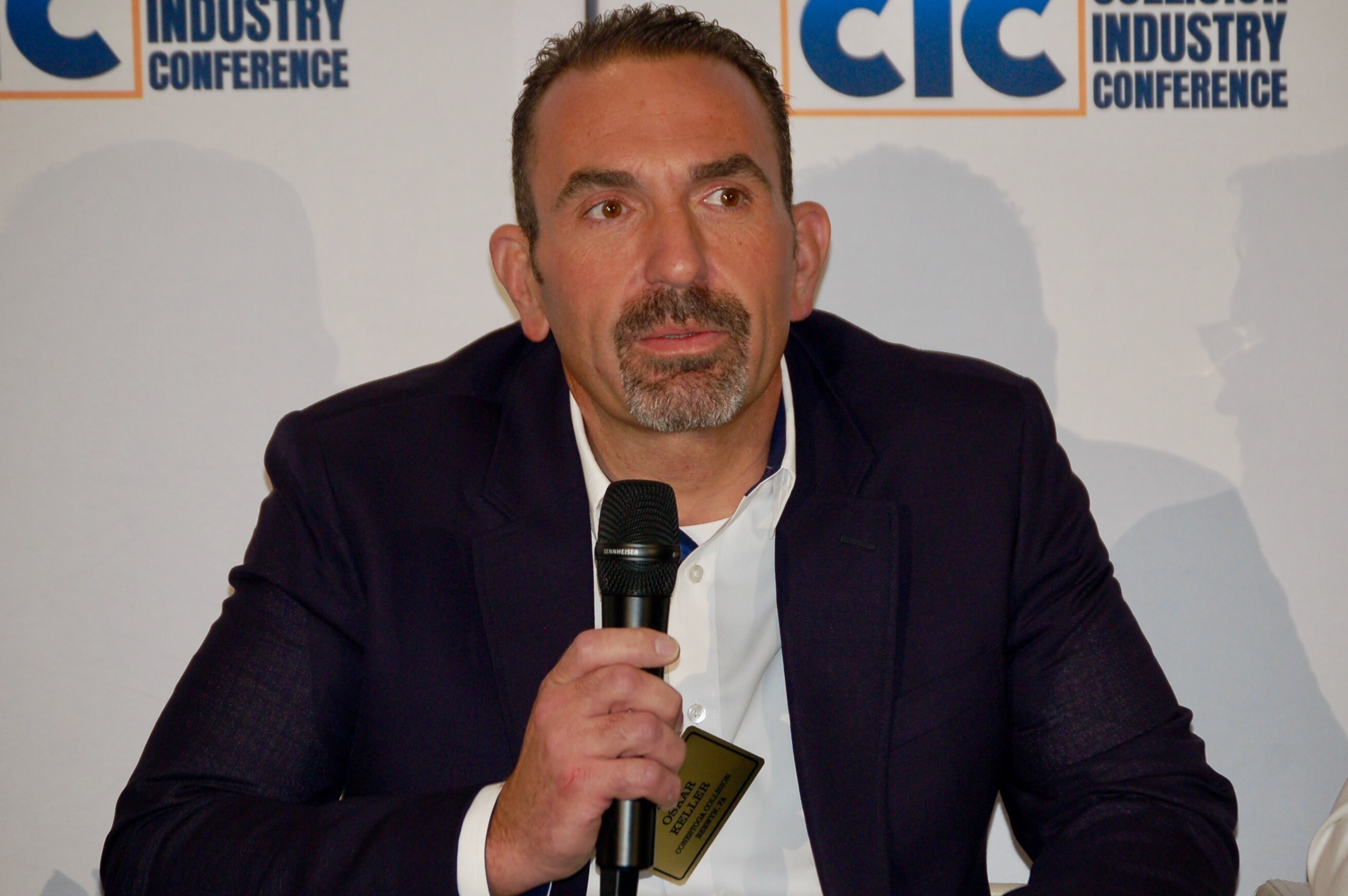 Max Keller.
“It was not going to get anywhere even near the threshold, let alone the ACV, yet it was decided to be totaled and pulled out of the [shop’s] work stream,” Schulenburg said. “That may be because of states like Virginia that allow [total losses] to go back [on the road] with a clean title, those types of things.
"I don’t know how much that’s influencing it or if there’s other factors there, but the reality is these are decisions made to total vehicles that are absolutely repairable, that can be repaired safely, properly, effectively," Schulenburg continued. "And the consumer could be put back in the vehicle that they have, especially in cases where the consumer wants to be back in that vehicle. It’s a problem.”
Max Keller, co-owner of Conestoga Collision and Auto Body Repair in Berwyn, PA, said total loss determinations can vary widely from one insurer to another.
“Some insurance companies in our state may decide to total loss a vehicle at 50, 60 or 70% [of ACV],” Keller said. “Other insurance companies are waiting until they see the cost of repair hit 70% or 80% before they’re running the formula. And we have a handful of insurance companies that’ll just let the repair cost hit 110, 120, 130% every day on cars that we’re comfortable repairing. That might be a vehicle six or seven years old and have a lot of sensors and ADAS and electronics or expensive headlights that are making it hit that number. But definitely nothing unsafe.”
Barry Dorn, who sold his Virginia-based collision repair business earlier this year, questions whether a percentage-based total loss threshold — which are enshrined in law in some states — still makes sense for modern vehicles. Some states in the past have chosen to exclude airbag-related costs when calculating repairs as a percentage of ACV, and he suggested there should perhaps be a similar exclusion for ADAS-related costs.
“Something has to change,” Dorn said. “In my opinion, we can’t stick with a 40-plus-year-old process with the vehicles that we have today.”
Check for Procedures Before Vehicle Totals
The effect that newer vehicle technology — whether materials or systems — has on the rate of total losses was also part of the discussion at CIC. Scott VanHulle of I-CAR urged the industry to remember that automakers continue to develop new repair procedures.
 Scott VanHulle.
“Everyone hears the word ‘boron,’ for example, and they instantly think, ‘Oh, it’s replace only,’” Van Hulle said. “And I don’t want anyone to say that I-CAR is saying that you can do anything with boron without an OEM procedure. But there are some procedures out there where the OEM has built in soft spots on a rear or front [boron] rail [and] have a sectioning procedure that you can do in a very specific area. Otherwise you’d have to put the whole rail in, cut quarter panels off, and it’s a very intrusive repair.”
He said I-CAR also can be a conduit to the automakers when a vehicle the shop believes could be safely repaired is close to being totaled.
“On a very specific repair, [we] can get in front of an engineer and they can look at that damage and say, ‘On this vehicle you can do X, Y and Z. On this job, you can do that repair,’” VanHulle said. “I think a lot of times we’re in such a hurry and have a knee-jerk reaction and so don’t take the time to just look around and see what’s there. And I think that goes for ADAS and telematics as well. There are a lot of things that are changing so quickly, and it’s very hard to keep up with, but we really need to be diligent because I think these are reasons a lot of these vehicles are getting totaled out at a faster rate.”
Teardown Charges Successfully Defended
During another panel discussion related to total losses at CIC, Andrew Batenhorst said a new Bureau of Automotive Repair (BAR) regulation in California this year requires shops in that state to define in layman’s terms what portion of the vehicle will be torn down as part of the estimating or pre-repair process.
“That impacts the total loss process because in the event [the vehicle] goes that route, if an insurer disagrees with the extent of disassembly that we went through, we could end up getting investigated by the BAR later on,” said Batenhorst, manager of Pacific BMW in Glendale, CA. “I’ve been investigated three times. And out of those three times it was determined that my charges and operations were itemized and reasonable and necessary for the determination of that vehicle being a total loss.”
Batenhorst confirmed it is insurance companies that trigger such investigations.
“In matters of storage and in matters of teardown or diagnostic charges, the [BAR] now has a hotline or an email that allows insurers to basically send a copy of the charges that were submitted to them, and the BAR will analyze those charges and then make a determination. Without naming names of a carrier, I’m starting to see where the carrier will say to us in an email, ‘We will pay your charges under duress, and then seek assistance from the BAR to review your charges and act accordingly.’”
Batenhorst said he’s asked the BAR how frequently it rules in shops’ favor in such investigations, and he said that data is not yet available.
“But what they did tell me is that they are completely overwhelmed with all the requests that they get to look at charges from shops, and they are not even responding to all of those requests because they just don’t have enough manpower,” Batenhorst said. “Given the financial state of California at the moment and the budget cuts that are happening, I don’t think, and this is just my opinion, we’ll see the BAR getting more budget allocated to them to be able to staff up to handle the sheer volume of those requests.”
Batenhorst said the outcome of the three investigations he went through was heartening.
“I think it just shows that if you’re persistent and you’re methodical and you itemize correctly, the BAR will see that there are legitimate shops out there that are just trying to follow the rules and get paid for the work [they] are doing,” he said.






John Yoswick