



This article is part two in a series on IBIS 2026.
Senior leaders from across the collision repair industry recently had an opportunity to share insight about what it takes to be a “Changemaker.” Their presentations were part of the annual International Bodyshop Industry Symposium (IBIS) USA conference, “Connecting Changemakers,” held in March in Scottsdale, Ariz.
Throughout the year, IBIS hosts a variety of local, regional, and annual events worldwide to bring together diverse stakeholders to explore timely challenges and share practical strategies for the future.
“It’s that diversity of experience and perspective that makes these gatherings so valuable,” said Suzie Scott, corporate head of sales for IBIS Worldwide.
At this year's U.S. event, two speakers offered particularly actionable guidance: one on rethinking the front office through agentic AI, and another on the structural moves shops can make to grow and compete in a consolidating market.
Agentic AI: The Next-Generation Office
Mark Fincher, vice president of product management at CCC Intelligent Solutions, discussed the opportunities available for repairers to rethink their current operating model and adopt next-generation business practices, including agentic AI.
He pointed out that repairers today deal with reduced volume and revenue, rising complexity, a scarce labor pool, and shrinking margins.
“Do we just roll over and accept it?” Fincher asked IBIS attendees. “I hope not.”
When Fincher walks into a typical body shop’s front office, he said it often looks and runs the same way it did 30 years ago, with employees rekeying information, physically chasing status updates, triaging exceptions across systems, and explaining delays after they occurred rather than proactively.
“Whether you're a large MSO or a small independent shop, we still have the same people in the office doing things the same way,” he said. “We are trying to run modern repair complexity with a front office model built for another era.”
Although the industry talks about vehicle complexity, he said “ecosystem complexity” isn’t addressed.
“Think about how much this industry changed … dealing with insurance companies, suppliers and most importantly, customers,” he said.
The bottleneck at most facilities, according to Fincher, is coordination and the flow of information, which can lead to stalled work.
Rather than hiring more employees, Fincher recommended incorporating a digital coworker: agentic AI.
“This is not about taking jobs,” he emphasized. “This is about supercharging our people, giving them an assistant to help them do more work.”
As leaders evaluate how to redesign their businesses, Fincher noted that the office doesn't just disappear. It upgrades.
From his experience, Fincher said agentic AI can help with low-value tasks, leading to less chasing and more orchestration, which in turn frees up time for employees to focus on work that creates the most value.
For example, the CSR shifts from greeter/status updater to customer advisor. The estimator becomes a repair orchestrator rather than a documentation producer.
What leaders should do now:
- Begin testing AI for a limited use case
- Work with the team to begin redesigning roles aligned with new workflow
- Measure improvements and identify additional opportunities
- Expand the use case and scale across other team members
- Monitor process and outcomes for continuous improvement
“Start really small,” Fincher advised. “For example, have an estimator use AI to write estimates for two weeks and then hear her feedback.” By sharing these experiences, Fincher said businesses will learn how to work with AI, rather than without it.
The key is building a continuous improvement loop. “It is really important in this process because it [agentic AI] is new and it does make mistakes,” he cautioned. “The only way you can understand what's coming is to start using it.”
Fincher said the future of collision repair will not be written by technology alone. “It will be written by the leaders who redesign their business to meet the technology,” he shared.
Building Business Value During Challenging Times
Arthur Crawford, president of Collision Operations at AutoCanada (ACX), acknowledged the frustrations many collision repairers experience daily, such as researching OEM repair procedures, while facing a talent shortage and increasing vehicle complexity.
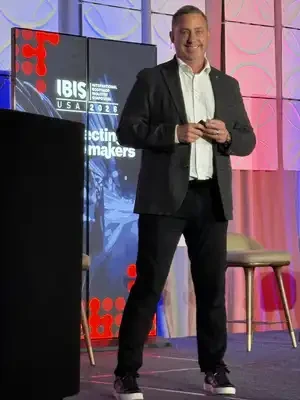 Arthur Crawford, president of Collision Operations at AutoCanada“It’s easy to get frustrated and overwhelmed with these challenges but when you sit back and think about the collision business and analyze it, it's actually littered with opportunity,” said Crawford, who shared the following steps for businesses to build significant value:
Build the Engine: Develop a platform for growth. This involves creating a scalable organization structure for growth that can take on additional complexities and volume without added cost.
“You need to build a scalable organization structure that can provide for streamlined decision-making,” Crawford explained. “That means you need defined roles and responsibilities that reduce bottlenecks, foster performance, and drive accountability.”
Add the Fuel: Develop people for long-term success. To help build future technicians, Crawford suggested bringing in apprentices and providing them a supportive working environment, as well as tooling and equipment so they can be successful in their jobs. As part of ACX’s apprentice program, participants receive a toolbox valued at approximately $10,000 and are supported through OEM and I-CAR training.
The company also created role-specific training and supports female employees through the ACX Women’s Collective. The collective focuses on combating isolation, providing mentorship and guidance, addressing gender specific concerns, and boosting confidence.
“What better way in a male-dominated industry to close the talent gap by supporting women,” noted Crawford.
The Momentum: Seize the industry tailwinds. Over the next three years, Crawford said the collision industry is expected to grow. He pointed to some trends shaping the industry, including the increased standard of repair, the ever-changing car park, and vehicle complexity.
“These are all tailwind opportunities that we can jump on and ride but you have to invest properly in the right tooling, equipment training and OEM certifications,” he emphasized. “If you do, you can provide high-quality repairs, exceptional customer service, and drive more business to your door.”
Potential business opportunities include partnering with a hail management company to bring in additional work and/or focusing on one of the following emerging profit centers: ADAS, calibration and/or glass.
Financial Strategy: Take advantage of multiple arbitrage. Crawford discussed how rapid expansion and capitalizing on multiple arbitrage opportunities can create significant value. Although multiple arbitrage doesn’t exist in every industry, Crawford noted how it can be applied to the collision industry.
Multiple arbitrage is a private equity strategy of buying smaller companies at fair valuation multiples and selling them as part of a larger, consolidated entity at higher multiples. Crawford said the collision industry has hit a tipping point where technical complexity exceeds independent capital and the success of consolidation is proven.
“Scale is a competitive advantage that drives outsized returns and multiple arbitrage is the central pillar of the current consolidation wave,” he explained. “It's the primary strategy used by private equity and large consolidators.”



Stacey Phillips Ronak