
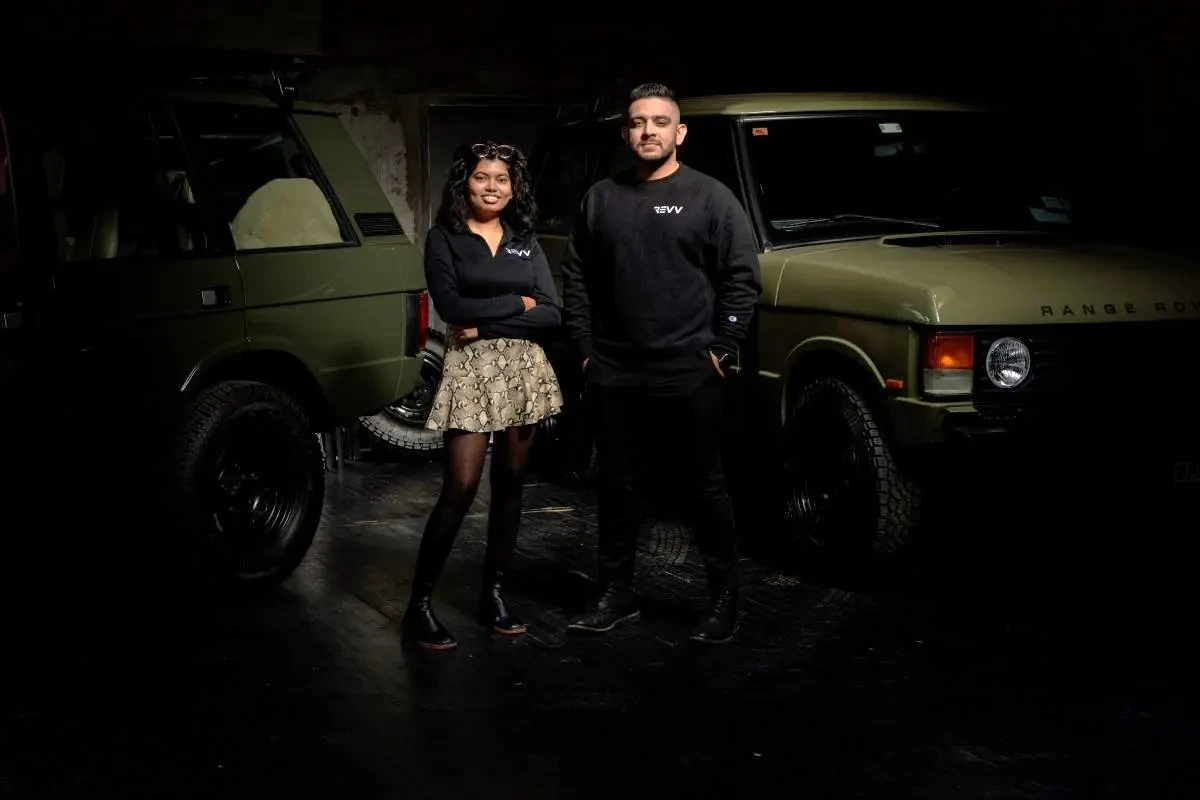
AirPro Diagnostics has merged with Revv in a nine-figure deal that pairs AirPro's calibration hardware and remote technicians with the software Revv's customers use to scope, document, and bill advanced driver assistance system (ADAS) work.
The merger, announced Aug. 24, brings Revv into the portfolio of Rotunda Capital Partners, which acquired AirPro in February 2025. Revv CEO and co-founder Adi Bathla becomes president and chief innovation officer of the combined company and joins its board. Driaan du Toit stays on as CEO.
Revv co-founder and chief technology officer Rashmi Sinha becomes senior vice president of technology and product integration, and both founders retain ownership stakes. The companies describe the result as an end-to-end ADAS platform spanning the full repair process.
Bathla and du Toit sat down together with Autobody News ahead of the announcement to discuss the details behind the deal. Neither framed it around scale or market share, but rather a car parc growing complicated faster than most shops can retool for it, and a merger meant to give those shops a way in without rebuilding the business first.
They both also kept returning to the principles they say guide their business — that repair work must be done right, and that the industry must come to a consensus about what "right" really means.
Helping shops make the jump to ADAS
"The complexity in the car parc is exponentially increasing," Bathla said, "and it's harder and harder for the entirety of the industry to actually bring ADAS operations holistically and operationalize it across the shops."
Shops are absorbing that alongside everything else on the floor. "Combine that with the headwinds of technician shortage, change management, and so much noise in the industry about the plethora of tools and utilities available to navigate this," Bathla said.
The result, he said, is pressure to rebuild the shop around a capability most were never designed for. "What this ADAS tailwind is doing is that it is becoming a forcing function for shops to overhaul their operations as it stands today. And not many shops can afford that. Not many shops can actually do it turnkey overnight."
That gap is what the combined company is aimed at, Bathla said. "This is our effort to bring an experience that didn't exist before for the portion of the market that actually wants that on-ramp, but is unable to do so."
Revv's own survey of 300 collision and mechanical shops put numbers to the same argument. It found a median upfront equipment cost of $55,000 and about $19,000 a year in ongoing costs, against average monthly ADAS revenue of roughly $21,500 at 9% net margins.
Du Toit put it in financial terms. "Shops are under pressure," he said. "Volumes are low, margins are being squeezed, and we are really an opportunity for these shops to add to their revenue line."
The market has also split, which is part of why AirPro went looking. The same Revv survey found 86% of shops now perform calibrations in-house, while only 21% have optimized the process.
"There were certain portions of the market that did not need to outsource the capability to someone anymore, because they now know what to do, so they appointed their own technicians," du Toit said.
Serving both kinds of shop required something AirPro did not have on its own. Du Toit, who took the CEO role Jan. 15, said the search did not take long. "When I started talking to everyone in the industry, the Revv name came up in every [other] discussion."
A platform that stays tool agnostic
Bathla founded Revv in 2022. The platform now runs in more than 6,100 shops and processes more than one million vehicles a year, according to the company, covering identification of required calibrations, original equipment manufacturer (OEM) procedures, documentation, billing, and reimbursement support.
Its value has rested partly on neutrality. Asked whether a shop that brought ADAS in-house, or that uses a competing provider, can remain a Revv customer, Bathla said the roadmap does not change.
"No matter what tool you use, whether it's AirPro or any other tool, be it remote diagnostics, do it yourself, Revv continues to deliver on the promise of being tool agnostic," he said. "Combined customers won't be forced to use an AirPro tool."
Du Toit made the same point from the service side. AirPro's roughly 200 U.S.-based technicians are worth extending to shops that run a different scan tool, he said, and the integrated offering is modular, so shops can take the full stack or individual pieces.
The merger lands seven months after Repairify and Opus IVS announced their own deal combining businesses, which closed in July.
Where OEM knowledge meets service history
Both executives described the merged data as the real asset. Revv contributes a knowledge graph built to OEM repair procedures, which Bathla said has brought the company into conversations, joint solutions, and partnerships with major automakers.
AirPro contributes a deep, long-standing execution record. "What people underestimate is the fact that we have done millions and millions of these repairs and calibration services and diagnostics over the last 10 years," du Toit said. "Our data set is much richer than anyone else's in the industry."
For Bathla, the automaker relationships already in hand are what make the combination hard to match. "That data set and that trust and relationship with OEs, combined with [AirPro's] data set, is actually a superpower of both the businesses coming together," he said.
He said the merged records change what is possible. "Once we combine those data sets, that becomes the most powerful data set in the industry around calibrations and diagnostics."
Data that creates defensibility
Combining the two data sets also lets predicted calibration requirements be checked against what technicians actually found. For shops, the payoff is documentation that holds up. "It's about defensibility," du Toit said. "It's about making sure that when you make the recommendations, it's supported by fact."
The process predicts required calibrations from estimate and build data up front, then checks the result once the work is finished. "Validating it at the end after the work was done, to make sure that what was said should be done was actually done and was necessary, that is key to this whole process," du Toit said. "And I think that adds value both to the repairer as well as the carrier."
Reimbursement is where that record gets tested. Revv's survey found that while 61% of vehicles arriving for collision repair require calibration, only 36% of direct repair program estimates include it, and pressure to cap what carriers will pay has been building.
Asked whether the combined company would pursue the close carrier relationships some competitors hold, du Toit started with where its loyalty sits. "We know who our customers are," he said.
He did not rule the relationships out, though, and described an opening on both sides of the claim. "There is significant room in the industry for connecting all the players," he said. "And through that, providing value and ability to transact and communicate and share information and files and getting things approved easier and paid easier."
He drew the line at what that cannot cost. "Our view would always be to try and position ourselves where we add value where it's needed and where it's required," he said. "And not sell our soul in the process. We will not enter into deals that put us in a compromising position and where there's conflicts of interest, where the wrong thing might be the thing to do to earn more money."
He said he had given the merged team the same standard. "We will do the right thing even when no one's looking."
A standard the industry has not yet defined
Both executives kept returning to one condition on all of it. "The most important thing is still to make sure that the car is repaired safely in accordance with OEM standards," du Toit said. "That goes without saying."
Pressed on whether that can be taken for granted in practice, he said it is the commitment the company is built on. "We're going to have processes in place to make sure that we do what is necessary on that car to return it to the road safely and according to OE standards."
However, procedures vary by automaker and model, validation methods are inconsistent, and shops and carriers routinely disagree over what a repair required. Du Toit was direct about that gap.
"We know we operate in an industry where these standards have not been clearly defined," he said, pointing to the number of groups working the problem separately. "My view is that it probably needs to be a more consolidated effort supported by some of the parties that all have friction with each other in the industry to get to the right answer."
Until that arrives, credibility has to be built incrementally. "It's all about gaining trust one step at a time. It's like earning it. We have to earn that trust," du Toit said. Both companies have done some of that separately, he said, "and together we will double down on trying to earn that trust in the industry by providing the best products and the best solutions that gives the most accurate answer."
Bathla said the United ADAS Collective, which was founded by Revv and now sits inside the combined company, stays a neutral knowledge hub organized around peer-to-peer learning, and that the case for it grows as the work gets harder. "It doesn't matter if that delivers customers to us or not," he said. "That's not the intention of the exercise." The group reports more than 1,600 members.
The approach, he said, is to feed existing efforts rather than start a competing one, because fragmentation is what has historically undercut the industry's attempts to settle these questions.
A deal that will fund future innovation
According to Du Toit, the transaction was structured to leave room to spend. Rotunda invests only in founder-owned businesses and comes in as their first investor, he said, which produces a different mentality than most private equity buyers bring.
"They did this deal with very little debt, putting very little debt on the balance sheet," he said. "So we are not highly leveraged. We have a lot of capital to invest in product solution sets to deliver this vision."
Bathla, whose company raised a $20 million round in November 2024, said he chose the merger over a Series B or another buyer based largely on the people involved. What distinguished Rotunda, he said, was how it approaches the companies it buys.
"Rotunda invests to build. Unlike traditional private equity, there's this very distinct thing that I saw, which made me gravitate towards them, which was they are investing in products. They're investing in the team." The firm is "very much aligned around the ethos that we win only when our customers win," he said.
Du Toit made the competitive case plainly. "I don't believe anyone else is better positioned than AirPro and Revv together to deliver that, both through the teams that we have, as well as the solution sets we have, the data sets, but as well as the capital partners that are backing us with the resources."
What that capital has to keep up with is a target that keeps moving. "You're not going to make this space better and innovate with ADAS and calibrations and scanning operations going forward, and be able to cater for the modern and new and evolving car parc, if you don't invest significant resources and money and people into figuring it out," du Toit said, "because it's going to look very different two years from now than it does today."


Jess Fritsche