


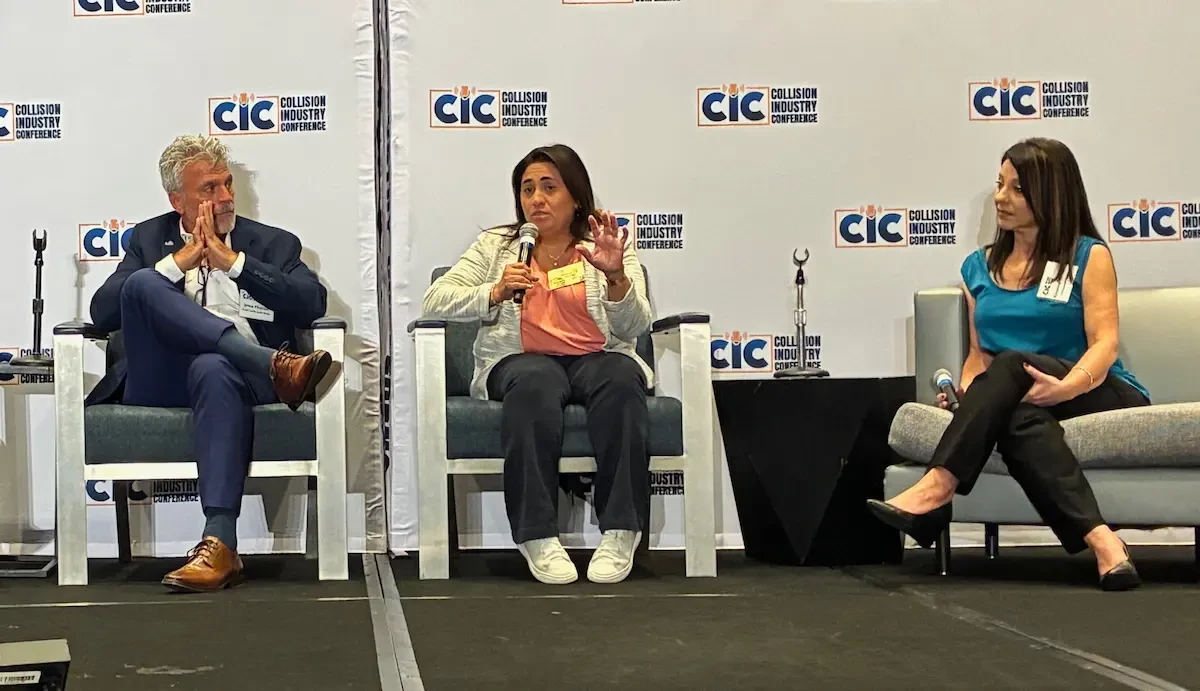
A number of committees presenting at this summer’s Collision Industry Conference (CIC) in Chicago focused on the consumer’s perspective relative to the subject on which they were presenting. But one panel discussion included an actual consumer, who offered her take on her experience with an auto claim earlier this year.
Roxanne Raffaelli hit a deer while driving her vehicle (that still had less than 2,000 miles on it), about 18 years after she last had a claim. Raffaelli said she immediately felt some relief on that “upsetting day” after her initial consultation at Body Builders Auto, a shop in the Chicago area (whose co-owner, Maria Quintero, was on the CIC panel and invited Raffaelli to participate). Raffaelli said the person she worked with at the shop put her at ease immediately.
Roxanne Raffaelli shared at CIC her recent experience with her first auto claim in 18 years.
“When I met with Joe, I was very comfortable,” Raffaelli said. “One thing that he did that I was not expecting going in was explain that I would have to navigate the claims process with my insurance carrier. And he really prepared me for that. I don’t feel that he could have explained it any better. The phrase he used initially with me was, ‘My team will be working on your case.’ And his team really did that, from day one to the last day. And my car was in the shop for 30 days. Everything he promised, it was completely delivered. They were wonderful and really fought for me.”
She said the shop updated her every other day, and she saw every email between the shop and her long-time insurer, with whom she was far less satisfied.
“I was very surprised at the level of denial of part of my claim and how it was handled,” Raffaelli said.
She said she ended up paying about $2,500 beyond her $500 deductible, in part for what she said was a small difference in labor rates, but primarily for the cost difference for OEM parts.
“I know that everybody in this room is going to laugh at me, but I have a master’s degree and I did not understand ‘OEM parts’ versus ‘aftermarket parts,’” Raffaelli said. (No one laughed.) “I wish that my insurance carrier would have said, ‘Hey, for a few dollars more, you could have this [OEM parts] rider.’ I would have bought it had I known what was going to happen to me. I’ve been a faithful customer of this insurance company and had not made a claim in 18 years. Yet I paid out of pocket $3,000. That is not reasonable for someone who has been a faithful insurance customer.”
Maria Quintero, a Chicago area shop owner, said helping customers understand the claims process up front helps them stay involved as needed.
Her main message to the CIC body and the industry: “You’re dealing with a person who’s had a really bad day,” Raffaelli said. “You could be instrumental in providing relief for them. The body shop did. The insurance company … they tried. I’m not here to criticize and say that they did it wrong. I’m here to say they could have done it better, by [remembering] that they were dealing with a real person behind that claim.”
She was asked whether she would be staying with that insurer — and whether her opinion about her vehicle’s brand had changed based on her experience.
“I will not say the name of the insurance company, but I will not be staying with that company,” Raffaelli said. “I am in the process right now of trying to break it off with them. My perception of the vehicle I purchased was that it saved my life. I don’t think I'll ever buy another brand of car.”
Educating the customer upfront
Shop owner Quintero, in discussing how her shop keeps customers involved in the process, said she sees the company’s first interaction with potential customers as key.
“Our initial consultation is really just a time for us to get to know our consumer,” Quintero said. “That’s really the objective. And it’s going to provide the consumer with some resources. So, they’re not leaving with an estimate per se; they’re leaving with resources and an understanding of how the claim process is going to work within our shop, and how that’s going to impact them. So, we just start by first getting to know the client, then we explain to them what we do.”
Quintero said discussion with the vehicle owner of what the insurer may or may not be willing to pay for — at least initially — is also done early in the process.
“During that initial consultation, we walk through the process of what is it going to look like from the consumer side,” she said. “What are we going to face right after disassembly? How is that going to work? What happens when denials happen, and the shortfall that exists? So, before we even touch the car, that conversation has already started. So, it is not a surprise when we have to contact the consumer to say, ‘This is where we’re at.’ It is going to be a conversation that needs to be had, and should be had early on before it becomes an issue later.”
‘It’s their claim’
Another panelist, Drew Plischke, the director of client-insurance reconciliation at Gold Coast Auto Body in Chicago, said the process was similar at his shop.
Drew Plischke of Gold Coast Auto Body said it’s the customer’s claim, and shops can only help educate and empower them while repairing the vehicle properly.
“My position [within the process] really doesn’t click into effect until the insurance denial happens, so the [upfront] consultation is done by others beside myself,” Plischke said. “I think the best way to describe what we’re doing is simply advocating for, educating, and empowering the consumer. Because this is not our claim. It’s their claim. We are in a position to safely and properly repair their automobile for them, and they are entrusting us to do so. But it’s their claim.”
Plischke said one thing that really stood out to him during the consumer’s discussion about her claims experience was that she paid about $2,500 beyond her deductible to have the vehicle repaired with OEM parts.
“You said that your car only had 2,000 miles in it, right,” Plischke asked Roxanne Raffaelli
“Fewer than that,” Rafaelli said. “My sister was in the passenger seat, and I said, ‘Look, I don’t even have 2,000 miles yet,’ and then boom.”
“Less than 2,000 miles, yet the largest portion out of your pocket was [to avoid] the use of alternative parts,” Plischke said, shaking his head.
Consumer ‘most powerful’ tool
Quintero said her shop’s customers are included in all emails with the insurer, receiving the same documentation sent to the carrier.
“At the end of the day, there is a contract between her and her insurance company,” Quintero said. “If there is a denial on a certain thing, there’s documentation that supports why we’re asking to get paid for it. That helps her. When they have to go to bat for themselves or they have to say something to the insurer, we need to prepare them with the documentation. They need to be able to have that educated conversation with their insurer. So that’s why we involve them in the whole process all the way through.”
“The most powerful piece of equipment or tool that you have inside your shop is the customer,” Plischke agreed. “They need to be hands-on because it’s their money.”



John Yoswick