
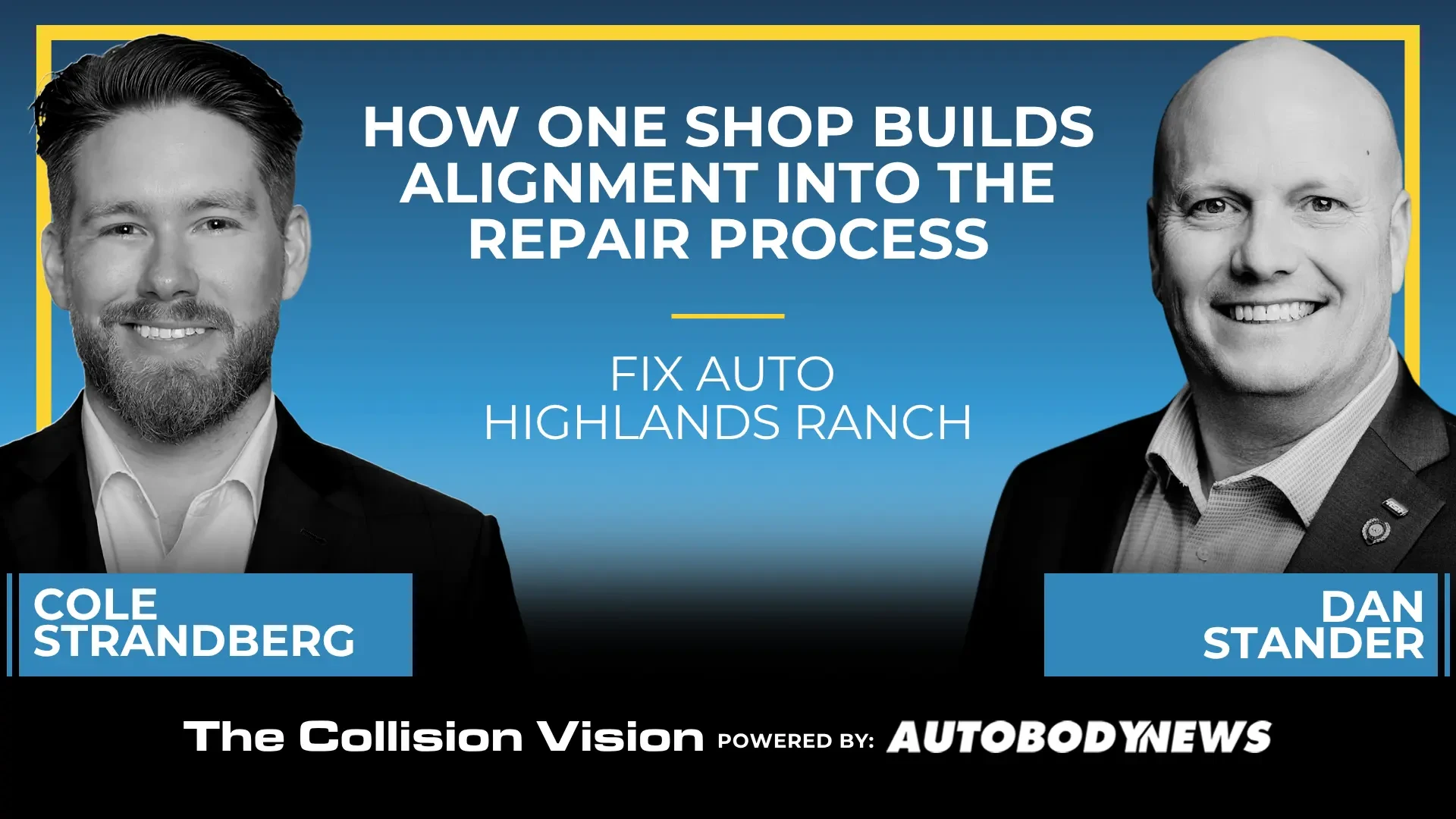
What does it look like when a collision shop treats alignment as a foundational repair step rather than a back-end formality? For Dan Stander of Fix Auto Highlands Ranch, it looks like a pre-wash, a pre-scan, a pre-alignment check, and an intake video before a single repair dollar is written, on every car, every time.
Stander joined host Cole Strandberg on The Collision Vision to talk through how his shop evolved on alignment over the past 15 years, why the traditional three-legged stool of body shop revenue is no longer enough to cover overhead, and what it takes to build a culture that does repairs the way the engineers intended them to be done.
The Three-Legged Stool Is Wobbling
Stander opens with a business framework that will be familiar to any shop owner who has watched margins compress over the past decade.
The traditional collision shop revenue model rests on three categories: labor, parts, and materials. Labor historically carried the highest gross profit, followed by parts, with materials trailing behind. For most of the industry's history, those three legs were enough to keep a shop financially stable.
"I think today with the market changing ... the three-legged stool isn't enough," Stander said. "The estimating system on those three items doesn't support traditional repair because as we're seeing, more cars are totaling. More cars have less labor and more parts. So now all of a sudden, it's changing our gross profit mix upside down."
Insurers pushing toward zone refinish, fewer paint operations, and tighter labor approvals have squeezed the model further. Stander's answer was to look for a fourth leg. Alignment became that leg.
Key Takeaway: If your shop's profitability is still entirely dependent on the traditional labor-parts-materials mix, now is the time to evaluate which in-house services you are currently subletting that could carry meaningful gross profit margin on their own.
Alignment Was Failing Before It Moved In-House
Before Stander brought alignment in-house, his shop was subletting the work to a vendor up the street. The experience was costing him more than he realized.
Roughly one in three cars was coming back with a customer complaint, a steering wheel that wasn't straight, or a vehicle that pulled. His shop was absorbing two-person trips to drop off and pick up each vehicle, often for a markup that didn't cover the labor involved. Pre-alignments were being towed. The process, as he described it, was a lose-lose for everyone.
"We're having to run it up to the mechanic shop for a very nominal markup," he said. "If we're making maybe $10, $20 on it, you're like, 'OK, so I'm taking two people to drive up there and drive back.'"
He told his parents he wanted to buy a used alignment rack to lose money on, because the shop was already losing money. That framing got the investment approved.
Key Takeaway: Before evaluating whether to bring alignment in-house, pull your sublet spend and calculate the true cost, including staff time, trip charges, comebacks, and customer satisfaction. For many shops, the ROI case is already made before the equipment conversation begins.
Who Runs the Alignment Rack May Surprise You
One of the most practical insights Stander shares is about who actually ended up running the alignment rack, and why.
His first attempt to get body technicians performing alignments failed. Some showed initial interest, but resistance set in when the work actually started=. He described the dynamic plainly: trying to force a skilled tradesperson into work they don't want to do is a reliable way to ensure it doesn't get done well.
His solution was to look sideways. Office staff and estimators, he found, were more open to learning the process. He ended up training three people without formal alignment certification, working from OEM specs, alignment sheets, and the prompts built into the Hunter equipment. Today, four people at his shop can perform alignments, including two estimators.
His 9-year-old daughter, helping on weekends, could follow the on-screen prompts to flag missed steps before he could. That observation reframed how he thought about the skill requirement entirely.
Key Takeaway: If technician resistance is blocking alignment adoption at your shop, consider whether your estimators or office staff might be more receptive. The process, when built around well-designed equipment and clear procedures, is learnable by people who did not come up through the mechanical side.
Pre-Alignment Is Now the First Step, Not the Last
Stander describes the current intake workflow at Fix Auto Highlands Ranch in detail. It will look different from what most shops are doing.
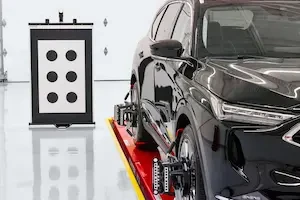
Every vehicle that comes in gets a pre-wash, because in his experience a clean car is treated with more care by technicians. From there, the car goes directly onto the alignment rack for a pre-alignment check, a pre-scan, and an intake video. The video, shot on an iPhone and played back on a 65-inch office monitor, captures prior damage that photographs miss.
The alignment check at intake serves a specific purpose: it generates data that can either close the conversation or open it. If specs are within range, the sheet confirms it and there is no charge. If specs are out, the shop has documentation in hand before a single repair line is written.
"I would say probably almost nine out of 10 cars need some sort of attention with the alignment," Stander said. "It's not much sometimes. A lot of them need just a minor little tweak in the toe, maybe a little tweak in the caster camber."
That data allows the shop to have a transparent conversation with the customer and the insurance company about what needs to be done, before the vehicle is deep into the repair process.
Key Takeaway: If alignment is currently happening at the end of your repair process, you are discovering problems when they are hardest and most expensive to resolve. Moving the pre-alignment check to intake changes the financial and operational dynamic of every repair that goes sideways.
OEM Data Says to Do It, But Most Shops Aren't
Stander walks through what the OEM repair data actually requires, manufacturer by manufacturer, and the gap between those requirements and what the industry is doing is significant.
For Audi, typing "collision" into AllData surfaces a requirement to perform an axle alignment after any collision, regardless of whether the wheels were involved in the damage. For Honda 2017 and newer, ADAS procedures require a wheel alignment.
For Toyota, removing the front bumper cover, even with no structural damage, triggers a radar calibration requirement, and that calibration requires a wheel alignment first.
Honda's final inspection job aid, pulled directly from OEM data, lists wheel alignment as a customer satisfaction requirement after a collision.
"How many shops are doing that?" Stander asked. "I think it's very few and I think it's sad because the engineer data is telling us to do that."
Ford, he noted, does not currently require an alignment in its collision repair documentation. He performs a check anyway, because the data it generates has value regardless of what the OEM mandates.
Key Takeaway: Pull the OEM repair procedures for the makes that make up the largest share of your car count. If alignment requirements appear in those procedures and your shop is not performing or documenting alignment on those vehicles, that is both a quality gap and a liability exposure.
Alignment Is an ADAS Prerequisite, Not a Separate Service
The thread connecting alignment to ADAS calibration is one Stander returns to repeatedly, and it is the same point that has been building across the industry's broader ADAS conversation.
Wheel alignment is not a standalone safety check. It is, in many cases, a required precondition for ADAS calibration to be valid. A radar that is calibrated on a vehicle with an out-of-spec wheel alignment may confirm a successful routine while still being off-target at operating distances. Stander describes the cumulative effect: a system that is 2 millimeters off at the sensor can translate to 20 feet of miss at 300 feet down the road.
"Just because somebody's not paying attention, not doing the right thing, does that mean the car should not function the way it should?"
He frames proper alignment, alongside good tires, a clear windshield, and functional wipers, as what he calls "accident avoidance techniques," things that keep the vehicle performing the way its engineers designed it to perform.
Key Takeaway: If your shop is performing ADAS calibrations but not confirming wheel alignment first, the calibration may not be producing the result you are documenting. Add alignment verification to your ADAS workflow, and check whether the OEM procedures for your most common makes require it explicitly.
SPARK: Safe, Profitable Automotive Repair Knowledge
Near the end of the conversation, Stander introduces a concept he has been developing through his work with ASA, one he calls SPARK.
The acronym stands for Safe, Profitable Automotive Repair Knowledge. The idea is simple, but the stakes behind it are not: shops that cut corners to hold down costs are making a choice that the customer is never told about. The consumer assumes the vehicle was repaired to OEM standards. If it wasn't, and a safety system fails in a subsequent event, someone absorbs that consequence.
SPARK is still in early stages, but Stander's framing of it is worth noting: profitability and safety are not in tension. The shops that do the work correctly, document it, and charge for it appropriately are the shops building a sustainable business.
Key Takeaway: The liability conversation in collision repair is no longer abstract. Shops that are not performing OEM-required alignment and calibration procedures on vehicles with active safety systems are creating exposure that is not eliminated by subletting, by customer waivers, or by the fact that other shops are doing the same thing.
Where It All Comes Together
The throughline of Stander's conversation is that alignment stopped being a back-end formality at Fix Auto Highlands Ranch a long time ago, and the business case, operational case, and safety case all point the same direction.
Pre-alignment at intake generates data. In-house capability improves gross profit and reduces comebacks. OEM procedures require it on the makes that dominate most shops' car counts. And proper alignment is a prerequisite for ADAS calibration to mean what shops are documenting it to mean.
For shops still sending alignment out the door, Stander's advice starts with an honest look at sublet costs, comeback rates, and the OEM data for their most common makes. The investment case tends to become clear from there.


Lisa McArdle