



If your shop is still assigning responsibility for the “feather, prime, and block” procedure to body technicians rather than refinish technicians, you’re falling behind an industry trend and could be impacting your shop’s efficiency and profitability.
That’s among the messages industry training and consultant Mike Anderson has based on the “Who Pays for What?” quarterly surveys. Results from a “Who Pays for What?” survey earlier this year, focused on not-included refinish procedures, showed that 56 percent of shops now report painters performing the “feather, prime, and block” work, up from about 48 percent just a few years ago. Anderson, who conducts the surveys with CRASH Network, said that shift is an encouraging sign.
“We review the profitability of paint materials for hundreds of collision repair facilities, and we consistently see stronger material gross profit when the refinish department performs the priming,” Anderson said. “Moving more of that work to the paint department helps improve material tracking, and allows body technicians to stay focused on higher-value repair work.”
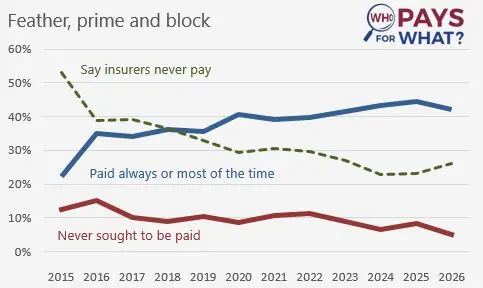
The payment data over time also suggests that insurers have generally become more willing over time to pay for feather, prime, and block. In 2015, just 22 percent of shops said the eight large national insurers asked about in the survey paid them “always” or “most of the time” for the procedure. That rose to 45 percent by 2025, though it did decline somewhat (within the survey’s margin of error) to 42 percent this year.
Meanwhile, the percentage of shops saying insurers “never pay” for this procedure has fallen from 53 percent in 2015 to less than half that (26 percent).
The share of shops saying they have never sought to be paid for feather, prime, and block has also declined over the long term, falling from 12 percent in 2015 to just 5 percent this year.
“Rising material costs make it more important than ever for shops to ensure feather, prime, and block work is being performed by the right department and that all related materials are being identified,” Anderson said.
Shops’ OEM research may have plateaued
The surveys can also point to troubling trends that should be a concern to the industry, Anderson said. The most recent completed “Who Pays What?” survey, for example, found that shops today are far more likely than they were a decade ago to research OEM repair procedures at the time they write the estimate. That’s the good news.
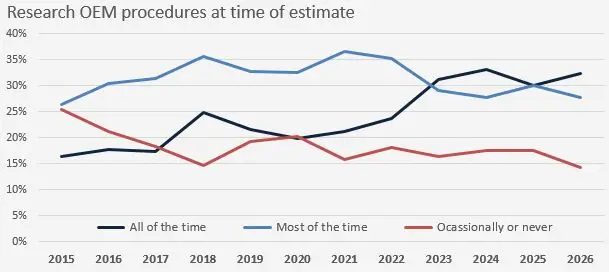
But the growth of OEM research within the industry appears to have stalled over the past several years. This year’s data shows that 32 percent of shops said they research OEM repair procedures “all the time” when writing estimates, double the percentage that said that in 2015. Another 28 percent said they do “most of the time,” meaning a combined 60 percent of shops now routinely research OEM procedures during the estimating process.
However, much of the improvement occurred several years ago. Over the past five years, the combined percentage of shops reporting they research OEM procedures all or most of the time has remained essentially unchanged at about 60 percent. Instead, the largest shift has been among those shops already researching procedures at the time of the estimate: more have moved from doing so “most of the time” to “all the time.”
But roughly 40 percent of shops still say they only research OEM repair procedures at the time of the estimate “some of the time,” “occasionally,” or “never.” That combined percentage has remained remarkably stable since 2021.
“Researching OEM repair procedures while writing the estimate allows you to identify manufacturer-required operations early in the repair planning process rather than discovering them after work is underway,” Anderson said. “As vehicles become increasingly complex, that upfront research takes on greater importance, and becomes more necessary to create a complete repair plan.”
Declining acceptance of updated blend formula
Another less than positive trend found in the surveys: The data suggests that insurers are resisting shops’ use of changes the estimating systems made to the blend formula more now than they were two years ago.
“Insurance companies do not acknowledge the change in CCC’s blend formula,” the owner of an independent shop in Los Angeles said in his response to the survey questions related to the blend formula.
A 2022 time study conducted by the Society of Collision Repair Specialists (SCRS) — with participation from major paint manufacturers — found that blending adjacent panels actually takes significantly more time than a full panel refinish, not 50 percent less time, the formula long used in the estimating systems. The study led to changes in 2023 and 2024 in all three estimating systems, giving users the ability to manually adjust the percentage used for blend time calculations.
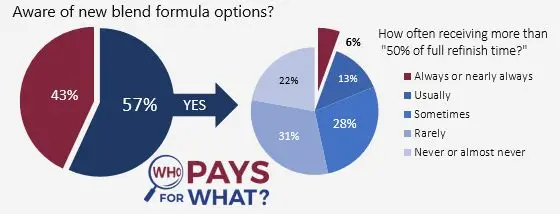
But acceptance of this change by insurers has, so far, been less than universal. This year, just 20% of shops negotiating more time for blend operations said they are paid an increased amount “always” or “usually” by the insurers they deal with. Two years ago, when the estimating system changes were still fairly new, 40% of shops said they were paid for more blend time “always” or “usually” by insurers.
“Every carrier other than State Farm and Progressive pays for 100% [of full panel refinish time] after negotiations,” an estimator at a large shop in Indiana that “usually” receives increased blend time said. “State Farm and Progressive will not, no matter what.”
More than half of respondents this year (53%) said they are paid “rarely” or “never” compared to just 35% who said that back in 2024.
The manager of a dealership shop in Illinois that “sometimes” gets paid for higher blend times said, “GEICO, Country, Acuity and a handful of others will pay full refinish on a blend panel when presented with the SCRS time study. State Farm and Allstate refuse to acknowledge the study, and claim CCC defaults to one hour and there’s nothing they can do.”
Several shops noted it is often the customer that ends up paying the difference.
“Our bill is our bill,” the owner of a mid-sized, independent shop in Washington state said. “If the insurance company doesn’t pay it, then the customer is billed. We provide documentation to the insurer about blending time, and educate our customer as well so they are aware of what their insurance is refusing to cover.”
Part of the blame for the decline in acceptance of blend time changes might also rest with shops. This year’s survey showed a decline in the percentage of respondents who said they were even aware of their new options for calculating blend time in the estimating systems. In two separate surveys in 2024, 70% of respondents said they knew about the option. This year, just 57% said they were aware of these estimating system changes.
The latest “Who Pays for What?” survey, focused on not-included body labor procedures, is now open through July. Shops can click here to complete the survey.






John Yoswick