
Every collision center deals with airborne dangers. Paint mist, metal dust, welding smoke — they hang in the air long after the spray gun is holstered and the sander is set down. And while slips, falls, and equipment injuries get a lot of attention on the shop floor, it's airborne hazards that actually rack up the most OSHA citations in the collision repair industry.
Respiratory protection (29 CFR 1910.134) is consistently the most frequently cited OSHA standard for auto body shops, and the fines that follow are just the start. The longer-term cost is paid by the technicians who breathe this stuff every day.
Here are the three respiratory hazards collision center operators need to understand, along with what OSHA requires you to do about them.
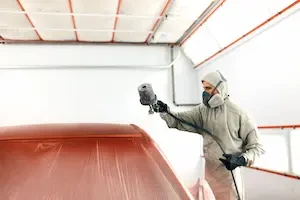
Diisocyanates: The #1 chemical threat in the paint booth
Diisocyanates (or isocyanates, as some call them) are the active curing agents in most modern automotive clearcoats and two-component urethane paints. They're also, according to OSHA, classified as potential human carcinogens, and one of the leading causes of occupational asthma in the United States.
Why it's serious: Exposure to isocyanates can trigger occupational asthma, chronic lung disease, and severe irritation of the eyes, nose, throat, and skin. What makes isocyanates especially dangerous is that once a technician becomes sensitized, even trace exposures can provoke an acute asthma attack. Sensitization is irreversible.
Some body fillers and seam sealers also contain isocyanates, meaning exposure isn't limited to spray painting operations. Isocyanates can settle on clothing and skin when a proper paint suit is not used. This allows the contaminant to travel home with the technician, exposing family members to secondary contamination.
What OSHA requires: OSHA's Respiratory Protection Standard (29 CFR 1910.134) mandates a written respiratory protection program for any operation where employees may be exposed to airborne hazards above permissible exposure limits (PELs). For isocyanates, this program must include:
- A written program with site-specific procedures
- Medical evaluations to determine each employee's ability to wear a respirator
- Fit testing before initial use and annually thereafter
- Employee training on proper use, donning, doffing, and limitations
One important note on respirator selection: research has found that half-face air-purifying respirators (the most common choice in body shops) may not provide adequate protection during spray painting operations when care and maintenance lacks, and a proper cartridge change out schedule is not followed. Supplied-air respirators (SARs) are often more appropriate when isocyanate concentrations are elevated.
Compliance checkpoint: Do you have a written respiratory protection program in place? Have all spray painters completed a medical evaluation and been fit-tested within the past 12 months?
Hexavalent chromium: The hidden threat in welding fumes
Collision centers that perform structural repair and welding on high-strength steel, particularly aluminum and specialty alloys used increasingly in modern vehicle construction, face a hazard that's easy to overlook: hexavalent chromium, or Cr(VI).
When chromium-containing metals are cut, ground, or welded, the heat oxidizes the chromium into its hexavalent form. This compound becomes airborne in welding fumes and, once inhaled, is a potent carcinogen. The International Agency for Research on Cancer (IARC) classifies all hexavalent chromium compounds as Group 1 carcinogens; the highest possible classification. Welders with significant Cr(VI) exposure face substantially elevated risk of lung cancer.
What OSHA requires: OSHA's Hexavalent Chromium Standard (29 CFR 1910.1026) sets a permissible exposure limit of just 5 micrograms per cubic meter (µg/m³) as an eight-hour time-weighted average — and an action level of 2.5 µg/m³ that triggers additional requirements before the PEL is even reached. Under this standard, employers must:
- Conduct personal air monitoring to assess exposure
- Implement engineering and work practice controls as the primary means of reducing exposure (local exhaust ventilation, source capture systems)
- Establish regulated areas where Cr(VI) concentrations may reach or exceed the PEL
- Provide respiratory protection when engineering controls alone can't bring exposure to or below the PEL
- Implement a medical surveillance program for exposed workers
- Maintain required records
Compliance checkpoint: Have you assessed Cr(VI) exposure levels for technicians who weld, grind, or cut chromium-containing metals? Is local exhaust ventilation in place and functional at welding stations? Are welding fume collectors available for employee use in areas where welding is frequently performed?
Sanding dust and VOCs: The everyday exposure that adds up
The third hazard is the one technicians encounter every single shift, and often underestimate because it feels mundane. Sanding generates fine particulate dust containing body filler compounds, primer particles, and in older vehicles, potentially hazardous pigment residues. Paints, solvents, and cleaners release volatile organic compounds (VOCs) into the air throughout the day.
Neither exposure is dramatic. Neither triggers an immediate, obvious reaction. But cumulative exposure over months and years can contribute to chronic respiratory disease, reduced lung function, and sensitization to other chemicals.
Why this matters in collision specifically: NIOSH has identified sanding dust in auto body shops as a priority control challenge. Dust from dry sanding operations can remain suspended in shop air for extended periods, and technicians performing wet sanding without adequate ventilation still face meaningful exposure. VOC vapors from solvents and thinners compound the respiratory burden.
What OSHA requires: OSHA's Hazard Communication Standard (29 CFR 1910.1200) requires employers to maintain current Safety Data Sheets (SDS) for all chemicals used in the shop, label containers appropriately, and provide training so workers understand the hazards they're working with and how to protect themselves.
For spray operations specifically, OSHA's ventilation standard (29 CFR 1910.94) sets requirements for spray booth design, makeup air, and airflow. When engineering controls can't adequately reduce exposure, 29 CFR 1910.134 applies; meaning respirators, fit testing, and a written program are required here too.
Sanding dust concentrations during dry sanding operations can exceed OSHA standards, and the primary recommended control is ventilated mechanical sanders — specifically rotary/orbital and straight line/reciprocating sanders equipped with high velocity, low volume (HVLV) local exhaust ventilation built into the tool's design. If vacuum sanders are not in use, dust levels in the shop are likely to exceed OSHA Permissible Exposure Limits, at which point respiratory protection — at minimum an N-95 NIOSH-approved respirator — is required.
Compliance checkpoint: Are orbital sanders or the shop equipped with a vaccuum-based dust collection system? Are your SDS files current and accessible to all employees? Have workers been trained on the specific chemicals used in your shop, not just handed a binder to sign off on?
The compliance thread running through all three
Notice the common element across all three hazards: OSHA's Respiratory Protection Standard (29 CFR 1910.134) shows up every time. That's not a coincidence. It's why respiratory protection is the No. 1 cited standard for collision repair facilities year after year.
A compliant respiratory protection program isn't just a document that lives in a filing cabinet. It's a living program that includes:
- Written procedures specific to your shop's operations and chemicals
- Respiratory exposure assessment with air monitoring to determine the actual levels of airborne contaminants in the operation
- Medical evaluations: Every employee who wears a respirator must be cleared by a PLHCP (physician or licensed health care professional) before use
- Fit testing: Annually, and whenever a different respirator model is issued
- Training: On proper use, storage, maintenance, and the limitations of the respirator being used
- Recordkeeping. Documenting evaluations, fit tests, and training
Many collision centers operate under the assumption that handing a technician a respirator equals compliance. It doesn't. Without a written program, medical evaluations, and fit testing, the respirator itself is just a box checked, and OSHA will cite you for the gaps.
Zach Pucillo, Regulatory Director, KPA has been gaining professional experience in the field of Environmental, Health, and Safety field for the past 17 years. He graduated with a bachelor’s degree in public health and safety from Indiana University in 2005. In 2006, Zach began his career with KPA where his main focus has been guiding companies to build positive cultures of safety.