Collision repair shops are facing a market where claim volume is down, vehicle complexity is up, and the gap between the two keeps widening. AEB systems and other ADAS features are cutting into claim frequency overall, but the vehicles that do come through the door require more scans, more calibrations, and more documentation than they did even two years ago. Against that backdrop, Autobody News asked its Technology Council a single question this month: What technology that most shops haven't adopted yet will be non-negotiable within the next three years?
The answers converged on a theme even though the specifics differed. AI came up in every response, but none of the three contributors treated it as a single tool. Instead, each pointed to where AI intersects with a deeper structural problem: coordination overhead, documentation gaps, and the calibration work shops can no longer afford to sublet out.
AI as infrastructure, not an add-on
Jonathon Best, founder and CEO of Better Collision Group and founder and CEO of BetterX, said shops are thinking about AI the wrong way. “Most shops still treat AI as a feature to bolt on,” he said. “A sharper estimate here, a scheduling assistant there. That mindset is going to age badly, and fast.”
Best argued that the technology that becomes non-negotiable will not be AI that simply helps people do their jobs. It will be AI that removes the coordination work shops shouldn't be paying skilled people to do in the first place; insurer back-and-forth, status updates, parts chasing, documentation, and compliance tracking. He said that load is compounding as more vehicles require calibrations and as the paperwork tied to each repair order grows heavier.
“You can't hire your way out of that problem,” Best said, adding that the math is especially difficult in a labor market where finding good people is already the hardest part of running a shop.
His prediction for the next three years: shops that win will move their entire coordination layer onto what he called an AI operating system, a system that runs routine work end-to-end and only involves a person when a judgment call is genuinely needed. He was careful to frame this as a talent strategy rather than a headcount reduction.
“It's about where you aim the good people you fought so hard to keep,” he said. Tools like estimating AI and calibration scanners matter and are becoming standard, Best sai
d, but the real dividing line in three years will be simpler: whether a shop is running on a system, or still moving information by hand.
Documentation and AI-driven communication
Josh McFarlin, chief operating officer at AirPro Diagnostics, also pointed to AI, though he located the biggest shift in customer communication rather than back-office coordination. Shops are under pressure to shorten cycle times while keeping customers informed, and McFarlin said AI can address both at once, through automated status updates, appointment scheduling, and repair-completion alerts. He cautioned that AI should support estimating and blueprinting work rather than replace the judgment behind it. "Someone still needs to review and validate the output," he said.
McFarlin said the shops that adopt AI well will not be replacing people. "They'll enable their teams to focus on higher-value decisions while technology handles repetitive tasks," he said, predicting that AI-driven repair planning and customer communication will stop looking like a competitive edge and start looking like a baseline expectation within three years.
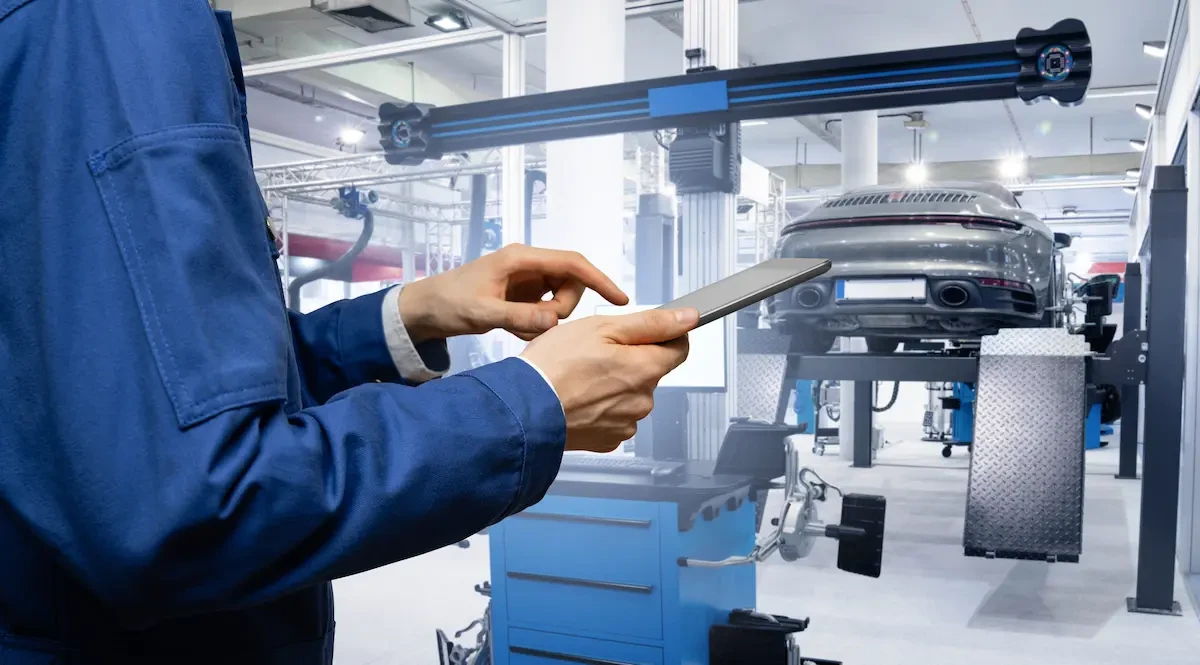
He paired that prediction with a second, less novel one: ADAS scanning, calibration, and documentation. McFarlin acknowledged the point might sound dated to some readers, but said AirPro still visits shops that have not fully adopted pre-scans, post-scans, or calibration verification. He emphasized verification specifically, meaning confirmation that a calibration was needed, confirmation that it was performed, and confirmation that the related systems are functioning as designed afterward.
"OEMs, insurers, and consumers are all demanding greater accountability," he said, and argued that proving a vehicle's safety systems were properly restored will carry as much weight as the repair itself.
In-house calibration and the AEB mandate
Joel Adcock, director of strategic partnerships at Revv and executive director of the United ADAS Collective, said he was hesitant to give a single firm answer, but pointed to AI as one technology shops will not be able to ignore in some form within three years, whether through photo-based estimating or AI-assisted customer service.
He said he did not expect the bigger shift to come from hardware or equipment. Instead, he pointed to education: shop teams genuinely understanding how ADAS systems work, including whether sensors operate independently or rely on other modules through sensor fusion, and staying current through OEM training platforms as vehicles continue to grow more complex.
Adcock also raised a less commonly discussed angle: the financial side of bringing ADAS in-house. He said shops considering their exit strategy need to think now about keeping ADAS and collision repair operations separate through the set up of an additional LLC for ADAS operations, since combining the two can muddy a business's financial picture in ways that matter to a buyer evaluating EBITDA.
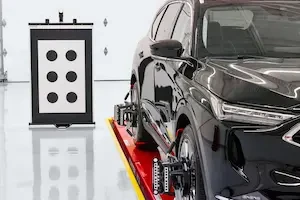
On equipment specifically, Adcock predicted that most shops will have some level of in-house calibration capability within three years, particularly dynamic calibration, which does not require the floor space, lighting, or wall setup that static calibration demands. He tied the timeline to FMVSS 127, the automatic emergency braking mandate, which he said will be in effect within that window. "That's by far and away shown to be the most prominent way that vehicles are mitigating accidents, through the AEB," Adcock said, adding that shops not preparing for the standard now are already behind.
AI across every layer of the business
Taylor Moss, vice president of strategic development at Quality Collision Group, said the industry is further behind the AI curve than most shops realize. "We are in the pregame, or maybe the first inning, of what AI is going to revolutionize for every business," he said.
Moss broke his answer into three areas where he expects AI to become standard. The first is internal tool-building, pointing to platforms like Claude, Cowork, and Claude Code as already letting everyday employees automate parts of their own workflow, not just management or IT staff.
The second is AI-driven phone systems handling after-hours calls, text overflow, and daytime call volume. Moss said his stores are already seeing thousands of calls a month touched first by an AI phone system, and predicted shops may eventually route all calls through AI first, since a well-integrated system can answer status, parts, and scheduling questions faster than staff can.
The third is centralized estimate review: AI giving MSOs, and eventually small MSOs and single shops, the same kind of rule-based, real-time estimate review capability that insurers already use internally.
“I think it will be accessible and used by everyone,” he said.
The Autobody News Technology Council is an invite-only group of industry leaders who respond to a monthly question on the technologies shaping collision repair. If you're interested in joining the conversation, please reach out to Jess Fritsche at jess@autobodynews.com to learn more.