Posted labor rates for U.S. collision shops changed very little in July, and year-over-year growth ticked down slightly from June's levels after climbing steadily earlier in the year, according to updated data from National Autobody Research (NABR).
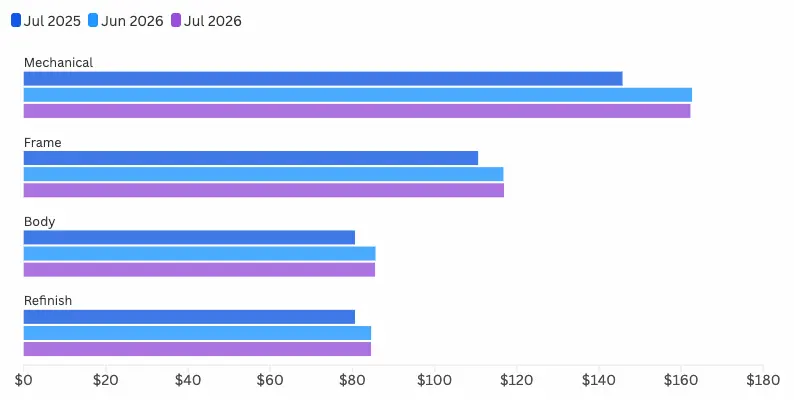
Body rates slipped from $85.62 in June to $85.50 in July, a decline of 12 cents, or 0.1%. Mechanical rates fell from $162.66 to $162.26, down 40 cents, or 0.2%. Refinish rates were essentially flat, down 3 cents, and frame rates rose slightly, up 16 cents, or 0.1%.
Month-over-month movement was minor across the board
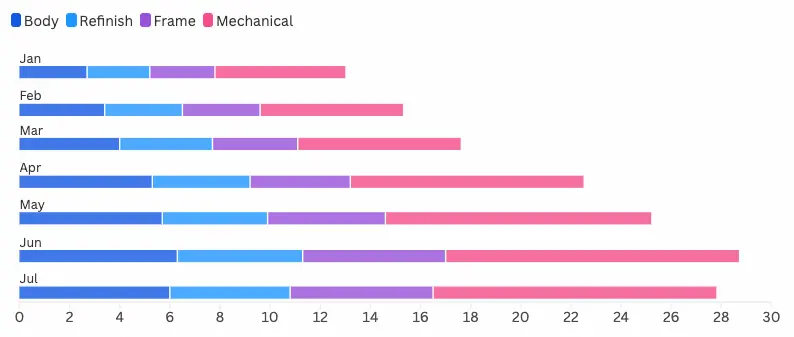
Annual growth ticked down from June's peak after climbing steadily since January
The year-over-year trend shows a clearer pattern than the month-to-month numbers. Body, refinish, and mechanical rates each saw their annual growth rate climb steadily from January through June before ticking down slightly in July; frame's annual growth also climbed through June but held flat into July. The year-over-year series in NABR's data currently spans January through July of 2026, seven months in total.
Sam Valenzuela of NABR said the broader pattern since January shows "there is increasing momentum of increasing labor rates," though July's reading came in slightly below June's across most categories.
Valenzuela attributed the year's overall trend to shop economics. "[W]ith fewer claims to work, shops need to maximize every repair, out of necessity," he said, adding that labor rates are a key part of that effort. He said the trend of incoming surveys reporting bigger rate hikes over time might reflect shops adjusting to today's business conditions.
This is the second installment of the Labor Rate Index, a recurring feature Autobody News is developing with NABR to track posted labor rates monthly across these four categories. Last month's inaugural installment found mechanical labor rates rising nearly twice as fast as body and refinish work on an annual basis, a gap that has held roughly steady since.
Data Methodology
NABR's data comes from labor rates shops post themselves, rather than rates negotiated with individual insurers. LaborRateHero enables shops to input their posted labor rates rather than insurer-contracted rates to gain insight into industrywide pricing trends.
NABR has also pushed back on the industry's use of the term “prevailing rate” to describe labor pricing. On its website, the company states “there is not one single labor rate in a market,” saying rates instead vary based on a shop's location, capability, the vehicle involved, and the type of repair performed.