David Black has seen the collision repair industry from almost every angle: grunt worker in his father's shop, independent owner, regional director at Sonic Automotive, consolidator-side manager under Rex Dunn, and now COO of Body by Cochran, a 13-location dealer-owned MSO in the Pittsburgh area. That breadth gives his perspective on growth, operations, and workforce development a credibility that comes only from having built things, broken them, and rebuilt them across multiple business models.
Black joined Cole Strandberg on The Collision Vision for a conversation that covered scaling discipline, ADAS calibration, technician development, and what the industry's headwinds actually mean for operators paying attention. The episode surfaces several lessons with direct application for collision repair operators at any stage of growth.
Breaking everything is sometimes the foundation
When Black joined the Cochran organization in 2015, the five collision centers operated as completely separate businesses with no shared infrastructure, no coordinated parts purchasing, and no unified management culture. His first task was demolition rather than growth.
"There was absolutely no foundation," Black said. "These were basically five dealer body shops that operated independent completely from each other."
The parts problem illustrated the dysfunction. Cochran's collision centers were purchasing 40% of their OEM parts from outside the Cochran dealer network for brands Cochran itself sold.
Parts cycle time at intake was 11.5 days. Nobody had been tracking it.
Key Takeaway: Before layering in additional locations, operators need an honest audit of whether shared infrastructure and management culture actually exist. Growth built on five separate systems produces five times the dysfunction, not five times the efficiency.
A collision-only parts warehouse changed the business
Black and his counterpart in parts and service, Dirk Harper, built an 80,000-square-foot collision-dedicated parts warehouse servicing all of the group's collision centers. The facility eventually consolidated 11 OEM brands under one set of dealer codes, negotiated through PMAs and with payments to dealers where necessary.
The result: parts cycle time dropped from 11.5 days to 1.3 days. The warehouse now services 500 body shops across the Pittsburgh region and runs approximately $100 million per year in parts volume, with Body by Cochran's own shops as the first-priority customer receiving two deliveries per day plus hot shots.
"We've got a $15 million inventory of nothing but collision parts," Black said.
Key Takeaway: Solving the parts problem before pursuing growth was the right sequence for Body by Cochran, and the metric that made the dysfunction visible was parts cycle time. Operators who aren't tracking it don't know what they're losing.
Calibration hubs grew out of a problem, not a business plan
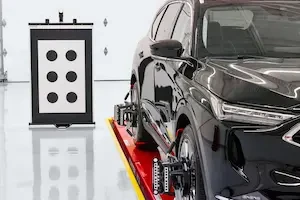
Body by Cochran's three in-house calibration hubs were not originally designed as profit centers. They were built to address the operational failure of sending vehicles to dealerships for calibration after OEM procedures became more demanding.
"I had Audis that I was taking to my Audi store and they were sitting there for two weeks to get calibrated," Black said.
Black's response was to take space already inside existing collision centers in strategic locations and build hubs capable of load-shifting vehicles from other locations as they completed the repair process. The operation also folded in a dedicated flatbed fleet and a glass company.
Last year, the three hubs produced $12.5 million in calibration revenue.
"We're not going to do anything but OE calibrations, OE scans pre and post," Black said. "Not interested in an aftermarket, not interested in that conversation."
Key Takeaway: For shops with volume, calibration is a service that can be brought in-house, controlled for quality, and run profitably. The shops best positioned to do this right are the ones that have already committed to OEM procedures and certifications.
Specialization is replacing the generalist model
Body by Cochran operates two high-technology centers that work across a wide range of makes, with the organization routing vehicles to whichever location has the technicians certified for that specific brand rather than fixing everything in one shop.
"What we’re trying to do is get into the specialization, taking locations and certifying them in specific brands," Black said.
The high-tech centers are staffed entirely with hourly technicians, all under 30, all recruited from trade schools, and all working as cohesive teams rather than on flat-rate systems.
"I won't put a flat-rate technician in there because they work as a team," Black said. "They work as a group. They enjoy their work life balance. They work 40 hours, maybe 42 hours, some weeks 45 hours. And then we pay a production bonus."
Key Takeaway: The single-store generalist model is losing ground to shops that are specifically certified and operationally built around a defined set of makes. That applies to independent shops as much as MSOs.
Growth for its own sake is a trap
Body by Cochran has 13 locations in 11 Pittsburgh-area counties plus three adjacent Ohio counties, with a growth target of potentially 25 to 40 locations within its brand recognition footprint. But Black drew a clear line around the logic behind expansion.
"We're not just looking to grow just to grow topline revenue. We're looking to grow for the right reasons."
That discipline extends to how the organization evaluates its own performance. Black pointed to topline revenue as an unreliable indicator of business health in an environment where vehicle complexity is pushing up average repair values independent of actual volume.
"You better be looking at car count because that's where the truth is," he said. "The technology increase is raising your topline sales. Doesn't mean that your business is getting better."
Key Takeaway: Car count is a more honest barometer of collision business health than revenue, particularly as ADAS-related repairs, calibrations, and OEM parts requirements inflate per-vehicle totals. Operators who benchmark only on revenue may be measuring the wrong thing.
Trade school graduates need a defined onboarding track
Body by Cochran recruits from trade schools with a specific skill set in mind rather than expecting graduates to arrive shop-floor ready. Black outlined five core competencies the program looks for: disassembly and reassembly, bagging and tagging, small dent repair, plastic repair, and paint prep.
From there, recruits enter a structured 24-month mentorship program with 90-day formal reviews and a clearly documented competency ladder from level one to level two.
In the first 90 days of employment, the organization also asks each recruit where they want to be in two, five, and 10 years.
"If I don't have a career path for you and I don't understand you, you're just going to be here for a little while and you're going to move on," Black said.
Key Takeaway: Retaining young talent requires more than competitive pay. It requires a visible career path and a structured development timeline that the employee and the organization both understand. Shops that can articulate what level two looks like and how to get there are at an advantage in recruiting.
The OEM repair standard is not negotiable
Black's position on repair quality is unambiguous, and he cited the financial reality directly.
"Full stop OE only. The way the OE repair process says to fix the car. That's it. There is no other way."
He acknowledged that full OE compliance sometimes means absorbing a cost that won't be reimbursed and then pursuing payment through direct conversation with the insurer.
"I may not get paid for it, and I just know that," Black said. "I'm not going to do it for free forever. I'm going to try to figure out how to get compensated for it."
Key Takeaway: Shops that have built their certifications and infrastructure around OEM standards are positioned to have that conversation with insurers from a documented position. The shops that have made exceptions to control cost have a harder case to make.
The industry's two biggest headwinds require active response
Black identified declining claim frequency and rising total-loss rates as the two macro forces he monitors most closely, both connected to vehicle technology doing what it was designed to do.
"The technology plays into the fact of the total losses," he said. "The costs are just so high."
His response has been to shift Body by Cochran's emphasis toward capturing customer-pay work through service drive relationships with Cochran's 43 dealerships, including AI-assisted drive-through damage identification, and instant estimating.
"[COVID] made us very weak. It made us quit selling," Black said. "We have a whole generation that we're retraining right now in our stores that they don't know anything but that because they came in during COVID."
Key Takeaway: Customer-pay is becoming a more significant component of collision revenue as claim volume softens. Shops connected to dealer service drives, or with strong direct-to-consumer relationships, are better positioned to replace that volume.
Where it all points
Black's career spans nearly every version of the collision repair business, and the throughline across all of it is the same: fix cars the right way, build the right people, and grow only when the foundation can support it. For operators watching claim volume soften and repair complexity climb, his advice is direct.
"Invest, train," he said. "If you're missing those pieces, you will become extinct. You are already out of business and you just don't know it yet."