
Three major automakers issued high-voltage battery fire recalls in the first two months of 2026, covering more than 117,000 electric and plug-in hybrid vehicles — and Mitchell International's 2025 Plugged-In: EV Collision Insights year-in-review shows those vehicle types are arriving in collision shops in growing numbers.
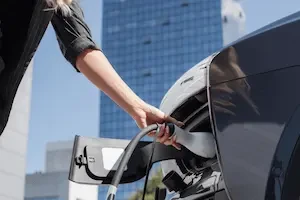
Battery electric vehicles accounted for 3.07% of all repairable U.S. collision claims in 2025, up 14.1% from 2024, even as overall BEV sales declined approximately 2%. Mild hybrids came in at 4.82% of claims and plug-in hybrids at 0.89%, both up year over year. Together, electrified vehicles now represent nearly 9% of repairable U.S. collision claims.
VW ID.4: Two NHTSA campaigns, 52,000-plus vehicles
Volkswagen will recall 44,551 ID.4 electric vehicles in the U.S. due to potential battery fire risks, NHTSA announced Jan. 27.
The action covers two separate campaigns. The primary recall, Campaign 26V030, affects 43,881 U.S. vehicles and 8,526 in Canada across 2023–2025 model year ID.4s. Battery modules supplied by SK Battery America may overheat and catch fire, according to NHTSA.
A second campaign, 26V028, covers approximately 670 ID.4s from model years 2023–2024 with misaligned electrodes in certain battery cell modules, which is a more acute defect that presents elevated fire risk.
For that smaller group, Volkswagen's interim instructions direct owners to park outside immediately after charging and avoid enclosed garages until the recall remedy is complete.
The broader remedy for both campaigns involves a battery software update and pack replacement if needed, at no charge. Owner notification letters were expected by March 20.
Volvo EX30: 40,000 EVs globally, pack replacement required
Volvo Cars will recall 40,000 EX30 electric SUVs worldwide, including an unspecified number in the U.S., over a battery fire risk, Reuters reported Feb. 23.
The recall affects 40,323 EX30 Single-Motor Extended Range and Twin-Motor Performance vehicles. Battery modules made by a Geely joint venture supplier, Shandong Geely Sunwoda Power Battery Co., will need to be replaced. Volvo said the supplier has fixed the underlying problem and will provide new cells for the remedy. The recall could cost nearly $200 million, according to a Reuters analysis.
As an interim measure, Volvo has told affected owners, including those in the U.S., to limit charging to 70% state of charge and park outdoors, away from buildings.
The February action follows a smaller January 2026 recall covering 40 EX30s for a separate battery defect involving lithium plating and potential internal cell short circuit. The NHTSA filing for the larger recall had not yet been posted publicly as of late February.
Ford Escape and Lincoln Corsair PHEVs: Recall extended to newer model years
Ford recalled approximately 24,690 vehicles on Feb. 17 due to a high-voltage battery defect that can cause vehicles to shut down and potentially catch fire, USA Today reported.
The recall, NHTSA Campaign 26V091, covers 17,345 units of the 2023–2025 Ford Escape PHEV and 7,345 units of the 2023–2026 Lincoln Corsair PHEV. A manufacturing defect in one or more battery cells may cause an internal short circuit. If the malfunction occurs while driving, the vehicle propulsion system will shut down and display a "Stop Safely Now" message, according to NHTSA.
Ford said it is still developing a permanent fix. In the meantime, owners are instructed to use "Auto EV" mode when driving and limit charging to a maximum of 80% battery capacity. Owner notification letters were expected around March 6.
The action is an extension of a November 2025 recall covering 20,558 vehicles for the same issue. Autobody News previously covered a February 2025 Samsung battery recall affecting earlier Escape and Corsair PHEV model years for a related fire risk.
What to know at intake
Recall status can be checked by VIN at nhtsa.gov/recalls.
All three campaigns include OEM interim instructions that remain in effect until the recall remedy is completed — among them, requirements to park affected vehicles outdoors and away from structures, and to limit state of charge. Those instructions apply to the vehicles whether or not they have collision damage.
The VW ID.4 and Volvo EX30 remedies require battery module or pack replacement at an authorized dealership. Ford has not yet finalized a hardware remedy for the Escape and Corsair PHEVs.