
For many collision repair customers, the hardest part of an auto insurance claim comes before any repair begins, according to April White of White's Collision Service.
"I would say that most customers don't have a very good understanding of how any of it works when they come in," White said.
White's Collision Service lists locations across Oregon. White said each shop has a customer service representative whose job is to guide customers through the claims process. Earlier this year, White told Autobody News that insurers in the state were issuing more outright denials as premiums rose.
Why customers arrive unsure
White said many customers walk in nervous because of things they've heard or insurance commercials suggesting their damage may not be covered. Many also have little recent experience with a claim. She said the average person is in an accident once every seven years.
"And even if they have, if you think about it, seven years ago was pre-COVID, and that was like a whole entire different industry than we're in right now," she said. "It's not even the same game we're playing, and so they don't know."
Filing the claim in the building
White said customers often assume someone else will start the claim for them.
"A lot of times, the customers think that we can file their claims, or their insurance company agent can file their claims, and some agents can, but most agents can't even file your claim anymore," she said.
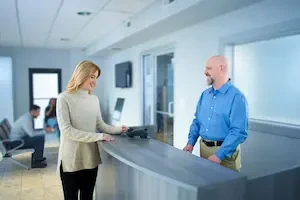
Instead, she said, customers usually have to call the insurer's toll-free claims line. The shop's representatives keep a list of those numbers and often set up a three-way call so the customer can file while still at the shop. White said elderly and less tech-savvy customers especially appreciate the help.
Some insurers then direct the customer to an app for photographing the damage. White estimated that about 25% of claims at her shops arrive that way. She said the app step is more than many customers can manage or want to deal with, including younger ones. When possible, staff walk them through the upload before they leave.
White said the shop sorts each auto insurance claim into one of four paths, depending on the insurer: the photo app, an open shop assignment once a claim number is issued, an independent appraiser, or an adjuster who comes out to inspect the vehicle. Staff then walk customers through the process based on which insurance company they have.
White said her main tip for other shops is to help customers through the initial insurance call, because customers find it the hardest part to handle on their own.
"Sometimes we find it is literally like if you send them on their way and they're like, no, I'll do it when I get home. They literally just never even file a claim," White said. "That's how difficult it's become to file them and to process them."
Where Oregon's appraisal clause stands
Oregon law does not require auto policies to include an appraisal clause. When a policy does include one, ORS 742.466 requires the insurer to reimburse the policyholder's reasonable appraisal costs if the final appraisal decision is higher than the insurer's last offer made before those costs were incurred.
"We do not have the right to appraisal clause. Most have appraisal clause written in, but right now most insurance companies are backing that out of their contract wording, and so it's in legislation right now," White said.
White said the clause has been coming out of policies over the last year. "It's just an option for them. It is not a legal thing," she said.
She said a group within the Oregon Collision Repair Association (OCRA) is working on legislation to keep the clause in policies. Other states have taken that step: Texas and Washington enacted right-to-appraisal laws in 2025, and Illinois' law was signed this year.
Who decides a total loss
Total losses are another source of confusion, White said.
"One of the misconceptions is that we are the ones that make that decision," she said, while the decision belongs to the insurer.
White said Oregon has no total loss threshold, so an insurer can choose to total a vehicle at any repair cost.
"They can make that decision that it's not worth it for them to repair the vehicle at any dollar figure, and so they do sometimes," she said.
She described a hypothetical pickup with an $18,000 salvage value that an insurer might total at $6,000. She called that a pretty extreme example.
Her shops do not tell customers a vehicle is a total loss until the insurer has made that call. The exception is an obvious total loss. In that case, White said, staff have the conversation at drop-off so customers can remove belongings and know an offer from the insurer is coming.
"We'll have that conversation just while the customer's there, so that they know that they can get their stuff out of the car," she said.
Otherwise, White said, the shop usually waits for the insurer to notify the customer, then calls to explain what happens next. When an insurer takes a long time to decide, the shop has to keep the customer informed while repairs can't start.
When totaled vehicles stay behind
White said she is seeing more cases where insurers have the customer keep a totaled vehicle without asking them. The settlement is reduced, and the vehicle is left at the shop. She said this has become more frequent over the last year as total loss values have climbed.
"So in in all the cases that I've seen of that, the customer didn't even know what happened," White said.
She said the vehicle technically becomes the customer's responsibility in those cases, though her shops deal with it.
Why customers need more help now
"I would say they need more help," White said. She pointed to three reasons. The first is technology. The second is the changing role of insurance agents: many customers don't have one, and she said shops are now "doing some of the stuff that maybe an agent would be handling in a collision accident in the past." The third is that customers often don't realize parts for a brand-new vehicle may not be in production yet.
"Previous to 2020, we never even ordered one part ahead of schedule," White said.
Now, she said, her shops reschedule jobs regularly or send vehicles out with repairs still pending because some parts have no estimated arrival date.
"We have to get them a drivable vehicle, or their vehicle is just going to sit here for six or eight months or whatever," she said.
In one recent case, she said, a customer's new $120,000 truck needed a fender with no production date in sight. The shop installed the bumper and headlights so the truck could be driven. The customer will return for the fender once it becomes available.
Outside her shops, White is working on the education side of OCRA, which opened to members Aug. 1. She said she is helping with programming and training, including monthly webinars and shop talks focused on shops' pain points.
How to help customers get a claim started
- File the claim with the customer before they leave. White said customers sent home to file on their own sometimes never do.
- Keep insurers' claims numbers on hand. A ready list lets staff set up a three-way call while the customer is at the shop.
- Know each insurer's claim path. Whether a carrier uses a photo app, an open shop assignment, an appraiser, or a field adjuster shapes how staff walk the customer through the claim.
- Explain who decides a total loss. Customers may assume the shop makes the call.
- Address obvious total losses at drop-off. Customers get a chance to collect their belongings and know an offer is coming.
- Keep customers driving when parts stall. Completing what can be done and returning later for back-ordered parts keeps the vehicle in use.
Want to share your shop's advocacy story? Every edition of The Advocate profiles a collision repair shop that went to bat for a customer in an insurance dispute, total loss reversal, denied supplement, or claims confusion. If your shop has a story like this, email us at lisa@autobodynews.com to be considered for a future feature.