

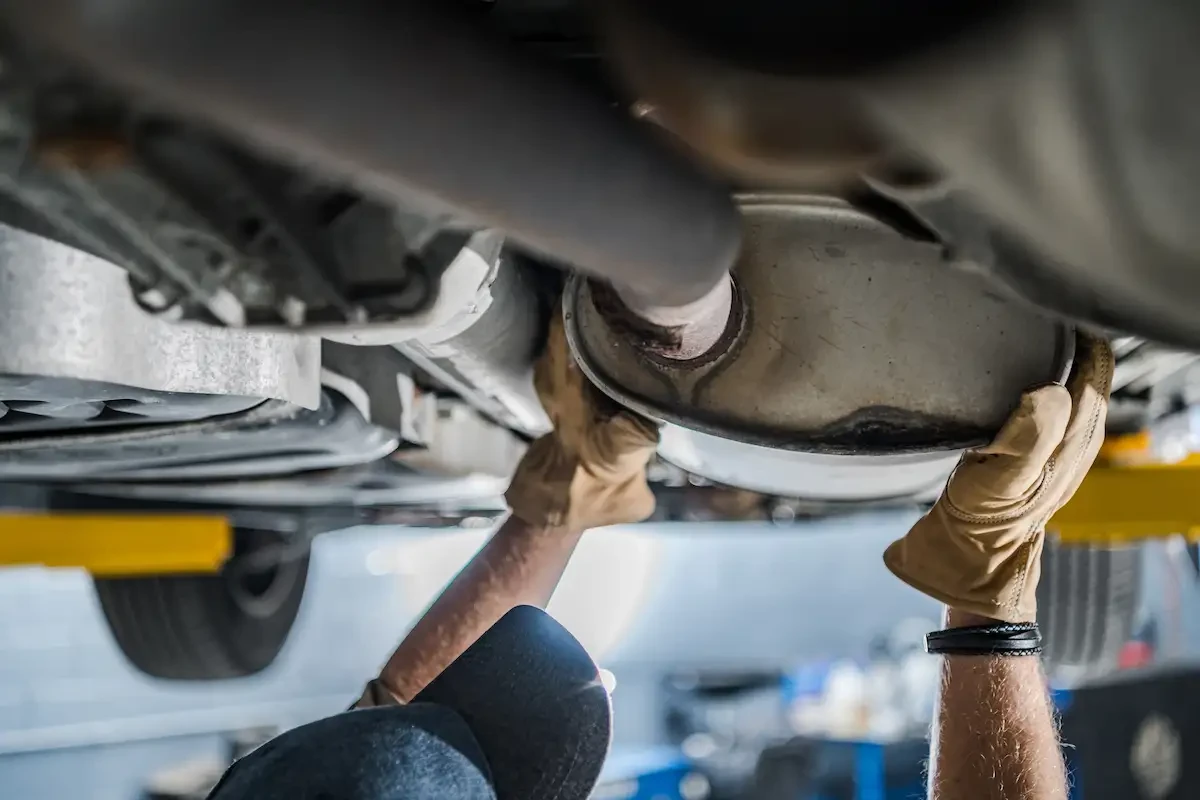
As catalytic converter theft surged across the country in recent years, collision repair shops found themselves on the front lines of a costly and frustrating trend. Vehicles arrived loud, damaged and often undrivable. It left shop owners to navigate parts shortages, insurance claims, and increasingly complex sourcing decisions.
Now, federal lawmakers are looking to address the issue through the PART Act, a bill designed to increase traceability, tighten record-keeping, and curb the black market for stolen parts. For collision repairers, the legislation could signal a shift — not in how they repair vehicles, but in how the broader parts ecosystem functions.
A Supply Chain Problem with Real Shop Consequences
 Robert L. Redding Jr., ASA’s Washington, D.C. Representative, outlines how the PART Act could improve parts traceability and supply chain accountability.At its core, the PART Act aims to close gaps in how automotive parts, especially catalytic converters, are tracked after entering the marketplace.
“The PART Act is about addressing an issue that has impacted consumers, law enforcement and shops for several years,” said Automotive Service Association’s (ASA) Washington, D.C., Representative Robert L. Redding Jr. “Right now, there’s a significant gap in how certain automotive parts are tracked and identified once they enter the marketplace.”
That lack of traceability has allowed stolen parts to circulate more easily, creating risks across the industry. For repairers, it’s not just a legal or regulatory issue; it’s a practical one.
“The timing of the legislation is important,” Redding said. “Vehicles are becoming more complex and more expensive to repair, and supply chain challenges have increased pressure on the parts market. That makes it even more critical that everyone has confidence in the origin and integrity of the parts being used.”
Lessons from Colorado: A Real-World Preview
For Dan Stander, chairman of ASA and owner of Fix Auto Highlands Ranch in Littleton, Colo., the impact of catalytic converter theft isn’t theoretical; it’s something his shop lived through.
During the COVID-era surge, Stander said his team saw a dramatic increase in theft-related repairs.
“We were doing three, four, five catalytic converters a month — sometimes more,” he said.
The financial impact on customers was significant. Replacement costs often ranged from $4,000 to $5,000, with some vehicles, particularly trucks with multiple converters, reaching $8,000 to $10,000. In some cases, otherwise functional vehicles were totaled due to the cost of replacement alone.
Beyond cost, the operational challenges were equally difficult. National backorders made OEM parts hard to obtain, forcing shops to consider aftermarket options.
“You could find something online for a few hundred dollars, but there’s no way it had the same level of precious metals or met the same standards,” Stander said. “That created real concerns about compliance and performance.”
How Regulation Reduced Theft
Colorado responded to the theft wave by implementing stricter requirements for recyclers, including ID verification, transaction records, and documentation tied to the vehicle of origin.
The results were dramatic.
“By 2024, they were saying there was about a 95 percent drop,” Stander said. “In the last couple of years, I’ve maybe seen one case.”
That experience offers a preview of what federal legislation like the PART Act could accomplish on a broader scale, particularly by targeting the resale side of the equation.
What the PART Act Would Change
The legislation focuses on increasing accountability across the parts supply chain, particularly in how catalytic converters are bought, sold and recycled.
Key elements include:
- VIN or ID-based marking systems for converters
- Stricter documentation and record-keeping requirements
- Increased penalties for theft and illegal resale
- A federal grant program to support marking and tracking efforts
For recyclers and distributors, this likely means more standardized processes. For repair shops, the impact is more indirect.
“The biggest shift would be greater accountability throughout the supply chain,” Redding said. “For repair shops, it’s more about verification and confidence. Shops may need to be more diligent in confirming the source of parts, but in return, they gain more assurance that what they’re installing is legitimate.”
Minimal Disruption, Greater Visibility
From an operational standpoint, Stander does not expect the PART Act to change day-to-day repair workflows significantly.
“I don’t think there would be any added compliance on our side,” he said. “This really targets the bad actor and how stolen converters are sold or scrapped.”
For shops, the process remains largely the same:
- Diagnose the missing or damaged converter
- Provide an estimate (often several thousand dollars)
- Work through an insurance claim, typically under comprehensive coverage
Where the law could make a difference is upstream by reducing theft incidents and stabilizing the parts environment.
Preparing for What’s Ahead
While the PART Act has not yet passed, Redding encourages shop owners to start paying attention now.
“Awareness is key,” he said. “Shop owners should understand where their parts are coming from and what documentation is being provided by their suppliers.”
He also suggests evaluating internal processes, including:
- How parts are received and recorded
- Supplier relationships
- Documentation and tracking practices
“Shops that already prioritize strong record-keeping and work with reputable vendors will be in a much better position if requirements change,” Redding said.
Industry Alignment Matters
Like many pieces of federal legislation, the PART Act faces timing and procedural challenges in Congress. But industry awareness and support could play a key role in advancing it.
“There are limited legislative vehicles available this session,” Redding noted. “That makes it even more important that the industry understands the issue and communicates why it matters.”
Importantly, the legislation does not distinguish between mechanical and collision repairers. Both segments, along with fleet operators, dealers, and nonprofits, would be eligible to participate in programs such as catalytic converter marking and identification.
A Shift Toward Prevention
 Dan Stander, ASA chairman and owner of Fix Auto Highlands Ranch in Littleton, Colo., discusses the real-world impact of catalytic converter theft on collision repair shops.For collision repairers, the PART Act ultimately represents a shift away from reacting to theft and toward preventing it.
While catalytic converter replacements once created a temporary spike in repair volume, shop owners like Stander are clear: that’s not the kind of work the industry wants.
“We don’t want catalytic converters being stolen just to create work,” he said. “At the end of the day, this is about protecting the customer.”
If the PART Act achieves what similar state-level efforts have already demonstrated, it could bring much-needed stability to both consumers and the repair ecosystem while closing the door on one of the industry’s most disruptive trends in recent years.








Leona Scott