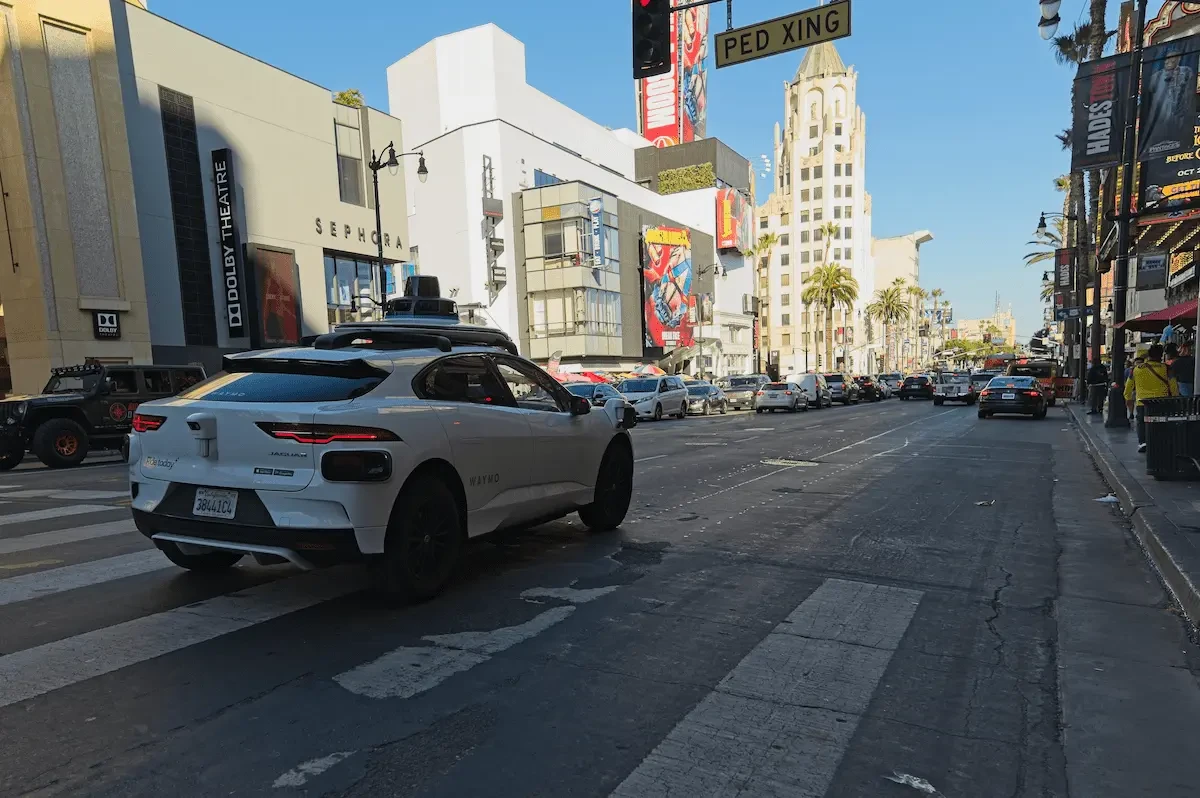
Waymo crashes in Los Angeles County more than tripled in 2025, to 219 from 69 in 2024, as the company added robotaxis to local streets. That's according to a Los Angeles Times review of autonomous vehicle crash reports filed with the National Highway Traffic Safety Administration. The Times found that incidents remained relatively uncommon and that most were fender benders.
The company has reported 186 crashes in the county so far in 2026, according to the Times, which cited the California Autonomous Vehicle Crash Dashboard. UC Berkeley's Safe Transportation Research and Education Center launched the dashboard in June with funding from the California Department of Motor Vehicles, according to the center.
Matthew Raifman, an autonomous vehicle researcher at the center, built the dashboard with colleagues, the Times reported. This year, 149 of the crashes involved a passenger vehicle, 11 involved a heavy truck, and two involved a first-responder vehicle.
Waymo measures crash severity in part with delta-V, or how much a vehicle's velocity shifts in a crash. In 40% of the vehicle-to-vehicle and single-vehicle collisions Waymo reported to NHTSA in Los Angeles through June 2026, that change was under 1 mph, according to the company's Safety Impact data hub, and Waymo says a change that small typically means light damage, such as dents or scratches.
Most county crashes caused no apparent injuries, and many involved a stopped Waymo
Many of the county's Waymo crashes this year occurred when the robotaxi wasn't moving. In 82 crashes the Waymo was stopped, and in 65 it was traveling straight, the Times reported.
Just over 80% of this year's crashes in the county produced no apparent injuries, according to the Times. Another 15% involved possible injuries, and fewer than 1% led to a suspected serious injury.
Federal crash reporting rules cover tow-aways, hospital transports, and certain property damage
According to the Times, most driverless car crashes that appear in government data are minor, and human drivers likely would not have reported crashes like them.
Under NHTSA's Standing General Order, the automated driving system companies named in the order must report a crash when the system was engaged within 30 seconds of impact and the crash caused certain property damage, a death, an airbag deployment, a tow-away, a hospital transport, or a vulnerable road user being struck, according to the agency.
The order's third amendment, effective June 16, 2025, added a property damage threshold for less severe automated-driving crashes. NHTSA also cautions that its published crash counts aren't adjusted for fleet size or miles traveled.
Waymo's California crash count nearly doubled; its per-mile crash rate declined
Across California, Waymo robotaxis were involved in more than 590 crashes in 2025, nearly twice the 2024 total of 304, according to NHTSA and dashboard data cited by the Times. Experts say crashes will naturally climb as more robotaxis take to the road and that the increase isn't an immediate cause for alarm, the Times reported.
Measured per mile, Waymo's crash rate has dropped. It went from about 57 crashes per million miles in 2023 to fewer than six per million miles in 2026, based on data through June, the Times reported.
Kris Kusano, who oversees Waymo's safety data research, said the company examines every crash and close call to improve its driving system. He also said Waymo's data shows its vehicles are safer than the typical driver in the cities where Waymo operates, according to the Times.
NHTSA data lists 18 California crashes this year involving Amazon-owned Zoox, which has test vehicles on the road in Los Angeles and San Francisco, the Times reported.
Researchers say the safety record reflects limited driving conditions
Raifman said autonomous vehicles are "likely quite safer than human drivers for most driving conditions," but added that the finding holds only within the conditions where the vehicles are currently permitted to drive, according to the Times.
Experts also warn that the public data so far comes from robotaxis driving in controlled environments and fair weather, the Times reported. Waymo's data hub notes that its current operating cities don't see significant snowfall, so neither its crash data nor its human benchmarks reflect snowy conditions.
San Diego and Culver City vote on robotaxi oversight; autonomous vehicle claims have climbed
San Diego's City Council voted in September to seek state authority over robotaxi deployment in the city, the Times reported. Currently, the California Public Utilities Commission, rather than individual communities, decides where robotaxis may expand. Culver City also voted in September to adopt rules on robotaxi fleets' charging, storage, and cleaning, including locations and hours.
The CPUC approved Waymo's expansion into Los Angeles in March 2024. In releasing its 2026 Autonomous Vehicle Study in September, Cox Automotive noted Waymo's figure of roughly 2 million U.S. robotaxi rides each month.
Verisk's ClaimSearch Trends Report found that claims involving self-driving cars grew from about 100 in 2021 to more than 400 in 2025. Within that total, claims linked to autonomous ride-hailing vehicles rose twentyfold over the same period, according to the report.