



This article is part three in a series on IBIS 2026.
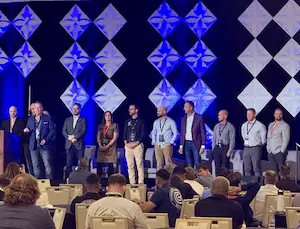
The need for industry collaboration was a central theme across many presentations at the recent International Bodyshop Industry Symposium (IBIS) 2026 conference. Held in Scottsdale, Ariz., the event brought together thought leaders to discuss current industry challenges and how to be a “Changemaker” in the future.
“It was fantastic to see IBIS USA 2026 bring the industry together in such a meaningful way,” said Louise Cooke, head of event content for IBIS Worldwide. “The success of the event wasn’t just in the conversations that happened on stage, but in the ones that continued beyond it.”
Repair Plans Now Average 110 Pages as Procedures Multiply
For collision repair shops, the daily reality of getting a vehicle through the repair process has become an exercise in navigating fragmentation, according to OEC President Greg Rivera. During IBIS USA 2026, Rivera detailed the scope of that burden, drawing on what OEC sees across the more than 135,000 repair facilities its platform connects.
Rivera's presentation mapped more than two dozen distinct workflows a shop may encounter on any given job — from assignment and first notice of loss (FNOL), to carrier-specific estimate approvals, supplement approvals, rental authorization, ADAS calibration, OEM scan procedures, parts sourcing, and returns — each with its own variations depending on the insurance carrier and OEM involved.
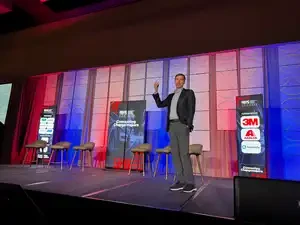 OEC President Greg Rivera"Any one of those may make sense, but you stack all of those up, and you get hundreds and hundreds of disparate processes and steps that a repairer has to go through every day to try to get their job done," Rivera explained.
At the same time, the technical complexity of repair procedures is accelerating at a pace Rivera described as unmanageable. OEC's data shows that out of roughly 14 million repair procedures tracked in 2025, more than 9 million were changed in some way — including 875,000 new procedures added, 7.5 million updated, and 680,000 removed. That means the majority of procedures a technician referenced on a previous repair may no longer be current, said Rivera.
"The challenge is that many think they have the most up-to-date information but are using outdated repair procedures," he noted.
The downstream impact on shops is significant. Rivera shared data showing that a single repair plan now averages 110 pages across 29 procedures, which could require more than seven hours just to read.
“That volume, industry-wide, is why the topic has become not just a quality issue but an operational one,” said Rivera. CCC Intelligent Solutions' 2026 Crash Course report found that calibrations now appear on 28.3% of all repairable estimates, up from 21.8% the year prior, and repairs involving multiple calibrations averaged more than 17 days keys-to-keys versus 13 for those without.
“Every job that does come through the door carries more complexity and more risk,” Rivera cautioned.
He said the industry is not prepared for this level of accelerating change. To help shops keep pace, OEC is applying AI to distill and surface the most relevant procedure information — what Rivera framed as a massive opportunity to simplify rather than add to the complexity shops already face.
Rivera encouraged shops to:
- Collaborate. Rivera urged the industry to work together across the full ecosystem — repairers, insurance carriers, OEM dealers, sublet vendors, software providers, and parts suppliers — rather than trying to solve problems in isolation. "We all need to show curiosity and empathy for the repairer, which is where a lot of the magic happens," he said. "You can only do a good job of that if you're talking to upstream and downstream partners."
- Experiment. With new approaches being discussed across the industry, Rivera encouraged shops and their partners to test and iterate rather than wait for perfect solutions.
"Some of these things are going to have hiccups," Rivera cautioned. "We just have to embrace that and be smart about incorporating learnings."
The Real Divide Is Connection Versus Isolation
Some uncomfortable truths about collision repair were shared by Michelle Sullivan, CEO of Certified Collision Group (CCG), a network of over 1,400 independent collision repairers with over 4,000 OEM certifications.
Truth 1: Vehicle complexity is rising faster than repair profitability. Every repair is becoming more technical, more advanced, and requires a level of sophistication that economics haven't kept pace with.
Truth 2: Many shops are underpricing the true cost of proper repair. It’s not because they don't know what it costs but because of extreme pressure and high expectations. Over time, Sullivan said it creates a very dangerous normalization.
“If we consistently underprice the work, the market believes that that is the true cost of the repair,” she said.
Truth 3: The collision repair industry lacks a unified voice, which means it shows up fragmented while other stakeholders show up aligned. In any negotiation, according to Sullivan, alignment equals outcome and fragmentation limits that ability.
Truth 4: Scale increasingly influences who has negotiating power. Sullivan said it brings leverage and is changing the balance of influence across the industry.
Truth 5: The industry often reacts to change instead of shaping it. “Rarely do we step back and ask, ‘How can we shape this for a different outcome?’” acknowledged Sullivan. “If we stay in a reactive position, we're always going to be one step behind.”
She noted that these are not criticisms, but realities. “When we face our realities, it's powerful and it gives us a choice.”
She challenged the industry to think differently about the future.
“Industries don't typically change overnight because of one factor,” shared Sullivan. “They change when multiple forces hit at the same time and start reinforcing each other.”
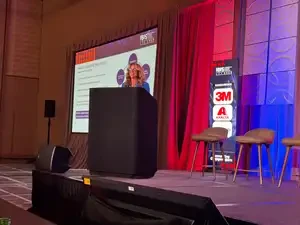 Michelle Sullivan, CEO of Certified Collision GroupSullivan noted that consolidation isn’t new. What’s different is the speed and the capital driving investments.
She pointed out that consolidation doesn’t mean the end of the independent shop.
“Independents still control one of the most important strategic assets in this industry —entrepreneurial ownership and local market execution,” noted Sullivan. “When independents come together, whether that's through networks, strategic partnerships or shared data, we see it firsthand that they compete effectively.”
One of the biggest misconceptions, according to Sullivan, is that independence means operating alone. “It doesn't,” she emphasized. “In today's environment, the real divide is not going to be consolidation versus the independent. It's going to be connection versus isolation.”
If operators are in isolation or silos, Sullivan forecasts the industry will remain fragmented. Consequently, the future will be decided by others.
Rather than giving up independence, Sullivan said the goal is to increase strength without losing identity.
“Find your community, whatever that looks like for you,” she advised. “Be part of something bigger than yourself.”
Sullivan also addressed data, which she said is an underutilized asset. “For decades, we've operated without visibility into consistent data,” she noted. However, this is changing.
As networks grow, consolidators scale and technology improves, Sullivan said data will be the industry’s most powerful strategic asset.
“Organizations that master data, operational discipline and the customer experience, whether they're consolidated or independent, will lead this industry,” she predicted.
Looking ahead, Sullivan stressed the importance of strategic leadership.
“Industry leaders who define the next version of this industry are the ones who get to decide what happens next,” said Sullivan. “This industry has everything it needs to accomplish this; it’s whether we choose to.”
What Shops Can Do Now
- Collaborate rather than operate in a silo
- Engage by influencing partners, not just reacting to them
- Invest in building capabilities
- Challenge outdated assumptions even when it's uncomfortable
- Leverage data as a strategic asset




Stacey Phillips Ronak